
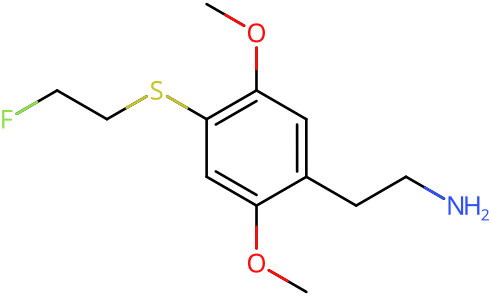
2C-T-21 Stats & Data
FCCSc1cc(OC)c(CCN)cc1OCZBUUUKBTOCTOPW-UHFFFAOYSA-NReceptor Profile
Receptor Actions
History & Culture
1991–present
2C-T-21 was first synthesized by Alexander Shulgin, representing the final compound in the 2C-T series to be completed. Shulgin and colleagues first described the substance in scientific literature in 1991, with detailed documentation appearing in his book PIHKAL (Phenethylamines I Have Known and Loved).
Psychedelic researcher Myron Stolaroff discussed 2C-T-21 in his book Thanatos To Eros, 35 Years of Psychedelic Exploration, characterizing it as "not psychedelic, but a wonderful energizer" and noting an unusual absence of the appetite suppression typically associated with other members of its class. However, Stolaroff also expressed concerns regarding the compound's potential toxicity.
2002–2005
On March 9, 2004, a 22-year-old quadriplegic man named James Edwards Downs in St. Francisville, Louisiana consumed an unknown quantity of 2C-T-21 by placing his tongue into a vial of powder he had purchased online. He developed a temperature of 108°F (42°C), experienced a tonic-clonic seizure, and entered a coma. Four days later, on March 13, Downs died at Lane Memorial Hospital in Zachary, Louisiana. This fatality became part of Operation Web Tryp, a two-year DEA investigation launched in 2002 targeting the online distribution of research chemicals. On July 22, 2004, the operators of American Chemical Supply were arrested on federal charges relating to distribution of controlled substance analogues in connection with Downs' death. The defendant pleaded guilty in March 2005.
Toxicity
PsychonautWikiOn March 9, 2004, a 22-year-old American male consumed an unknown dose of 2C-T-21 by sticking his tongue into a vial of powder he had purchased online. He developed a temperature of 108 degrees Fahrenheit (42 degrees Celsius), had a tonic-clonic seizure, and slipped into a coma before dying four days later. These symptoms are consistent with those seen in fluoroacetate poisoning, for which there is no known effective antidote. Fluoroacetate is hypothesized to be a metabolite of 2C-T-21. Sub-lethal doses of fluoroacetate take up to four days to clear from the body.
Effect Profile
Curated + 21 ReportsStrong visuals with strong body load, moderate headspace, mild auditory effects
Tolerance & Pharmacokinetics
drugs.wikiTolerance Decay
Practical guidance from 2C‑T‑x/psychedelic literature suggests rapid tolerance after a single strong session, partial decay over several days, and near‑baseline sensitivity after 1–2 weeks; cross‑tolerance occurs with other serotonergic psychedelics (e.g., LSD, psilocybin).
Demographics
Gender Distribution
Age Distribution
Reports Over Time
Effect Analysis
Erowid + BluelightEffects aggregated from 21 experience reports (13 single-substance Erowid + 8 Bluelight)
Effect Sentiment Distribution
Confidence Distribution
Each bar is the share of reports mentioning the effect; its whisker, and the band on the rows below, is the 95% interval: where the share could plausibly be with other reports of the same kind.
Rows resting on fewer than 20 reports show a count (“3 of 7”) instead of a bar. Why 20?
Positive Effects 37
Adverse Effects 15
Show 9 neutral or unclassified mentions
Also reported in combinations. In the 7 2C-T-21 reports where another drug was taken too, 1 mentions hospital, emergency services or an overdose, 0 a seizure and 1 psychosis (too few reports for percentages). In the 13 single-substance reports: 1, 0 and 0. These are not in the figures above: they cannot be put down to 2C-T-21 alone, and a mention is not always something that happened to the writer.
Dosage Distribution
Dose distribution from experience reports, one dose per report (the first listed). Doses above Q3 + 3×IQR, far above what people typically take, are left out of the median and range and listed under each route: most are real heavy doses or overdoses, not mistakes.
Real-World Dose Distribution
ErowidFrom 20 of 28 recorded dose entries: those that state a weight (mg, g or µg), in routes with at least five of them. Values above Q3 + 3×IQR, far above what people typically take, are left out; they can include real heavy doses and overdoses, not only mistakes.
Oral (n=19)
Common Combinations
Most co-occurring substances, as a share of all 20 reports filed under 2C-T-21; whiskers are 95% intervals
Form / Preparation
Most common forms and preparations, as a share of the 19 reports that give one
Too few reports for bars: these forms come from 19 reports, and a bar is drawn only from 20 reports or more. With fewer, a percentage cannot tell a common effect from a rare one. Counts are shown instead. Why 20?
- Powder / Crystals 15 of 19
- Capsule 3 of 19
Body-Weight Dosing
Dose per kg of body weight, one dose per report (the first listed), from reports giving a weight of 30–250 kg. Doses above Q3 + 3×IQR, far above what people typically take, are left out of the median and range and listed under each route.
Redose Patterns
Redosing behavior across 19 reports
Too few reports for a chart: redosing is known from 19 reports, and a split is drawn only from 20 reports or more. Counts are shown instead. Why 20?
- Single dose 15 of 19
- Redosed 4 of 19
Legal Status
| Country | Status | Notes |
|---|---|---|
| Austria | Illegal (NPSG) | Possession, production, and sale are prohibited under the Neue-Psychoaktive-Substanzen-Gesetz (New Psychoactive Substances Act). |
| Canada | Schedule III (CDSA) | Became a controlled substance under Schedule III of the Controlled Drugs and Substances Act on October 31, 2016. |
| Germany | Controlled (NpSG) | Regulated under the Neue-psychoaktive-Stoffe-Gesetz (New Psychoactive Substances Act) since November 26, 2016. Production, importation for market placement, administration to others, marketing, and trading are punishable offenses. Possession is technically illegal but not subject to criminal penalties. |
| Switzerland | Controlled (Verzeichnis E) | Regulated as a phenethylamine derivative under Verzeichnis E point 130 of the Betäubungsmittelverzeichnisverordnung. Exemptions exist for legitimate scientific or industrial applications. |
| United Kingdom | Class A | Controlled as a Class A substance under the Misuse of Drugs Act 1971 due to the phenethylamine catch-all clause. Class A drugs carry the most severe penalties, including up to 7 years imprisonment for possession and life imprisonment for supply. |
| United States | Unscheduled (Analogue Act applies) | Not specifically scheduled under the Controlled Substances Act. However, due to structural similarity to 2C-T-7, possession or sale intended for human consumption may be prosecuted under the Federal Analogue Act as a Schedule I equivalent. In 2004, a chemical supplier was federally indicted for distributing 2C-T-21 as a controlled substance analogue, subsequently pleading guilty in March 2005. |
Harm Reduction
drugs.wiki• Extremely rare research chemical; human data limited to PIHKAL notes and scattered community reports—assume high uncertainty in potency and effects. Keeping initial doses very low and spacing trials widely is prudent.
• For low‑milligram substances, a ±1–2 mg weighing error can double the experience. Use a calibrated milligram scale and consider volumetric dosing to dilute into a measurable liquid and reduce misdosing risk.
• Avoid redosing early: some 2C‑T‑x show variable or delayed onset; stacking doses within the first 2–3 hours can cause unexpectedly intense effects.
• Intranasal 2C‑T‑x typically causes intense burning and more adverse effects; intranasal use has been implicated in severe reactions and fatalities with 2C‑T‑7. Prefer oral administration if experimenting at all.
• Strongly avoid combining with MAOIs, tramadol, DXM, MDMA, or other potent serotonergic/stimulant drugs due to seizure, hypertensive, and serotonin‑toxicity concerns.
• Because of dose sensitivity and rarity/mislabelling risks, identify material with multiple reagents when possible and consider submitting a tiny sample to a drug checking service; some phenethylamines produce overlapping reagent colors and cannot be distinguished without lab analysis.
• Expect typical psychedelic mental health cautions: those with personal/family histories of psychotic or bipolar disorders may experience destabilization; ensure safe set/setting and a trusted sober sitter.
• Tolerance and cross‑tolerance with other serotonergic psychedelics develop rapidly; frequent use diminishes effects and may encourage risky redosing—space trials by at least a week (preferably longer).
• Emergency signs warranting medical help include severe agitation, profuse vomiting with confusion, chest pain, seizures, or loss of consciousness—these have featured in serious 2C‑T‑x adverse events.
References
Cited References
- Brandt SD et al. - Pharmacology of 2C-T compounds (2017)
- Erowid: 2C-T-21 Experience Vault
- Erowid: 2C-T-21 Vault
- Gallardo-Godoy et al. - Sulfur-Substituted α-Alkyl Phenethylamines as MAO-A Inhibitors (2005)
- Nichols DE - Structure-activity relationships of hallucinogenic phenethylamines (2004)
- Shulgin & Shulgin - PIHKAL entry #49 (2C-T-21)
- Trachsel D - Fluorine in psychedelic phenethylamines (2012)
- TripSit: Factsheet - 2C-T-21
Additional references
- Erowid 2C‑T‑21 Experience Vault (index of reports)
- Isomer Design: 2C‑T‑21 (names/ID; references to potency tables)
- PubChem CID 44349972 entry (chemical identifiers)
- Erowid Psychoactives Journal Article #8 (Shulgin potency table citing 2C‑T‑21 8–12 mg)
- TripSit: Drug combinations (2C‑x / 2C‑T‑x sections incl. MAOI, tramadol, stimulants)
- Hi‑Ground: 2C’s overview (combinations; SSRIs may attenuate)
- Erowid 2C‑T‑7 Dosage/Overdose warnings (intranasal risk; fatalities)
- Erowid 2C‑T‑7 Effects (intranasal burning/adverse effects)
- Erowid 2C‑T‑7 Death report summary (insufflated fatal cases)
- TripSit main (volumetric dosing tool mentioned)
- SubstanceSearch: 2C‑T‑21 (community‑aggregated onset/duration/effects)
- Bluelight Big & Dandy 2C‑T‑21 thread (range of user experiences; subtlety; dose sensitivity)