
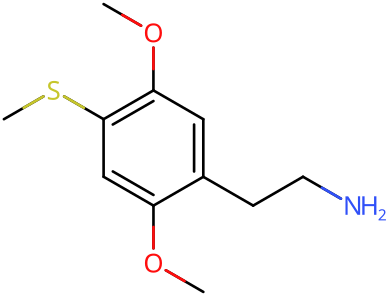
2C-T Stats & Data
UPZMYCMLLQTYEM-UHFFFAOYSA-NReceptor Profile
Receptor Actions
History & Culture
2C-T emerged from collaborative research between pharmacologist David E. Nichols and chemist Alexander Shulgin, with the compound first appearing in scientific literature in 1976. The substance was subsequently documented in greater detail in Shulgin's 1991 book PiHKAL (Phenethylamines I Have Known And Loved), which described both its synthesis and subjective effects. The compound's nomenclature follows conventions established for the 2C-x series of phenethylamines. The "T" designation derives from the original name for ALEPH-1, which was DOT (indicating a desoxy- modification with a thiomethyl group at the 4-position). This pattern mirrors other 2C compounds that take their names from amphetamine prototypes—2C-B from DOB, 2C-C from DOC, 2C-I from DOI, and so forth. The subsequent numbering of 2C-T variants (2C-T-2, 2C-T-7, and others) reflects the chronological order in which they were conceived rather than indicating any structural relationship, similar to how houses in residential Tokyo are assigned numbers based on construction sequence rather than position along a street. Despite its documentation in foundational psychedelic literature, 2C-T has remained largely obscure in recreational drug markets. The compound is almost unknown on the black market and is rarely encountered through online vendors or traditional distribution channels.
Toxicity
PsychonautWikiThe toxicity and long-term health effects of recreational 2C-T use do not seem to have been studied in any scientific context and the exact toxic dosage is unknown. Anecdotal reports suggest that there are no negative health effects attributed to trying this drug, but nothing can be completely guaranteed. It is strongly recommended that one use harm reduction practices when using this substance.
Addiction & dependence
2C-T is not habit-forming and the desire to use it can actually decrease with use. It is most often self-regulating. Tolerance to the effects of 2C-T is built almost immediately after ingestion.
Effect Profile
Curated + 2 ReportsStrong visuals and auditory effects with strong body load, moderate headspace
Strong sensory enhancement with moderate stimulation, low euphoria
Tolerance & Pharmacokinetics
drugs.wikiTolerance Decay
Experience Report Analysis
ErowidDemographics
Gender Distribution
Too few reports for a chart: gender is known from 2 reports, and a split is drawn only from 20 reports or more. Counts are shown instead. Why 20?
- Male 2 of 2
Age Distribution
Reports Over Time
Legal Status
| Country | Status | Notes |
|---|---|---|
| Canada | Schedule III | Classified as a controlled substance under Schedule III of the Controlled Drugs and Substances Act as of October 31, 2016. Listed as a derivative of 2,5-dimethoxyphenethylamine. |
| United Kingdom | Class A | Controlled under the Misuse of Drugs Act 1971. Designated as Class A due to the phenethylamine catch-all clause, which captures structurally related phenethylamine compounds regardless of explicit scheduling. |
| United States | Unscheduled (Federal Analog Act applies) | Not explicitly scheduled under federal law; however, its structural and pharmacological similarity to scheduled compounds such as 2C-T-7 may subject possession and sale to prosecution under the Federal Analog Act when intended for human consumption. Operation Web Tryp, commenced in 2004, resulted in prosecutions and convictions of online vendors selling similar phenethylamine compounds. |