
3-CMC Stats & Data
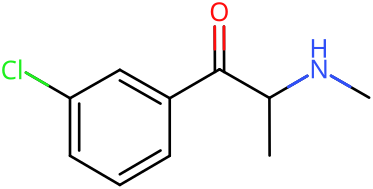
CNC(C)C(=O)c1cccc(Cl)c1VOEFELLSAAJCHJ-UHFFFAOYSA-NReceptor Profile
Receptor Actions
History & Culture
3-CMC first appeared in 2014, emerging as part of the broader wave of synthetic cathinones entering the European designer drug market during this period. The substance was primarily sold through online vendors, with initial distribution concentrated in Germany, Poland, the Netherlands, and Sweden. Over the following years, 3-CMC spread across the continent, eventually being detected in 25 European countries. Poland became the region with the highest number of seizures, while the Netherlands accounted for the largest quantities identified. Annual seizure data from 2014 to 2021 demonstrated a consistent increase, indicating growing production and availability throughout this period. Production sources shifted over time. While early supplies originated primarily from China, manufacturing subsequently relocated to India following regulatory changes in the former country. Customs authorities have since identified Indian sources as the origin for large-scale imports into Europe, with little production documented as occurring within European borders.
Toxicity
PsychonautWiki3-CMC's isomer 4-CMC is a known neurotoxin, and research shows that 3-CMC is neurotoxic in mice. If 3-CMC's mechanism of action is inherently neurotoxic then damage to human health may be incurred even at moderate recreational doses. Anecdotal reports mention highly concerning cardiovascular and neurological symptoms after frequent or high-dose use, which seems to confirm this suspicion. It is strongly advised to avoid this substance completely. Use excessive harm reduction practices if planning on using this substance, and avoid redosing.
Effect Profile
Curated + 2 ReportsModerate empathy and stimulation with mild euphoria and sensory enhancement
Mild stimulation and euphoria with strong anxiety/jitters
Tolerance & Pharmacokinetics
drugs.wikiTolerance Decay
Patterns inferred from stimulant/cathinone use reports: notable acute tachyphylaxis within a session, residual tolerance persisting days to weeks; robust evidence is lacking.
Cross-Tolerances
Experience Report Analysis
ErowidDemographics
Gender Distribution
Too few reports for a chart: gender is known from 2 reports, and a split is drawn only from 20 reports or more. Counts are shown instead. Why 20?
- Male 2 of 2
Age Distribution
Reports Over Time
Form / Preparation
Most common forms and preparations, as a share of the 2 reports that give one
Too few reports for bars: these forms come from 2 reports, and a bar is drawn only from 20 reports or more. With fewer, a percentage cannot tell a common effect from a rare one. Counts are shown instead. Why 20?
- Powder / Crystals 2 of 2
Legal Status
| Country | Status | Notes |
|---|---|---|
| China | Prohibited | Banned since October 2015. Following this prohibition, production reportedly shifted primarily to India, with little supply originating from within Europe. |
| European Union | Controlled | As of March 2022, the European Commission implemented control measures for 3-CMC based on a risk assessment conducted by the EU Drugs Agency (EMCDDA) in November 2021. Several member states had already implemented generic controls prior to this EU-wide decision. |
Harm Reduction
drugs.wiki3‑CMC has been recognised by EU authorities as a harmful new psychoactive substance; EMCDDA/EUDA conducted a formal risk assessment in 2021, leading to EU‑wide control in 2022. Multiple fatal and non‑fatal intoxications have been reported, commonly with polydrug use. Because it is short‑acting, compulsive redosing is frequently described, which increases acute risks such as hypertension, hyperthermia, agitation, and insomnia. Drug‑checking services repeatedly warn that powders or pills sold as “3‑MMC” or “MDMA” often contain 3‑CMC or mixtures; always test if possible and begin with a small allergy dose when identity is uncertain. 3‑CMC and its isomer iso‑3‑CMC have both been found in the market; iso‑3‑CMC’s toxicity is poorly characterised, and 3‑CMC may degrade to isomeric/by‑products, particularly in solution—avoid pre‑dissolving for storage and keep material dry, cool, and protected from light. Nasal use can be harsh and may increase compulsion to redose; spacing doses and planning a hard stop time reduces harm. Combining with MAOIs, tramadol, or high‑dose serotonergics can precipitate serotonin toxicity (agitation, clonus, hyperthermia); seek urgent care if these occur. For parties or hot environments, avoid overheating: take regular cool‑down breaks, sip electrolytes, and do not overhydrate. Aftercare (sleep, calories, fluids) mitigates ‘cath‑flu’ dysphoria. Avoid driving and hazardous tasks until fully baseline.
References
Data Sources
Cited References
- Blough et al. 2019 - Methcathinone Analogs Releasing Activity (DOI)
- EMCDDA: Initial Report on 3-CMC (2022)
- EMCDDA: Risk Assessment Report on 3-CMC (2021)
- Romańczuk et al. 2023 - 3-CMC Metabolism and Biomarkers (DOI)
- Synthetic Cathinones and Neurotoxicity Risks: A Systematic Review (DOI)
- Walther et al. 2019 - Structure-Activity Studies on Methcathinones (DOI)
- WHO 46th ECDD Critical Review: 3-CMC (2024)
- Metabolism of 3-CMC in human dried blood spots (2024)
- TripSit: Factsheet – 3-CMC
- User experience discussions – Bluelight.org threads 2014–2024
Additional references
- EUDA/EMCDDA Risk Assessment: 3‑CMC (2022)
- Commission Delegated Directive (EU) 2022/1326 (adds 3‑CMC to EU ‘drug’ definition)
- EUDA news release on EU control of 3‑MMC/3‑CMC (Mar 18, 2022)
- PubChem entry – 3‑Chloromethcathinone
- Saferparty.ch – 3‑CMC and iso‑3‑CMC sold as MDMA (warning)
- Saferparty.ch – 3‑CMC sold as MDMA (warning, 2025)
- Bluelight 3‑CMC megathread (user reports incl. binge/redosing)
- DIMS Annual Report 2024 (mislabelled ‘3‑MMC’ often contains 2‑MMC/3‑CMC)
- TripSit – combo chart/info portal (general interaction guidance)