
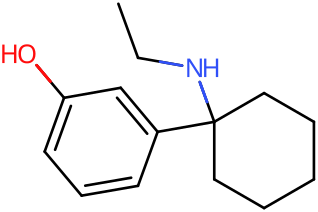
3-HO-PCE Stats & Data
CCNC1(CCCCC1)c1cccc(O)c1MIKNPNLBFHVMKK-UHFFFAOYSA-NReceptor Profile
Receptor Actions
Receptor Binding
History & Culture
3-HO-PCE emerged on the grey market research chemical scene during the 2010s without any prior presence in scientific literature. Unlike its close structural analog 3-HO-PCP, which had been discussed in underground chemistry forums since the late 1990s before appearing as a designer drug in 2009, 3-HO-PCE appears to have been synthesized specifically for commercial distribution through online research chemical vendors rather than originating from academic or clandestine chemistry documentation. The substance remains poorly characterized from a scientific standpoint. As of the early 2020s, no independent analytical laboratories had conducted formal studies on samples of 3-HO-PCE distributed through grey market channels, and there continues to be a notable absence of data regarding its pharmacological properties, metabolism, and toxicity profile. This lack of documentation places 3-HO-PCE among the many novel arylcyclohexylamines whose properties are primarily understood through user reports rather than controlled research.
Toxicity
PsychonautWikiThe toxicity and long-term health effects of recreational 3-HO-PCE use has not been studied in any scientific context and the exact toxic dosage is unknown. This is because 3-HO-PCE has a very short history of human usage.
Effect Profile
Curated + 1 ReportsStrong dissociative depth with strong mania, moderate motor impairment and insight
Duration Timeline
BluelightCommunity Effects
TripSitTolerance & Pharmacokinetics
drugs.wikiTolerance Decay
Modeled on typical arylcyclohexylamine patterns: rapid within‑week build, week‑scale decay. Data quality mostly anecdotal; adjust conservatively.
Cross-Tolerances
Experience Report Analysis
ErowidDemographics
Gender Distribution
Too few reports for a chart: gender is known from 4 reports, and a split is drawn only from 20 reports or more. Counts are shown instead. Why 20?
- Male 2 of 4
- Not Specified 2 of 4
Age Distribution
Reports Over Time
Real-World Dose Distribution
ErowidFrom 50 of 50 recorded dose entries: those that state a weight (mg, g or µg), in routes with at least five of them. Values above Q3 + 3×IQR, far above what people typically take, are left out; they can include real heavy doses and overdoses, not only mistakes.
Rectal (n=15)
Insufflated (n=8)
Oral (n=27)
Form / Preparation
Most common forms and preparations, as a share of the 3 reports that give one
Too few reports for bars: these forms come from 3 reports, and a bar is drawn only from 20 reports or more. With fewer, a percentage cannot tell a common effect from a rare one. Counts are shown instead. Why 20?
- Powder / Crystals 2 of 3
Legal Status
| Country | Status | Notes |
|---|---|---|
| Germany | Controlled (NpSG) | Regulated under the Neue-psychoaktive-Stoffe-Gesetz (New Psychoactive Substances Act) since July 18, 2019. Production, importation for market distribution, administration to others, and commercial distribution are criminal offenses. Personal possession is prohibited but does not carry criminal penalties. |
| Sweden | Consumption illegal | Not scheduled as a controlled substance for research purposes. However, human consumption is prohibited under Swedish law. |
| Switzerland | Controlled (Verzeichnis E) | Specifically listed as a controlled substance under Verzeichnis E of the Swiss narcotics scheduling system. |
| Turkey | Illegal | Classified as a controlled drug under Turkish narcotics legislation. Possession, production, supply, and importation are all prohibited. |
| United Kingdom | Class B | Controlled under the Misuse of Drugs Act 1971 via the arylcyclohexylamine generic clause introduced by Statutory Instrument 2013/239, effective February 26, 2013. This catch-all provision was recommended following an Advisory Council on the Misuse of Drugs report in October 2012 that addressed methoxetamine and its analogues. Possession, production, supply, and importation are criminal offenses. |
Harm Reduction
drugs.wiki• Batch variability and mislabeling have been reported in the unregulated market, including cases where material sold as 3‑HO‑PCE behaved like an opioid (e.g., O‑DSMT). Use professional drug checking when possible; reagent kits will not reliably detect mislabeling and fentanyl strips do not detect O‑DSMT. Start with an allergy dose and avoid redosing until baseline pharmacology is clear. Community threads describe inconsistent potency and occasional opioid‑like effects when misidentified, underlining the need to test.
• Volumetric dosing is strongly advised. Even at 10–40 mg active ranges, small scale errors can double the intended dose. TripSit guidance for potent arylcyclohexylamines recommends volumetric dosing and warns that onset can be delayed, so early redosing is a key cause of accidental overintoxication.
• Avoid CNS depressants (alcohol, opioids, GHB/BDO, high‑dose benzodiazepines). Dissociatives and depressants can synergize to cause vomiting with aspiration, loss of consciousness, and respiratory depression; TripSit flags these combinations as unsafe or dangerous across the class.
• Allow long redose intervals (≥2 hours). Community reports consistently call 3‑HO‑PCE a ‘creeper’; premature redosing can suddenly stack effects into panic, delirium, or functional impairment.
• Mood lability, hypomania/insomnia, and panic can occur—particularly with redosing, stimulant co‑use, or sleep deprivation. Plan set/setting, avoid driving or hazardous tasks during the experience and until fully baseline. Multiple first‑hand reports describe stimulating, psychiatric‑like headspaces and poor sleep if taken late.
• Urinary risk: While specific human data for 3‑HO‑PCE are lacking, chronic/high‑frequency use of arylcyclohexylamines (e.g., ketamine) is linked to cystitis and bladder damage. Keep frequency moderate, maintain hydration, and stop if urinary symptoms (urgency, pain, blood) appear.
• Drug testing: PCP immunoassays have poor specificity and cross‑react with several substances; ketamine can yield false‑positive PCP screens. ACHs may therefore trigger presumptive PCP positives; confirmation by GC/MS is definitive.
• Metabolism/detection: In vitro HLM and user sample work identifies multiple phase‑I and O‑glucuronide metabolites for 3‑HO‑PCE. Targeted LC‑HRMS can detect M10 in urine and M5 in hair—useful if forensic confirmation is needed; routine immunoassays will not target these analytes.
• Intranasal care: Finely crush material, use your own clean straw, alternate nostrils, and rinse with saline pre/post to reduce mucosal injury.
• Tolerance rises rapidly across ACHs; spacing sessions by several weeks reduces escalation and adverse mental effects. Cross‑tolerance with ketamine/O‑PCE/PCP‑like compounds is expected.
References
Cited References
- Bluelight: Big & Dandy 3-HO-PCE thread
- Bluelight: 3-HO-PCE info & Q&A (2024)
- CFSRE Analytical Report: 3-HO-PCE (NMS Labs 2019)
- Drugs-Forum: 3-HO-PCE experiences thread
- Erowid Experience Vaults: 3-HO-PCE
- Larabi et al. (2023): Metabolism study (DOI)
- Morris & Wallach (2014): SAR of PCP analogues
- Nervewing: 10 mg × 2 IN trip report (2017)
- Nervewing: 25 mg IN revisited report (2020)
- PubChem: 3-HO-PCE (CID 155774333)
- Reddit r/dissociatives: dosage survey (2021)
- Reddit r/researchchemicals: 10-30 mg hypomania log (2024)
- Reddit r/researchchemicals: 30 mg discussion thread (2023)
- Larabi et al. (2023) – HR-MS metabolism study
Additional references
- Effect Index – “I Am a Mannequin” (3‑HO‑PCE 20 mg IN)
- TripSit – Drug combinations overview and 3‑MeO‑PCP HR notes (volumetric dosing; avoid depressants)
- TripSit – 3‑MeO‑PCP page (measurement cautions; avoid alcohol/benzos)
- Hi‑Ground – Ketamine and Arylcyclohexylamines safer‑use tips (2‑h redose spacing; mixing cautions; nasal care)
- Larabi et al., 2023 – 3‑HO‑PCE metabolism (HLM, urine, hair)
- DrugWise – Ketamine risks (urological damage with heavy use)
- EUDA/EMCDDA – European Drug Report 2025 (ketamine-related harms incl. bladder)
- Erowid – PCP Drug Testing (poor specificity; false positives)
- Erowid – Ketamine Drug Testing (possible PCP false-positives)
- Bluelight – Big & Dandy 3‑HO‑PCE thread (anecdotal dose/variability)
- Reddit r/researchchemicals – “3‑HO‑PCE didn’t do much” (creeper, redose cautions)