
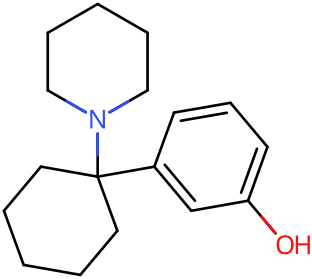
3-HO-PCP Stats & Data
Oc1cccc(c1)C1(CCCCC1)N1CCCCC1AMSXTZUCNOKUEN-UHFFFAOYSA-NReceptor Profile
Receptor Actions
Receptor Binding
History & Culture
3-HO-PCP was first synthesized in 1978 during investigations into the structure-activity relationships of phencyclidine (PCP) derivatives. Throughout the 1980s, researchers continued to characterize its pharmacological properties, discovering its activity at opioid receptors in animal models during this period. The compound remained largely unknown outside academic circles until 1999, when a chemist operating under the pseudonym "John Q. Beagle" discussed it in a post on The Hive, a now-defunct online chemistry forum. Beagle highlighted the compound's substantially increased potency compared to PCP and its notable affinity for opioid receptors. Even before the substance became commercially available, members of the Bluelight forum had begun documenting its psychoactive effects based on personal experimentation. Around 2009, 3-HO-PCP entered the research chemical market through online vendors. Despite being structurally related to PCP—a compound that had developed considerable notoriety through decades of media coverage and street names like "angel dust," "rocket fuel," and "sherm"—3-HO-PCP has remained one of the more obscure members of the arylcyclohexylamine class. It continues to be distributed primarily through gray-market online sources, with very little formal research having been conducted on its effects, metabolism, or toxicity in humans.
Toxicity
PsychonautWikiThe toxicity and long-term health effects of recreational 3-HO-PCP use have not been studied in any scientific context and the exact toxic dosage is unknown. This is because 3-HO-PCP has an extremely brief history of human usage.
Effect Profile
Curated + 12 ReportsStrong dissociative depth with strong motor impairment and mania, moderate insight
Duration Timeline
BluelightCommunity Effects
TripSitTolerance & Pharmacokinetics
drugs.wikiTolerance Decay
Tolerance builds rapidly with repeated use over days and decays over 1–2+ weeks; numbers are approximate and largely anecdotal for this specific analogue.
Cross-Tolerances
Demographics
Gender Distribution
Too few reports for a chart: gender is known from 17 reports, and a split is drawn only from 20 reports or more. Counts are shown instead. Why 20?
- Male 11 of 17
- Not Specified 6 of 17
Age Distribution
Reports Over Time
Effect Analysis
Erowid + BluelightEffects aggregated from 12 experience reports (7 single-substance Erowid + 5 Bluelight)
Effect Sentiment Distribution
Confidence Distribution
Each bar is the share of reports mentioning the effect; its whisker, and the band on the rows below, is the 95% interval: where the share could plausibly be with other reports of the same kind.
Too few reports for bars: these effects come from 7 single-substance Erowid and 5 analyzed Bluelight reports, and a bar is drawn only from 20 reports or more. With fewer, a percentage cannot tell a common effect from a rare one. Counts are shown instead. Why 20?
Positive Effects 17
Adverse Effects 21
Show 1 more adverse effect
Show 12 neutral or unclassified mentions
Also reported in combinations. In the 10 3-HO-PCP reports where another drug was taken too, 2 mention hospital, emergency services or an overdose, 0 a seizure and 2 psychosis (too few reports for percentages). In the 7 single-substance reports: 0, 0 and 2. These are not in the figures above: they cannot be put down to 3-HO-PCP alone, and a mention is not always something that happened to the writer.
Real-World Dose Distribution
ErowidFrom 156 of 160 recorded dose entries: those that state a weight (mg, g or µg), in routes with at least five of them. Values above Q3 + 3×IQR, far above what people typically take, are left out; they can include real heavy doses and overdoses, not only mistakes.
Oral (n=71)
Rectal (n=69)
Topical (n=5)
Insufflated (n=11)
Common Combinations
Most co-occurring substances, as a share of all 17 reports filed under 3-HO-PCP
Too few reports for bars: these combinations come from 17 reports, and a bar is drawn only from 20 reports or more. With fewer, a percentage cannot tell a common effect from a rare one. Counts are shown instead. Why 20?
- THC 3 of 17
Form / Preparation
Most common forms and preparations, as a share of the 13 reports that give one
Too few reports for bars: these forms come from 13 reports, and a bar is drawn only from 20 reports or more. With fewer, a percentage cannot tell a common effect from a rare one. Counts are shown instead. Why 20?
- Powder / Crystals 7 of 13
- Liquid 5 of 13
Body-Weight Dosing
Dose per kg of body weight, one dose per report (the first listed), from reports giving a weight of 30–250 kg. Doses above Q3 + 3×IQR, far above what people typically take, are left out of the median and range and listed under each route.
Redose Patterns
Redosing behavior across 13 reports
Too few reports for a chart: redosing is known from 13 reports, and a split is drawn only from 20 reports or more. Counts are shown instead. Why 20?
- Single dose 7 of 13
- Redosed 6 of 13
Legal Status
| Country | Status | Notes |
|---|---|---|
| Czech Republic | Schedule I (List 4) | Controlled under Nařízení vlády č. 463/2013 Sb. (§ 1, d), 1.). Permitted for research purposes and restricted therapeutic applications only. |
| Germany | Unscheduled | Not listed as a controlled substance under the Betäubungsmittelgesetz (BtMG). However, under §2 of the Arzneimittelgesetz (AMG), sale for human consumption remains prohibited. |
| Sweden | Illegal | Prohibited substance under Swedish drug control legislation. |
| Switzerland | Controlled (Verzeichnis E) | Specifically named as a controlled substance in Verzeichnis E of Swiss narcotics legislation. |
| Turkey | Illegal | Classified as a controlled drug under Turkish law. Possession, production, supply, and importation are prohibited. |
| United Kingdom | Class B | Controlled under the Misuse of Drugs Act 1971 via the arylcyclohexylamine generic clause introduced by S.I. 2013/239, effective February 26, 2013. As a derivative of 1-phenylcyclohexylamine with a 1-piperidyl group and hydroxy substitution on the phenyl ring, it falls within this catch-all provision. Possession, production, supply, and importation are criminal offenses. |
Harm Reduction
drugs.wikiPotency is high and interindividual variability is large; 1–2 mg can noticeably change effects, so weigh with a calibrated 0.001 g scale or volumetrically. Onset—especially intranasal—can be delayed 40–90+ minutes; redosing during the come‑up is a common trigger for blackouts and hazardous behavior. Several experienced users and moderators note unusually prominent muscle tension/soreness after higher doses; spacing sessions reduces cumulative strain. Intranasal use is often caustic and can inflame sinuses; oral routes are gentler on mucosa. Mislabeling/adulteration has been documented in the wild (e.g., MD‑PiHP sold as 3‑HO‑PCP); use professional drug checking when possible, and do not assume reagent tests can definitively identify PCP analogues. The compound’s opioid receptor profile in vitro is debated; regardless, mixing with CNS depressants increases sedation and slows breathing—avoid these combinations. Dissociatives in general can aggravate mood instability, mania, and psychosis; people with a history of these should avoid or use only with strong support and conservative dosing in a safe setting. Heavy, frequent dissociative use (well‑established for ketamine) is linked to urinary tract problems; while specific data for 3‑HO‑PCP are limited, adopt the same precautions—hydrate, avoid daily use, and stop if urinary symptoms appear. Because ambulation can be preserved while judgment is impaired, trips should be done sitting/lying down with a sober sitter available to prevent accidents.
References
Data Sources
Cited References
- Bluelight: The Big & Dandy 3-HO-PCP Thread
- CAHMA: Safer Using - 3-HO-PCP
- Drug Users Bible: 3-HO-PCP
- Erowid: 3-HO-PCP Experience Reports
- Itzhak et al. (1981) - On the opioid nature of phencyclidine and its 3-hydroxy derivative
- Kalir et al. (1978) - Structure-activity relationship of some phencyclidine derivatives
- Morris & Wallach (2014) - From PCP to MXE: A comprehensive review of dissociative drugs
- PMC: Severe Toxicity to 3-Hydroxyphencyclidine and N-Ethylhexedrone Case Report
- Substance Search: 3-HO-PCP
- WHO Critical Review: 3-Hydroxyphencyclidine
- TripSit Factsheet: 3-HO-PCP
Additional references
- Hi‑Ground harm‑reduction brief: Arylcyclohexylamines (includes 3‑HO‑PCP dose ranges)
- SubstanceSearch: 3‑HO‑PCP overview (onset/duration summary; rarity; negative side‑effects)
- Bluelight Big & Dandy 3‑HO‑PCP thread (muscle tension; seizure concern; caution consensus)
- EffectIndex trip reports for 3‑HO‑PCP (oral 15 mg; and 10 mg intranasal)
- Erowid: 3‑MeO‑PCP effects/duration (ACH intranasal irritation; dissociative risks used for class‑level cautions)
- TripSit PCP factsheet (general ACH cautions: CNS depression with depressants; mobility risk)
- Reddit reagent‑testing/adulteration report: product sold as 3‑HO‑PCP was MD‑PiHP
- DrugWise: Ketamine risks (urinary tract harm; extrapolated caution to ACHs)