
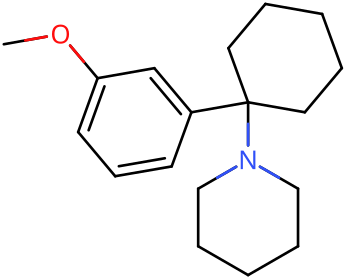
3-MeO-PCP Stats & Data
COC1=CC=CC(=C1)C2(CCCCC2)N3CCCCC3BQQSZHHKGPOXLN-UHFFFAOYSA-NInteraction Warnings
This combination is not advised because 3-MeO-PCP has been reported to cause extreme psychological disturbances such as psychosis and mania at a significantly higher rate than other dissociatives.
This combination is not advised because 3-MeO-PCP has been reported to cause extreme psychological disturbances such as psychosis and mania at a significantly higher rate than other dissociatives.
Receptor Profile
Receptor Actions
Receptor Binding
History & Culture
1979–present
3-MeO-PCP was first synthesized in 1979 by Geneste and colleagues during an investigation into phencyclidine derivatives. This work followed earlier research by Maddox et al. in 1965, which had produced the related compounds 2-MeO-PCP and 4-MeO-PCP as part of an exploration into potential central nervous system depressants. Following its synthesis, 3-MeO-PCP remained largely confined to occasional scientific research for approximately two decades. During this period, researchers such as Vignon et al. in 1982 conducted investigations into its pharmacological properties, but its activity in humans remained undocumented in the scientific literature.
1999–present
A chemist operating under the pseudonym John Q. Beagle provided the first documented description of 3-MeO-PCP's effects in humans in 1999. Posting on The Hive, an online drug chemistry forum, Beagle reported that the compound produced effects qualitatively similar to PCP with comparable potency. Despite this early report, the substance did not gain significant attention for another decade.
2009–2015
Discussion of 3-MeO-PCP began appearing on drug information forums around 2009, with one of the earliest reports coming from a user named 'hugo24' on Bluelight.org. By April 2011, online vendors including Buy Research Chemicals UK had begun selling the compound, and the number of available sources increased alongside a growing collection of user experience reports, many of which were positive in tone. Analysis of forum activity data from Drugs-Forum.com revealed that 3-MeO-PCP first appeared around 2011, reached peak discussion levels between 2011 and 2013, and had largely faded from active discussion by early 2016. The substance was first reported to the European Union's Early Warning System in March 2012 by the United Kingdom. Sweden's STRIDA project, which monitors suspected intoxications involving novel psychoactive substances, first detected 3-MeO-PCP in the fourth quarter of 2013. Fatalities associated with 3-MeO-PCP began appearing by the mid-2010s. In October 2014, the European Monitoring Centre for Drugs and Drug Addiction received notification of three deaths linked to the substance in Sweden, representing some of the earliest documented fatalities. These reports contributed to regulatory responses across multiple jurisdictions, with Sweden implementing controls in early 2015 and several other European countries following with scheduling measures throughout 2015 and subsequent years.
Subjective Effects
Physical
- Increased heart rate
- Tactile disconnection
- Spontaneous tactile sensations
- Tactile enhancement
- Tactile suppression
- Bodily control enhancement
- Motor control loss
- Stimulation: This drug is extremely stimulating in comparison to other dissociatives such as ketamine, MXE, or DCK.
- Physical autonomy
- Physical euphoria
- Perception of decreased weight
- Dizziness
- Nausea
Cognitive
- Psychosis: This effect is more common on 3-MeO-PCP than other dissociatives (such as ketamine or MXE). It commonly occurs during the offset of the trip.
- Mania: This effect is more common on 3-MeO-PCP than other dissociatives. It commonly occurs during the offset of the trip.
- Mindfulness
- Depersonalization
- Derealization
- Consciousness disconnection
- Memory suppression
- Ego death
- Thought deceleration
- Immersion enhancement
- Information processing suppression
- Time distortion
- Euphoria
- Introspection
- Déjà vu
- Conceptual thinking
- Compulsive redosing
- Anxiety suppression
- Disinhibition
- Amnesia
- Feelings of impending doom
- Creativity enhancement
- Existential self-realization
Sensory
- Suppression
- enhancement
- Distortions
- Hallucinations
- Perspective distortions
- Environmental cubism
- Environmental orbism
- Scenery slicing
- Colour enhancement
- Acuity enhancement
- Internal hallucinations: (autonomous entities; settings, sceneries, and landscapes; alterations in perspective and scenarios and plots)
- Visual disconnection: This eventually results in 3-MeO-PCP's equivalent of the famous "k-hole" or more specifically, holes, spaces and voids alongside of structures.
- Visual acuity suppression
- Double vision
- Pattern recognition suppression
- Frame rate suppression
Forked from Subjective Effect Documentation work by Josie Kins, August 2016. Via dose.wiki (CC0).
Toxicity
PsychonautWikiThe toxicity and long-term health effects of recreational 3-MeO-PCP use has not been studied in any scientific context and the exact toxic dosage is unknown. This is because 3-MeO-PCP has very short history of human usage. There is one death involving this substance recorded in the medical literature. In this case, the individual's cause of death was determined to be from a combination of 3-MeO-PCP, amphetamine, and diphenhydramine.
Addiction & dependence
3-MeO-PCP produces dependence with chronic use and has a high potential for abuse. In comparison to other dissociatives, 3-MeO-PCP has been reported to be more likely to produce psychological dependence than other dissociatives. When dependence has developed, cravings and withdrawal effects may occur if one suddenly stops their usage.
Effect Profile
Curated + 31 ReportsStrong dissociative depth and insight with strong mania and motor impairment
Duration Timeline
BluelightCommunity Effects
TripSitTolerance & Pharmacokinetics
drugs.wikiTolerance Decay
Model reflects rapid tolerance build with frequent use and slow decay over weeks as commonly reported for arylcyclohexylamines; confidence is limited due to reliance on user reports rather than controlled studies.
Cross-Tolerances
Demographics
Gender Distribution
Age Distribution
Reports Over Time
Effect Analysis
Erowid + BluelightEffects aggregated from 31 experience reports (16 single-substance Erowid + 15 Bluelight)
Effect Sentiment Distribution
Confidence Distribution
Each bar is the share of reports mentioning the effect; its whisker, and the band on the rows below, is the 95% interval: where the share could plausibly be with other reports of the same kind.
Rows resting on fewer than 20 reports show a count (“3 of 7”) instead of a bar. Why 20?
Positive Effects 36
Adverse Effects 31
Show 11 more adverse effects
Show 17 neutral or unclassified mentions
Also reported in combinations. In the 31 3-MeO-PCP reports where another drug was taken too, 5 (16.1%) mention hospital, emergency services or an overdose, 0 (0.0%) a seizure and 3 (9.7%) psychosis. In the 16 single-substance reports: 4, 0 and 0. These are not in the figures above: they cannot be put down to 3-MeO-PCP alone, and a mention is not always something that happened to the writer.
Dosage Distribution
Dose distribution from experience reports, one dose per report (the first listed). Doses above Q3 + 3×IQR, far above what people typically take, are left out of the median and range and listed under each route: most are real heavy doses or overdoses, not mistakes.
1 report gave a dose above the typical range (119 mg), so it is not in the figures above. Listing a dose here does not mean it is safe.
Show the report
- 119 mg · another drug taken too
Real-World Dose Distribution
ErowidFrom 62 of 73 recorded dose entries: those that state a weight (mg, g or µg), in routes with at least five of them. Values above Q3 + 3×IQR, far above what people typically take, are left out; they can include real heavy doses and overdoses, not only mistakes.
Insufflated (n=38)
Oral (n=12)
Sublingual (n=8)
Common Combinations
Most co-occurring substances, as a share of all 47 reports filed under 3-MeO-PCP; whiskers are 95% intervals
Form / Preparation
Most common forms and preparations, as a share of the 41 reports that give one; whiskers are 95% intervals
Body-Weight Dosing
Dose per kg of body weight, one dose per report (the first listed), from reports giving a weight of 30–250 kg. Doses above Q3 + 3×IQR, far above what people typically take, are left out of the median and range and listed under each route.
Sublingual
Insufflated
1 report gave a dose above the typical range (1.534 mg/kg), so it is not in the figures above. Listing a dose here does not mean it is safe.
Show the report
- 1.534 mg/kg · another drug taken too
Oral
1 report gave a dose above the typical range (1.9 mg/kg), so it is not in the figures above. It mentions hospital, emergency services or an overdose. Listing a dose here does not mean it is safe.
Show the report
- 1.9 mg/kg · mentions hospital, emergency services or an overdose
Redose Patterns
Redosing behavior across 43 reports
Legal Status
| Country | Status | Notes |
|---|---|---|
| Australia | Prohibited (Schedule 9 analogue) | Captured under broad drug analogue laws at both federal and state levels. As PCP is a Schedule 9 prohibited substance, 3-MeO-PCP is similarly prohibited as a structural analogue. |
| Austria | Illegal (NPSG) | Controlled under the Neue-Psychoaktive-Substanzen-Gesetz (New Psychoactive Substances Act). Possession, production, and sale are prohibited. |
| Brazil | Controlled substance | Added to Portaria SVS/MS nº 344 on May 17, 2018. Possession, distribution, and use are prohibited. |
| Canada | Schedule I (CDSA) | Controlled under the Controlled Drugs and Substances Act as a PCP analogue. The CDSA places all PCP analogues, derivatives, and salts under Schedule I prohibition, making 3-MeO-PCP automatically banned despite not being mentioned by name. |
| Chile | Illegal | Controlled under Ley 20000 (Ley de drogas). As an ether of PCP, 3-MeO-PCP falls under the prohibition of all PCP esters and ethers specified in Chilean drug law. |
| Czech Republic | Schedule I | Became a scheduled substance effective October 1, 2015 under Government Decree no. 243/2015 Coll., which amended Government Regulation no. 463/2013 Coll. |
| Denmark | Illegal | As of August 25, 2015, all MeO-PCP isomers including 3-MeO-PCP were added to the list of controlled substances. |
| Germany | Anlage II BtMG | Added to Anlage II of the Betäubungsmittelgesetz on November 21, 2015. Production, sale, and possession are prohibited. |
| Italy | Schedule I | Listed as a Schedule I controlled substance under Italian drug legislation. Possession, production, and distribution are prohibited. |
| Netherlands | Schedule I (Opiumwet) | Listed as a Schedule I controlled substance under the Dutch Opium Act. Possession, production, and distribution are prohibited. |
| Portugal | Uncontrolled | Not specifically controlled as 3-MeO-PCP is neither a salt nor an isomer of PCP under Portuguese drug legislation. Standard decriminalization policies for personal drug use may apply. |
| Sweden | Controlled substance | The Swedish public health agency recommended classification as a hazardous substance on November 10, 2014. On January 16, 2015, 3-MeO-PCP was officially declared a controlled substance. |
| Switzerland | Controlled (Verzeichnis E) | Specifically named as a controlled substance under Verzeichnis E of Swiss narcotics legislation. |
| Turkey | Illegal | Classified as a controlled drug. Possession, production, supply, and importation are prohibited. |
| United Kingdom | Class B | Controlled under the Misuse of Drugs Act 1971. Covered by the arylcyclohexylamine generic clause (S.I. 2013/239) which came into effect on February 26, 2013. This clause prohibits derivatives of 1-phenylcyclohexylamine where the amine has been replaced with a 1-piperidyl group and further substituted in the phenyl ring with an alkoxy substituent. |
| United States | Unscheduled (Federal Analogue Act applies) | Not a federally scheduled substance. However, due to structural and pharmacological similarities to the Schedule II drug PCP, possession or distribution for human consumption could be prosecuted under the Federal Analogue Act. Virginia has specifically scheduled 3-MeO-PCP as a Schedule I substance under Code of Virginia 54.1-3446. |
Harm Reduction
drugs.wiki3‑MeO‑PCP is active in the single‑milligram range; inaccurate scales can lead to large relative dosing errors, so volumetric dosing is strongly recommended. The dose–response curve is steep and onset can be delayed, making premature redosing a common cause of accidental over-intoxication. It is an NMDA receptor antagonist and has been described by TripSit as also exhibiting mild serotonin reuptake inhibition, so combinations with serotonergic substances warrant extra caution. Compared with ketamine, it can produce clearer stimulation but is also more likely to induce ambulatory delirium, disinhibition, and manic or psychotic states at strong doses. Erowid documents that at least one death has been associated with 3‑MeO‑PCP and warns of episodes where users cannot distinguish fantasy from reality, increasing risk of harm in uncontrolled environments. Avoid mixing with alcohol or benzodiazepines due to unpredictable sedation and accident risk; avoid driving or hazardous activities until the next day because after‑effects can persist up to 48 hours. People with a personal or family history of psychosis, bipolar disorder, or mania should avoid due to elevated risk of psychiatric destabilization. The RC market is prone to mislabeling and variable purity; reagent testing and conservative allergy tests reduce risk. Tolerance builds rapidly with frequent use; spacing sessions by multiple weeks reduces both tolerance and compulsive redosing patterns.
References
Data Sources
Cited References
- Bakota et al. (2016) - Fatal Intoxication Involving 3-MeO-PCP
- Berar et al. (2019) - Intoxication with 3-MeO-PCP alone: A case report
- Erowid: 3-MeO-PCP Vault
- KnowDrugs: 3-MeO-PCP
- Morris & Wallach (2014) - From PCP to MXE: comprehensive review
- Roth et al. (2013) - Ketamine Analogue Methoxetamine and PCP Analogues
- WHO Critical Review Report: 3-Methoxyphencyclidine
- Isomer Design: Methoxetamine and analogues
- Drug Users Bible: 3-MeO-PCP
Additional references
- TripSit 3‑MeO‑PCP Wiki (dosage, duration, SRI note, interactions warning)
- Erowid 3‑MeO‑PCP Vault (general description, ambulatory delirium, associated death)
- Bluelight: 3‑MeO‑PCP + MDMA combo thread (potentiation and cautionary guidance)
- Reddit r/FADQ 3‑MeO‑PCP write‑up (Ki values; mania/psychosis caution aggregated from reports)
- Effect Index – Drifting (lists dissociatives incl. 3‑MeO‑PCP as potential inducers)
- Effect Index – Frame rate suppression (common under dissociatives)
- Isomer Design (ACMD 2012 background on arylcyclohexylamines)
- Drug Users Bible: 3‑MeO‑PCP overview