
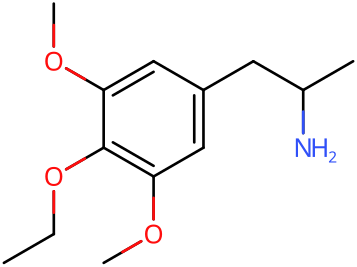
3C-E Stats & Data
CCOc1c(OC)cc(CC(C)N)cc1OCAHLXCGRWNKUNTQ-UHFFFAOYSA-NReceptor Profile
Receptor Actions
Toxicity
PsychonautWikiThe toxicity and long-term health effects of recreational 3C-E use do not seem to have been studied in any scientific context and the exact toxic dose is unknown. This is because 3C-E is a research chemical with very little history of human usage. Anecdotal evidence from people within the community who have tried 3C-E suggests that there are no negative health effects attributed to simply trying it by itself at low to moderate doses and using it very sparingly (but nothing can be completely guaranteed). Independent research should always be done to ensure that a combination of two or more substances is safe before consumption. It is strongly recommended that one use harm reduction practices when using this substance.
Effect Profile
Curated + 1 ReportsStrong visuals, headspace, and auditory effects with strong body load
Strong euphoria with strong anxiety/jitters, mild stimulation and focus
Tolerance & Pharmacokinetics
drugs.wikiTolerance Decay
Rapid, session‑immediate tolerance typical of serotonergic psychedelics; partial cross‑tolerance expected across classical psychedelics and psychedelic amphetamines. Values are heuristic and based on community practice (space 2–3 weeks between full experiences).
Cross-Tolerances
Experience Report Analysis
ErowidDemographics
Gender Distribution
Too few reports for a chart: gender is known from 3 reports, and a split is drawn only from 20 reports or more. Counts are shown instead. Why 20?
- Male 3 of 3
Age Distribution
Reports Over Time
Real-World Dose Distribution
ErowidFrom 6 of 10 recorded dose entries: those that state a weight (mg, g or µg), in routes with at least five of them. Values above Q3 + 3×IQR, far above what people typically take, are left out; they can include real heavy doses and overdoses, not only mistakes.
Insufflated (n=6)
Legal Status
| Country | Status | Notes |
|---|---|---|
| Germany | 3C-E is controlled under the NpSG (New Psychoactive Substances Act) as of November 26, 2016. | Production and import with the aim to place it on the market, administration to another person and trading is punishable. Possession is illegal but not penalized. |
| Japan | 3C-E is a controlled substance in Japan effective March 25th, 2015. | |
| Switzerland | 3C-E can be considered a controlled substance as a defined derivative of a-methylphenethylamine under Verzeichnis E point 130. | It is legal when used for scientific or industrial use. |
| United Kingdom | It is illegal to produce, supply, or import this drug under the Psychoactive Substance Act, which came into effect on May 26th, 2016. | |
| United States | 3C-E is technically not scheduled in the United States, but could be considered an analog of mescaline and may, therefore, be considered a Schedule I drug under the Federal Analogue Act. |
Harm Reduction
drugs.wiki3C‑E is the α‑methyl homologue of escaline and sits pharmacologically between the 2C‑series and the longer‑acting DOx family; Shulgin explicitly names 3C‑E as the amphetamine analogue of escaline. Verify identity: ‘3C’ compounds are rare; use multiple reagents and, where possible, a drug checking lab; single‑reagent outcomes can be misleading and some related phenethylamines show weak or absent Marquis reactions. Oral dosing tends to be smoother; insufflation commonly increases stimulation and lingering wakefulness. Community bioassays describe a bimodal profile: mescaline‑like color/visual warmth with noticeable peripheral stimulation (jaw tension, sweating, mild hypertension). Body‑load is dose‑dependent; higher oral doses (≥50 mg) and nasal use have produced nausea, tremor, and vascular tightness in reports—start low, dose once, and allocate ≥12 h without responsibilities. Plan cooling, hydration, and breaks from exertion; avoid hot environments and vigorous exercise during peak. Avoid combining with other stimulants; combinations (even small boosters) can markedly raise heart rate and prolong stimulation. Lithium has a unique, well‑documented risk of seizures when mixed with serotonergic psychedelics; do not combine. Tramadol and bupropion lower seizure threshold; avoid or exercise strict caution. Allow at least 2–3 weeks between sessions to reduce tolerance and after‑effects (insomnia, headache). No formal human PK data exist; anecdotal back‑calculation suggests an elimination half‑life on the order of several hours, with active O‑desethyl metabolites possible. Perform an allergy test (1–2 mg) with any new batch and use a milligram scale or volumetric dosing—eyeballing is unsafe.
References
Cited References
- Bluelight discussion: 3C-E – 4 Initial Trials
- Erowid: 3C-E Vault – dosage, effects and experience reports
- McLean et al. Substitution on Mescaline Analogues Determines 5-HT2A Affinity. J Med Chem 49 (2006): 4269-4280
- PIHKAL entry #25 – 3C-E
- Shulgin & Shulgin, TIHKAL/PIHKAL – overview of substituted amphetamines
- Bluelight discussion: 3-halo-4-(1,1-difluoromethoxy)-5-methoxy-phenethylamine homologs (user reports include 3C-E)
Additional references
- PIHKAL — #72 E (Escaline) mentions 3C‑E as the amphetamine analogue
- Bluelight — 3C‑E: 4 initial trials (oral vs nasal, stimulation/insomnia, allergy testing)
- Effect Index — 3C‑E trip report: 50 mg oral produced prominent nausea/body load
- TripSit Wiki — Drug combinations (general phenethylamine/2C‑x, MAOI & stimulant cautions)
- Erowid — MDMA testing FAQ: Marquis reactions table (examples include 2C‑E no reaction; 3C‑P orange) illustrating need for multi‑reagent testing
- Drug Users Bible — The 10 Commandments of Safer Drug Use (allergy test, weighing)
- TripSit Wiki — Ayahuasca/harmalas caution regarding MAOI interactions with amphetamines
- Erowid — 2C‑E duration/effects (used as a comparator within the class for session planning)
- Reddit summaries and literature noted in Wikipedia — lithium plus psychedelics seizure risk summary (used to support the lithium contraindication)