
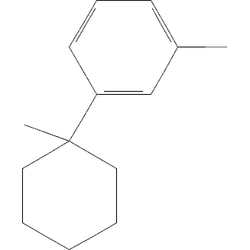
3F-PCP Stats & Data
Fc1cccc(c1)C1(CCCCC1)N1CCCCC1PFPLGKFWWBXTNP-UHFFFAOYSA-NReceptor Profile
Receptor Actions
History & Culture
3F-PCP is a relatively recent addition to the novel dissociative market. The compound was first analytically identified in Slovenia in October 2020, marking its initial detection by drug monitoring services. As a designer arylcyclohexylamine, it emerged as part of the ongoing development of novel phencyclidine derivatives intended for recreational use.
Effect Profile
Curated + 1 ReportsStrong dissociative depth with strong motor impairment, mild insight and mania
Duration Timeline
BluelightCommunity Effects
TripSitTolerance & Pharmacokinetics
drugs.wikiTolerance Decay
Rapid tolerance within a session is commonly reported for PCP‑class dissociatives; cross‑tolerance across the class is expected. Estimates above are anecdotal aggregates and vary substantially by individual, dose, and redose pattern.
Cross-Tolerances
Experience Report Analysis
ErowidDemographics
Gender Distribution
Too few reports for a chart: gender is known from 1 report, and a split is drawn only from 20 reports or more. Counts are shown instead. Why 20?
- Not Specified 1 of 1
Reports Over Time
Legal Status
| Country | Status | Notes |
|---|---|---|
| Hungary | Illegal | Classified as a controlled substance in April 2021. Production, distribution, and possession are prohibited under Hungarian drug control legislation. |
Harm Reduction
drugs.wiki• Identification and purity: 3‑F‑PCP first appeared in Europe (Slovenia) in late 2020; multiple user communities have since noted batch variability and occasional mislabeling as other PCP analogues (e.g., 3‑Cl‑PCP), making lab‑based drug checking highly advisable. Reagent tests are non‑specific for the class; GC/MS or FTIR is preferable via local drug‑checking services.
• Onset and redosing: Several reports emphasize a slow or uneven come‑up—especially orally/sublingually—so avoid topping up for at least 2–3 hours to prevent accidental overdosing into manic confusion.
• Nasal harm reduction: Insufflation commonly causes severe burn and caustic drip; use finely powdered, tiny test lines, allow long gaps between bumps, and rinse with sterile saline after sessions to reduce tissue damage and epistaxis risk.
• Functional impairment and injury risk: PCP‑class dissociatives can produce profound analgesia, proprioceptive distortion, and overconfidence. Do not cook, drive, swim, or climb during the session and for the entire residual period. Use a sober sitter for strong doses.
• Mental health cautions: High or repeated doses increase risk of acute psychosis‑like states (paranoia, delusions, disinhibition). Individuals with psychosis‑spectrum or bipolar histories should avoid.
• Tolerance/compulsion: Rapid tolerance accrues within a session and over days. Spacing sessions by 10–14 days reduces escalation.
• Hydration and temperature: Maintain gentle hydration and a cool environment; avoid strenuous activity—stimulant‑like activation plus dissociation is associated with overheating and accidents in PCP‑class use.
• IM use is high‑risk: Variable solubility, unknown excipients, and pH can cause tissue injury or abscess; many find IM doses deceptively strong and dysphoric beyond low–moderate ranges. Prefer non‑injecting routes.
References
Cited References
- Wikipedia: 3-Fluoro-PCP
- Bluelight: Small & Handy 3F-PCP Thread
- Bluelight: 3F-PCP 70mg Intranasal Experience
- CFSRE: Toxicology Monograph - F-PCP
- Cone et al. (1984) - Structure-Activity Studies PCP Derivatives
- Erowid: 3F-PCP Experience Index
- Erowid: Experience - Drenched in Purgatory (3F-PCP 70mg Insufflated)
- GlpBio - 3-Fluoro-PCP Analytical Standard
- Morris & Wallach (2014) - PCP to MXE Comprehensive Review
- PiHKAL.info - 3F-PCP Chemical Data
- Reddit: r/researchchemicals - 3F-PCP Extensive Overview
- Reddit: r/dissociatives - 3F-PCP Oral vs Intranasal
- Slovenian National Forensic Lab - 3F-PCP Analytical Report (2020)
- Syntheses of Fluorinated Phencyclidine Analogues
- Wallach et al. (2014) - Structure-Activity PCP Derivatives
- Syntheses of fluorinated phencyclidine analogs
- Structure-activity study of PCP derivatives
- Erowid: 3F-PCP general category reports
Additional references
- Bluelight – Small & Handy 3‑Fluoro‑PCP thread (insufflation burn, high‑dose effects)
- Bluelight – 3F‑PCP (70 mg intranasal) report (burn, timeline)
- Effect Index – “Drenched in Purgatory” (70 mg intranasal)
- Reddit r/dissociatives – Oral 60–100 mg reports (onset, duration, strong dose caution)
- Bluelight – moderator remarks on 3F‑PCP dose‑response and avoiding high doses
- Bluelight – discussion of “dirty” domestic batch (possible 3‑Cl/3‑F mix)
- TripSit – HR hub and combo chart (general dissociative combinations guidance)
- Erowid PCP Vault – Effects & risks (psychosis, seizures, accidents)
- Erowid – 3‑MeO‑PCP Effects (stimulation, confusion scales for class context)
- Toronto Drug Checking Service – Why to check (service overview; supports GC/MS/FTIR use)