
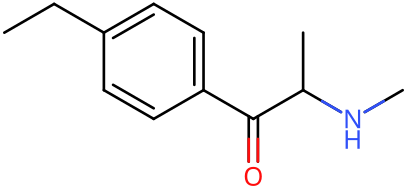
4-EMC Stats & Data
CCc1ccc(cc1)C(=O)C(C)NCFUYPDKFWOHBUFT-VIFPVBQESA-NReceptor Profile
Receptor Actions
History & Culture
4-Ethylmethcathinone (4-EMC) is a synthetic cathinone that emerged as part of the broader wave of designer stimulants developed as alternatives to controlled substances. As a structural isomer of 4-MEC and 3,4-DMMC, it represents one of many positional variations explored within the substituted cathinone chemical space. The compound was initially identified through forensic detection in Europe, where it circulated among other novel psychoactive substances in recreational drug markets. Its presence was subsequently confirmed in Australia in 2020, demonstrating the typical pattern of global diffusion seen with designer drugs as they spread from initial markets to other regions.
Effect Profile
Curated + 1 ReportsStrong sensory enhancement with moderate empathy and stimulation, mild euphoria
Mild euphoria with strong anxiety/jitters, low stimulation
Tolerance & Pharmacokinetics
drugs.wikiTolerance Decay
Based on user‑community guidance for mephedrone and similar cathinones: fast‑building, slow‑decaying tolerance; spacing by ≥2 weeks commonly suggested to restore sensitivity and reduce compulsion. Data are anecdotal and extrapolated rather than derived from controlled studies.
Cross-Tolerances
Experience Report Analysis
ErowidDemographics
Gender Distribution
Too few reports for a chart: gender is known from 3 reports, and a split is drawn only from 20 reports or more. Counts are shown instead. Why 20?
- Male 3 of 3
Age Distribution
Reports Over Time
Legal Status
| Country | Status | Notes |
|---|---|---|
| United States | Schedule I | Classified as a Schedule I controlled substance under federal law as a positional isomer of 4-methylethcathinone (4-MEC). The state of Vermont has additionally scheduled 4-ethylmethcathinone as a controlled substance as of January 2016. The substance may also be subject to prosecution under the Federal Analogue Act in jurisdictions where it is not explicitly scheduled, when sold for human consumption. |
Harm Reduction
drugs.wikiIdentity and naming: 4‑EMC is the para‑ethyl homologue of mephedrone (4‑MMC) and is distinct from 4‑MEC (para‑methyl, N‑ethyl); these are often confused in sales posts and user reports, increasing misidentification risk—verify structure/supplier claims via reagent/lab checking where possible. Supply risk: unregulated cathinone markets routinely show substitution/adulteration; drug‑checking services (reagents/FTIR/GC‑MS) reduce this risk but have limitations—reagents can be fooled and cannot quantify dose. Physiology: effects are consistent with a short‑acting entactogenic stimulant—euphoria, sociability, empathy, tactile enhancement—alongside sympathetic signs (tachycardia, mydriasis, sweating, vasoconstriction). Heat/water: like MDMA and related cathinones, exertion plus serotonergic stimulation can cause hyperthermia; over‑compensating with large volumes of plain water risks hyponatremia—sip fluids with electrolytes, take cooling breaks, and monitor for confusion, headache, vomiting, or swelling. Redosing: compulsion to redose is common; stacking doses rapidly increases cardiovascular strain and worsens comedown/insomnia—set a firm session cap and timing before starting. ROA: insufflation is notably caustic to nasal/throat tissue; IV use carries elevated risk of vasoconstriction and ischemic ‘blue’ extremities with binges—strongly discourage parenteral routes. Comedown: next‑day dysphoria, anxiety, and poor sleep are frequently reported; nutrition, sleep hygiene, and avoiding alcohol/sedatives at the tail end reduce rebound issues. Tolerance/spacing: tolerance climbs quickly and can take weeks to normalize; spacing sessions by at least two weeks (longer after binges) lowers risk of compulsive use and mood decline. Seizure risk: tramadol and bupropion both lower the seizure threshold; combining with stimulants amplifies risk—avoid or use only with medical oversight. Data quality: human PK/safety evidence specific to 4‑EMC is sparse; most guidance extrapolates from analogous para‑substituted cathinones and user reports—dose‑conservatively, test batches, and prefer oral over faster ROAs.
References
Data Sources
Cited References
- Drugs-Forum: 4-EMC Experience Reports
- Erowid: 4-Ethylmethcathinone Experience Reports
- EMCDDA: Europol Joint Report on 4-EMC (2014)
- Neuropharmacology of Synthetic Cathinones - Baumann et al. (2018)
- Prosser & Nelson: The Pharmacology of Synthetic Cathinones, Critical Reviews in Toxicology (2012)
- Reddit: r/ResearchChemicals - 4-EMC Discussion (2020)
- Sommers et al.: Identification and Characterization of Novel Cathinones, Forensic Science International (2016)
Additional references
- Erowid – 4‑Ethylmethcathinone Experience Index
- Isomer Design (Isomer Design) – 4‑EMC identifiers & synonyms
- PubChem – 4‑Ethylmethcathinone compound record
- Bluelight – 4‑ethylmethcathinone discussion thread (2010)
- Bluelight – 4‑EMC (4‑ethylmethcathinone) user thread (2012)
- TripSit Wiki – Drug combinations (general combo safety)
- TripSit Wiki – Mephedrone factsheet (HR notes, redosing, nasal issues, spacing)
- Erowid – MDMA water issues (hyperthermia and hyponatremia)
- Erowid – Mephedrone (4‑MMC) Health warnings (vasoconstriction, binge risks)
- Erowid – Drug Checking information (limitations of reagents; lab testing)
- DrugWise – Early reference to 4‑EMC synthesis/experience (2010)
- Toronto’s Drug Checking Service – program overview (supply variability context)
- Drugs‑Forum – Bupropion interactions and seizure‑risk advisory