
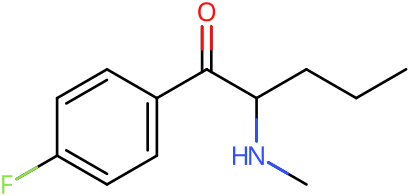
4-Fluoropentedrone Stats & Data
CCCC(NC)C(=O)c1ccc(F)cc1QBFXBDUCRNGHSA-UHFFFAOYSA-NReceptor Profile
Receptor Actions
Effect Profile
CuratedModerate euphoria and focus with strong anxiety/jitters, low stimulation
Tolerance & Pharmacokinetics
drugs.wikiTolerance Decay
Anecdotal patterns suggest rapid tolerance with binge/redosing across 1–2 days, partial decay over 3–7 days, and near‑baseline by ~2 weeks. Data quality is low and varies widely among individuals.
Cross-Tolerances
Harm Reduction
drugs.wikiReason for additions/edits: 1) Identity and naming cross-checked with PubChem; human PK for 4‑FPD is uncharacterised, so dose/ROA guidance emphasises allergy/test-dosing and milligram-accurate weighing. 2) Acute harm-reduction focuses on managing a sympathomimetic toxidrome: benzodiazepines are first-line in severe agitation/hyperthermia; avoid pure beta‑blockers as monotherapy during acute intoxication due to unopposed α-agonism risk; seek urgent care for chest pain, confusion, high fever, or persistent tachycardia. 3) Overheating and dehydration are common with cathinones: plan cool‑down breaks; sip ~250 ml water/hour at rest (up to ~500 ml/hour if active) plus electrolytes; avoid over‑hydration. 4) Insufflation: high risk of mucosal injury; crush finely, use personal sterile equipment, rinse with saline before/after, alternate nostrils, and avoid sharing to reduce BBV risks. 5) Rectal use: dissolve in sterile water, lubricate, shallow insertion; precise volumetric dosing reduces local irritation. 6) Drug checking: single reagents can be misleading; prefer multi‑reagent panels (Marquis, Froehde, Simon’s, Zimmermann, Morris) and, where available, FTIR/GC‑MS drug checking; be cautious of cathinones mis-sold as MDMA or mixed in stimulants. 7) Interactions: MAOIs are high‑risk; tramadol and bupropion lower seizure threshold; co‑use with serotonergics (e.g., SSRIs/SNRIs/MDMA) increases serotonin‑toxicity risk; combining with QT‑prolonging agents increases arrhythmia risk. 8) Driving/complex tasks: stimulants and residual effects impair sleep and reaction time; community guidance suggests waiting at least 48 h after cathinone use before driving. 9) We removed an earlier, specific reagent‑color and purity range claim due to insufficient reliable sourcing and replaced it with general multi‑reagent and lab‑testing guidance. Evidence sources are cited below.
References
Cited References
- Cayman Chemical - 4-fluoro Pentedrone (hydrochloride) analytical data
- European Monitoring Centre for Drugs and Drug Addiction - Early-Warning Report on New Cathinones
- Hondebrink L. et al. - Neuropharmacology of substituted cathinones (2018)
- PiHKAL.info - 4-Fluoropentedrone
- PubChem: 4-Fluoropentedrone
- SWGDRUG Monograph: 4-Fluoropentedrone
- United Kingdom ACMD Synthetic Cathinones Harms Assessment (2020)
Additional references
- PubChem – 4‑Fluoropentedrone compound entry (identity/synonyms)
- StatPearls: Sympathomimetic Toxicity (benzodiazepines first-line; beta‑blocker caveats)
- StatPearls: QT‑Prolonging Drugs (general QT/TdP risk factors, stacking risks)
- PubMed case series/review: Cardiotoxicity after synthetic cathinone use
- Handbook of Exp Pharmacol 2018: Neuropharmacology of Synthetic Cathinones (class mechanisms, DAT/NET/SERT)
- Curr Top Behav Neurosci 2017: Neurotoxicology of synthetic cathinone analogs
- Hi‑Ground cathinones factsheet (hydration, dosing variability, testing, driving interval)
- Hi‑Ground cathinones page (dosing/testing guidance)
- Hi‑Ground snorting guidance (nasal care; personal equipment)
- Hi‑Ground shelving/plugging safety tips
- DrugWise: mephedrone & related cathinones (compulsive redosing; nasal injury; palpitations)
- DrugChecking.community – onsite technology considerations (why FTIR/GC‑MS services matter)
- EUDA: EU Early Warning System on NPS (cathinone market trends; monitoring)
- TripSit: Tramadol (seizure risk; serotonergic)
- PubMed: Seizures and bupropion (dose-dependent seizure risk; additive risk with stimulants)
- Bluelight list noting 4‑Fluoropentedrone among RCs (existence in community discourse)