
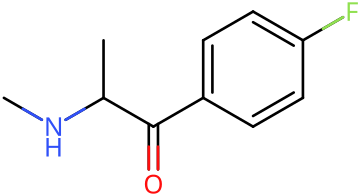
4-FMC Stats & Data
CNC(C)C(=O)c1ccc(F)cc1MWKQPIROPJSFRI-UHFFFAOYSA-NReceptor Profile
Receptor Actions
History & Culture
Flephedrone first appeared on the recreational drug market in 2008, where it was sold online as a designer drug. It was marketed primarily as a replacement for mephedrone, which was gaining popularity during the same period. The substance represents one of the earlier synthetic cathinones to emerge in the designer drug marketplace, and its appearance prompted rapid regulatory responses across multiple jurisdictions, with Denmark becoming one of the first countries to prohibit it by the end of 2008.
Effect Profile
Curated + 1 ReportsStrong euphoria and sensory enhancement with moderate empathy, mild stimulation
Strong euphoria with strong anxiety/jitters, mild focus, low stimulation
Tolerance & Pharmacokinetics
drugs.wikiTolerance Decay
Tolerance to entactogenic/stimulant effects appears to build rapidly across a single day and decays over 1–6 weeks. Values are rough, inferred from user reports for short‑acting cathinones; data quality is anecdotal.
Cross-Tolerances
Experience Report Analysis
ErowidDemographics
Gender Distribution
Too few reports for a chart: gender is known from 3 reports, and a split is drawn only from 20 reports or more. Counts are shown instead. Why 20?
- Male 3 of 3
Age Distribution
Reports Over Time
Form / Preparation
Most common forms and preparations, as a share of the 3 reports that give one
Too few reports for bars: these forms come from 3 reports, and a bar is drawn only from 20 reports or more. With fewer, a percentage cannot tell a common effect from a rare one. Counts are shown instead. Why 20?
- Powder / Crystals 2 of 3
Legal Status
| Country | Status | Notes |
|---|---|---|
| Australia | Potentially illegal | Most likely controlled as an analogue or derivative of cathinone under analogue provisions. Legal status may vary by state and territory. |
| Brazil | Illegal | Controlled since 2017 as an analogue or derivative of cathinone under Brazilian drug legislation. |
| China | Controlled | Listed as a controlled substance since October 2015 under national drug control regulations. |
| Denmark | Illegal | Prohibited since December 2008. One of the earliest European nations to control flephedrone. |
| Finland | Controlled | Scheduled in the government decree on psychoactive substances banned from the consumer market. |
| Lithuania | Illegal | Prohibited since April 2010 under national drug control legislation. |
| Poland | Illegal | Prohibited since April 2010 under national controlled substances legislation. |
| Sweden | Narcotic | Classified as a narcotic substance since October 2010. Subject to penalties under Swedish narcotics law. |
| United Kingdom | Illegal | Prohibited since April 2010. Possession, production, and supply are criminal offenses. |
| United States | Schedule I | Temporarily placed in Schedule I of the Controlled Substances Act at the federal level. Permanently listed as Schedule I in Florida, Georgia, and Pennsylvania. |
Harm Reduction
drugs.wikiReasoning for harm‑reduction additions (with sources): 1) Mislabeling risk is high: both 3‑FMC and 4‑FMC have been sold as “flephedrone”; this explains divergent reports and mandates allergy testing and lab checking when possible. Bluelight threads explicitly discuss the 3‑FMC/4‑FMC confusion; EMCDDA’s cathinone profile lists 4‑FMC as flephedrone and notes NPS are often mis‑sold. 2) Oral vs insufflated risks: user timelines support short, stacked duration with a harsher crash when snorted; several reports describe painful, irritating drips and long tails after repeat lines. Favor oral to reduce nasal damage and compulsive re‑lining. 3) MAOI combos are dangerous with stimulants/MDMA due to hypertensive crisis and serotonin toxicity; this general rule applies to cathinones as mixed monoamine agents. 4) Tramadol and bupropion lower the seizure threshold; both increase seizure risk when combined with stimulants. Avoid. 5) General stimulant harm reduction applies: overheating and hypertension are risks; stay cool, avoid hot environments, plan rest; do not mix multiple stimulants. 6) Injection/rectal use increases harm and has been linked to outbreaks (HIV/HCV) with cathinones in Europe; avoid injecting and share no equipment. 7) Set dosing boundaries to prevent binges: pre‑measure single dose plus at most one booster; lock away remainder; use a milligram scale; avoid multi‑day runs to reduce comedown intensity and sleep deprivation. 8) Hydration: sip small amounts of electrolyte fluids regularly; avoid overhydration; take cooling breaks. 9) Post‑use care: magnesium for bruxism, gentle nutrition, sleep hygiene; avoid alcohol and strong stimulants on the comedown. 10) Space uses generously: at least 2–4 weeks between sessions to let tolerance and mood normalize. 11) Drug checking: use reagents and, where available, lab drug checking services; branded “legal highs” may contain other cathinones (e.g., MDPV) with very different dose ranges. 12) If chest pain, severe agitation, hyperthermia, or persistent tachycardia occurs, seek urgent care and disclose stimulant use. Sources are cited below. Overall toxicity data for 4‑FMC in humans are sparse; guidance extrapolates from related cathinones and HR best practice.
References
Data Sources
Cited References
- Archer, R. P. (2009) - Fluoromethcathinone, a new substance of abuse
- Banks et al. (2015) - Abuse-Related Neurochemical Effects of Para-Substituted Methcathinone Analogs
- Eshleman et al. (2013-2017) - In vitro transporter assays of synthetic cathinones
- Erowid: 4-FMC Vault
- PsychonautWiki Talk: 4-FMC
- Simmler et al. (2013) - Pharmacological characterization of designer cathinones
- Strano-Rossi et al. (2014) - Immunoassay screening and LC-HRMS analysis of cathinones
- Thornton et al. (2012) - Psychosis from bath salt product containing flephedrone and MDPV
- Erowid: 4-FMC Experience Reports & Dose Info
- Freeman, S. et al. (2012) "Analytical characterization and in vitro toxicity of 4-fluoromethcathinone"
- Erowid: 4 Fluoromethcathinone
Additional references
- Erowid 4‑Fluoromethcathinone (4‑FMC) Vault
- Bluelight — The 3‑FMC/4‑FMC (Flephedrone) Megathread (mislabeling noted)
- EUDA/EMCDDA — Synthetic cathinones drug profile (naming, modes, market patterns)
- EUDA/EMCDDA — Synthetic cathinones: distribution and supply in Europe (injecting, outbreaks)
- Drugs‑Forum — Flephedrone (4‑FMC) Experiences (dose, duration, nasal irritation)
- TripSit — Drug combinations (general MAOI + stimulant guidance)
- Erowid — MAOI interactions summary (avoid MAOIs with stimulants/MDMA)
- Drugs‑Forum — Tramadol wiki (seizure and serotonin syndrome cautions)
- Bluelight — Article: Are Bupropion and MDMA a risky combination? (seizure threshold note)
- Bluelight — Biology, Pharmacology and Drugs 101 (stimulant HR: BP/HR, overheating)