
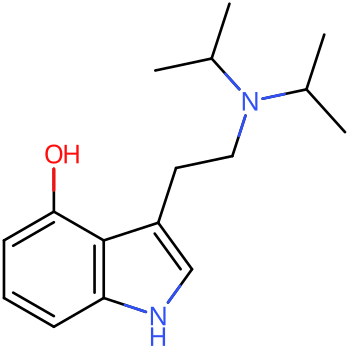
4-HO-DiPT Stats & Data
KBRYKXCBGISXQV-UHFFFAOYSA-NReceptor Profile
Receptor Actions
History & Culture
4-HO-DiPT was first described in the scientific literature in 1977, with its synthesis published by chemist David B. Repke. Two decades later, Alexander Shulgin investigated the substance's effects in humans and characterized it in his 1997 book TiHKAL ("Tryptamines I Have Known and Loved"). Shulgin noted that 4-HO-DiPT possessed an unusual combination of properties among psychedelics, including rapid onset (becoming apparent approximately 15 minutes after ingestion), considerable intensity at relatively low doses (with 20 milligrams capable of producing a transcendent peak experience), brief overall duration (typically 2-3 hours), and pronounced dose sensitivity. The compound was subsequently encountered as a novel designer drug by 2005 and has since circulated on the online research chemical market, though it remains relatively uncommon. Today, 4-HO-DiPT is used for both recreational and entheogenic purposes, though it has a limited history of human use. In the 2020s, pharmaceutical interest emerged with the development of luvesilocin (also known as RE-104, FT-104, or 4-GO-DiPT), a prodrug of 4-HO-DiPT that has entered phase 2 clinical trials for the treatment of psychiatric conditions including postpartum depression and treatment-resistant depression.
Toxicity
PsychonautWikiThe toxicity and long-term health effects of recreational 4-HO-DiPT use do not seem to have been studied in any scientific context and the exact toxic dose is unknown. This is because 4-HO-DiPT is a research chemical with very little history of human usage. Anecdotal reports from those who have tried 4-HO-DiPT suggests that there are no negative health effects attributed to simply trying it by itself at low to moderate doses and using it very sparingly (but nothing can be completely guaranteed). Independent research should always be done to ensure that a combination of two or more substances is safe before consumption. It is strongly recommended that one use harm reduction practices when using this drug.
Effect Profile
Curated + 32 ReportsStrong visuals, headspace, and auditory effects with strong body load
Tolerance & Pharmacokinetics
drugs.wikiTolerance Decay
Cross-Tolerances
Experience Report Analysis
ErowidDemographics
Gender Distribution
Age Distribution
Reports Over Time
Effect Analysis
ErowidEffects aggregated from 32 experience reports (32 single-substance Erowid)
Effect Sentiment Distribution
Confidence Distribution
Each bar is the share of reports mentioning the effect; its whisker, and the band on the rows below, is the 95% interval: where the share could plausibly be with other reports of the same kind.
Positive Effects 11
Adverse Effects 5
Show 4 neutral or unclassified mentions
Also reported in combinations. In the 21 4-HO-DiPT reports where another drug was taken too, 1 (4.8%) mentions hospital, emergency services or an overdose, 1 (4.8%) a seizure and 0 (0.0%) psychosis. In the 32 single-substance reports: 6.2%, 0.0% and 3.1%. These are not in the figures above: they cannot be put down to 4-HO-DiPT alone, and a mention is not always something that happened to the writer.
Dose-Response Correlation
How effect frequency changes across dose levels. Whiskers, and the numbers' hover text, give each figure's 95% interval.
Not drawn, too few reports (a dose tier needs 20): Oral Strong (n=11). Why 20?
Dosage Distribution
Dose distribution from experience reports, one dose per report (the first listed). Doses above Q3 + 3×IQR, far above what people typically take, are left out of the median and range and listed under each route: most are real heavy doses or overdoses, not mistakes.
1 report gave a dose above the typical range (65 mg), so it is not in the figures above. Listing a dose here does not mean it is safe.
1 dose more than 50 times the median may be a typing or unit error and is not in the figures either: check the report.
Real-World Dose Distribution
ErowidFrom 65 of 70 recorded dose entries: those that state a weight (mg, g or µg), in routes with at least five of them. Values above Q3 + 3×IQR, far above what people typically take, are left out; they can include real heavy doses and overdoses, not only mistakes.
Insufflated (n=5)
Oral (n=57)
Common Combinations
Most co-occurring substances, as a share of all 53 reports filed under 4-HO-DiPT; whiskers are 95% intervals
Form / Preparation
Most common forms and preparations, as a share of the 39 reports that give one; whiskers are 95% intervals
Body-Weight Dosing
Dose per kg of body weight, one dose per report (the first listed), from reports giving a weight of 30–250 kg. Doses above Q3 + 3×IQR, far above what people typically take, are left out of the median and range and listed under each route.
1 dose more than 50 times the median may be a typing or unit error and is not in the figures either: check the report.
Redose Patterns
Redosing behavior across 43 reports
Legal Status
| Country | Status | Notes |
|---|---|---|
| Finland | Scheduled | Listed in the government decree on psychoactive substances prohibited from the consumer market, restricting sale and distribution to consumers. |
| Germany | NpSG (Controlled) | Controlled under the Neue-psychoaktive-Stoffe-Gesetz (New Psychoactive Substances Act) as of July 18, 2019. Production, import with intent to distribute, administration to others, and trading are criminally punishable. Possession is prohibited but not subject to criminal penalty. Use is permitted only for industrial and scientific purposes. |
| Japan | Designated Substance (Shitei-Yakubutsu) | Controlled under the Pharmaceutical Affairs Law as a Designated Substance. Both possession and sale are prohibited under this classification. |
| Sweden | Illegal (Health Hazard) | Classified as a 'health hazard' under the Lagen om förbud mot vissa hälsofarliga varor (Act on the Prohibition of Certain Goods Dangerous to Health) as of March 1, 2005, per regulation SFS 2005:26. Both possession and sale are prohibited. |
| Switzerland | Uncontrolled | Not listed under Buchstabe A, B, C, or D of the Swiss controlled substances regulations. Generally considered legal, though status should be verified with current regulations. |
| United Kingdom | Class A | Controlled as a Class A substance under the Misuse of Drugs Act 1971 due to the tryptamine catch-all clause, which covers substituted tryptamines regardless of whether they are individually named in the schedules. |
| United States | Unscheduled (Federal Analogue Act may apply) | Not scheduled at the federal level. However, it may be considered an analogue of psilocin (4-HO-DMT) or 5-MeO-DiPT, potentially subjecting purchase, sale, or possession to prosecution under the Federal Analogue Act when intended for human consumption. The DEA proposed scheduling in January 2022 but withdrew the proposal in July 2022 following public response. |
| United States (Florida) | Schedule I | Listed as '4-Hydroxy-N,N-diisopropyltryptamine' as a Schedule I controlled substance under Florida state law, making it illegal to buy, sell, or possess within the state. |
References
Cited References
- Bluelight: The Big & Dandy 4-HO-DiPT Thread
- Chadeayne et al. (2025). 4-Hydroxy-N,N-diisopropyltryptammonium hydrofumarate crystal structure
- Drugs-Forum: 4-HO-DiPT Trip Reports
- Glatfelter et al. (2023). Binding and functional activity of psilocin analogs at serotonin receptors
- Kelly et al. (2024). Psychedelic tryptamine pharmacology and therapeutic potential
- Repke et al. (1977). Psilocin analogs synthesis
- Repke, D. B. et al. (1977). Psilocin analogs synthesis