
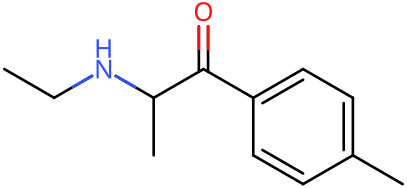
4-MEC Stats & Data
[Cl-].CCNC(C)C(=O)c1ccc(C)cc1.[H+]RQTXXFLUWZXGIE-UHFFFAOYSA-NReceptor Profile
Receptor Actions
History & Culture
4-MEC has been marketed commercially under the name "NRG-2," sold either as a standalone product or in mixtures containing other substituted cathinones. The compound has also been identified as an active ingredient in counterfeit ecstasy tablets, with reports from countries including New Zealand documenting its use as a substitute for MDMA in illicit pill markets.
Effect Profile
Curated + 15 ReportsStrong sensory enhancement with mild empathy, euphoria, and stimulation
Moderate euphoria with strong anxiety/jitters, low stimulation and focus
Tolerance & Pharmacokinetics
drugs.wikiTolerance Decay
Acute tolerance within a session is common; users report markedly diminished returns after initial doses and stronger comedowns with binges. Conservative spacing (≥2 weeks) is commonly advised in HR communities to limit cumulative harms; empirical pharmacodynamic tolerance half-life is not well established.
Cross-Tolerances
Experience Report Analysis
ErowidDemographics
Gender Distribution
Age Distribution
Reports Over Time
Effect Analysis
ErowidEffects aggregated from 15 experience reports (15 single-substance Erowid)
Effect Sentiment Distribution
Confidence Distribution
Each bar is the share of reports mentioning the effect; its whisker, and the band on the rows below, is the 95% interval: where the share could plausibly be with other reports of the same kind.
Too few reports for bars: these effects come from 15 single-substance Erowid reports, and a bar is drawn only from 20 reports or more. With fewer, a percentage cannot tell a common effect from a rare one. Counts are shown instead. Why 20?
Positive Effects 5
Adverse Effects 6
Show 3 neutral or unclassified mentions
Also reported in combinations. In the 7 4-MEC reports where another drug was taken too, 2 mention hospital, emergency services or an overdose, 0 a seizure and 0 psychosis (too few reports for percentages). In the 15 single-substance reports: 0, 0 and 0. These are not in the figures above: they cannot be put down to 4-MEC alone, and a mention is not always something that happened to the writer.
Real-World Dose Distribution
ErowidFrom 38 of 49 recorded dose entries: those that state a weight (mg, g or µg), in routes with at least five of them. Values above Q3 + 3×IQR, far above what people typically take, are left out; they can include real heavy doses and overdoses, not only mistakes.
Insufflated (n=29)
Oral (n=8)
Common Combinations
Most co-occurring substances, as a share of all 22 reports filed under 4-MEC; whiskers are 95% intervals
Form / Preparation
Most common forms and preparations, as a share of the 16 reports that give one
Too few reports for bars: these forms come from 16 reports, and a bar is drawn only from 20 reports or more. With fewer, a percentage cannot tell a common effect from a rare one. Counts are shown instead. Why 20?
- Powder / Crystals 15 of 16
Body-Weight Dosing
Dose per kg of body weight, one dose per report (the first listed), from reports giving a weight of 30–250 kg. Doses above Q3 + 3×IQR, far above what people typically take, are left out of the median and range and listed under each route.
Redose Patterns
Redosing behavior across 16 reports
Too few reports for a chart: redosing is known from 16 reports, and a split is drawn only from 20 reports or more. Counts are shown instead. Why 20?
- Single dose 6 of 16
- Redosed 10 of 16
Legal Status
| Country | Status | Notes |
|---|---|---|
| United States | Schedule I | Classified as a Schedule I controlled substance under the Controlled Substances Act, indicating high abuse potential with no currently accepted medical use in treatment. |
Harm Reduction
drugs.wiki4‑MEC is a synthetic cathinone with a short human use history; availability often followed mephedrone controls and products may be mislabelled or adulterated (e.g., sold as 3‑MMC or even ketamine), so test before use and titrate cautiously. 4‑MEC likely acts as a mixed monoamine stimulant/entactogen; as with serotonergic cathinones like 4‑MMC, combining with MAOIs or serotonergic agents (SSRIs/SNRIs, tramadol, DXM) increases risk of serotonin toxicity and should be avoided. Stimulant risks include tachycardia, hypertension, hyperthermia, vasoconstriction, bruxism, and insomnia; risk rises with dose and rapid redosing. Insufflation causes local irritation and, with repetition, can damage nasal mucosa; use your own clean utensil, saline rinse, switch nostrils, and rest the nose. Injecting cathinones adds significant harm (vein and tissue injury, infection) and can encourage compulsive redosing; if someone proceeds despite risks, sterile technique (new syringe, sterile water, filtration, site prep) reduces—but does not remove—harms. Redose compulsion (“fiending”) is frequently reported; spacing use (e.g., multiple weeks) reduces neuro/psychological stress and helps sleep and nutrition recover. The same name (‘4‑MEC’) has appeared in branded blends (e.g., ‘NRG‑2’) and non-analysed powders; do not assume purity or identity without drug checking. Formal pharmacokinetics (e.g., half-life) in humans remain poorly defined; expect variability across batches and individuals. Compared with 4‑MMC, 4‑MEC is often described as less potent and somewhat more sedating by users, but objective potency and toxicity data are limited—dose conservatively.
References
Data Sources
Cited References
- Baumann et al. (2015) - Second-Generation Mephedrone Analogs, 4-MEC and 4-MePPP
- Bluelight: 4-MEC Megathread
- Erowid: 4-MEC Vault
- Gil et al. (2013) - Analysis of 4-MEC in biological and non-biological material
- PsychonautWiki: 4-MEC
- Van Hout (2014) - Internet Study of User Experiences of 4-MEC
- Erowid: 4-Methylethcathinone (4-MEC) Overview
Additional references
- Erowid 4‑MEC overview (history, NRG‑2 context, short human-use history)
- PubChem compound record for 4‑MEC (synonyms/identifier)
- TripSit Wiki: Mephedrone (HR: SSRI/MAOI serotonin syndrome warning; typical stimulant adverse effects; nasal harm)
- Saferparty Zürich: 4‑MEC sold as ketamine (Oct 15, 2024) — mislabeling warning
- Saferparty Bern: 4‑MEC sold as 3‑MMC (Aug 28, 2025) — mislabeling warning
- Isomerdesign (PiHKAL/Cdsa): US emergency scheduling entry for 4‑MEC (2014) — nomenclature/legal ref
- Hi‑Ground cathinone HR (snorting/IV safer‑use practices, overdose signs)