
5-APB Stats & Data
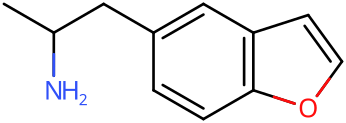
CC(CC1=CC2=C(C=C1)OC=C2)NVKUMKUZDZWHMQU-UHFFFAOYSA-NReceptor Profile
Receptor Actions
History & Culture
1993–2000
The development of 5-APB emerged from research into benzofuran-based entactogens during the 1990s. Medicinal chemist David E. Nichols and colleagues at Purdue University conducted foundational work on benzofuran analogues, examining the role of the MDA dioxole ring structure in interacting with serotonergic neurons. This research was motivated in part by efforts to identify a potentially non-neurotoxic alternative to MDMA, which was being investigated as a possible adjunct to psychotherapy but was also raising concerns about neurotoxic effects. 5-APB and its positional isomer 6-APB were formally described in a patent by Karin Briner and colleagues at Eli Lilly and Company in 2000. These compounds were studied as serotonin 5-HT2C receptor agonists for potential therapeutic applications, though they were not developed further for medical use.
2010–present
Recreational use of 5-APB was not documented until 2010, when it emerged for sale on the global research chemical market. The compound became particularly prominent in the United Kingdom's "legal highs" market, where 5-APB and related benzofuran entactogens were sold under the brand name "Benzofury" and gained a following in the rave scene. This period of legal availability was relatively short-lived. Following recommendations from the Advisory Council on the Misuse of Drugs, 5-APB and related analogues were classified as controlled substances in the UK in 2014, effectively ending the legal sale of benzofuran entactogens in that country. Similar regulatory actions followed in other jurisdictions.
Toxicity
PsychonautWikiThe toxicity and long-term health effects of recreational 5-APB use do not seem to have been studied in any scientific context and the exact toxic dosage is unknown. This is because 5-APB has very little history of human usage. Anecdotal evidence from people who have tried 5-APB within the community suggest that there do not seem to be any negative health effects attributed to simply trying this drug at low to moderate doses by itself and using it sparingly (but nothing can be completely guaranteed). 5-APB's high affinity for the 5-HT2b receptor makes it likely that 5-APB would be cardiotoxic with long-term use, as seen in other 5-HT2B agonists such as fenfluramine and MDMA. It is strongly recommended that one use harm reduction practices when using this substance.
Effect Profile
Curated + 8 ReportsStrong visuals and auditory effects with strong body load, mild headspace
Strong empathy and euphoria with moderate stimulation and sensory enhancement
Strong euphoria and focus with strong anxiety/jitters, mild stimulation
Duration Timeline
BluelightCommunity Effects
TripSitTolerance & Pharmacokinetics
drugs.wikiNo tolerance chart. No study has measured how long tolerance to it lasts, so this page shows what is known instead of a curve.
No study has measured tolerance to 5-APB in people; research so far is on cells, rats and poisoning cases. PsychonautWiki estimates that tolerance halves in 3-7 days and is gone in 1-2 weeks, without citing a source. Lab tests show 5-APB activates the 5-HT2B receptor, which is linked to heart-valve damage, so regular use carries a risk of its own.
Sources: Iversen et al. 2013 · Rickli et al. 2015 · PsychonautWiki: 5-APB
Cross-Tolerances
Demographics
Gender Distribution
Too few reports for a chart: gender is known from 10 reports, and a split is drawn only from 20 reports or more. Counts are shown instead. Why 20?
- Male 9 of 10
- Female 1 of 10
Age Distribution
Reports Over Time
Effect Analysis
Erowid + BluelightEffects aggregated from 8 experience reports (2 single-substance Erowid + 6 Bluelight)
Effect Sentiment Distribution
Confidence Distribution
Each bar is the share of reports mentioning the effect; its whisker, and the band on the rows below, is the 95% interval: where the share could plausibly be with other reports of the same kind.
Too few reports for bars: these effects come from 2 single-substance Erowid and 6 analyzed Bluelight reports, and a bar is drawn only from 20 reports or more. With fewer, a percentage cannot tell a common effect from a rare one. Counts are shown instead. Why 20?
Positive Effects 16
Adverse Effects 7
Show 17 neutral or unclassified mentions
Real-World Dose Distribution
ErowidFrom 116 of 133 recorded dose entries: those that state a weight (mg, g or µg), in routes with at least five of them. Values above Q3 + 3×IQR, far above what people typically take, are left out; they can include real heavy doses and overdoses, not only mistakes.
Oral (n=98)
Insufflated (n=17)
Common Combinations
Most co-occurring substances, as a share of all 10 reports filed under 5-APB
Too few reports for bars: these combinations come from 10 reports, and a bar is drawn only from 20 reports or more. With fewer, a percentage cannot tell a common effect from a rare one. Counts are shown instead. Why 20?
- Alcohol 3 of 10
Form / Preparation
Most common forms and preparations, as a share of the 4 reports that give one
Too few reports for bars: these forms come from 4 reports, and a bar is drawn only from 20 reports or more. With fewer, a percentage cannot tell a common effect from a rare one. Counts are shown instead. Why 20?
- Capsule 3 of 4
Legal Status
| Country | Status | Notes |
|---|---|---|
| Brazil | Illegal | Listed on Portaria SVS/MS nº 344. Possession, production, and sale are prohibited under Brazilian drug control legislation. |
| France | Narcotic | Classified as a narcotic substance since May 9, 2018, alongside other benzofuran-derived compounds. |
| Germany | Anlage II BtMG | Controlled under Anlage II of the Betäubungsmittelgesetz (Narcotics Act, Schedule II) since July 17, 2013. Manufacturing, possession, import, export, purchase, sale, procurement, or dispensing without a license is illegal. |
| Japan | Controlled substance | Designated as a controlled substance effective September 16, 2015. |
| Netherlands | Legal (under review) | Currently unscheduled, though it belongs to a substance group that may be prohibited under recently passed New Psychoactive Substances (NPS) legislation. |
| Switzerland | Controlled (Verzeichnis E) | Specifically named as a controlled substance under Verzeichnis E of Swiss drug control legislation. |
| United Kingdom | Class B | Initially classified as a Temporary Class Drug on June 10, 2013. Made a permanent Class B, Schedule 1 substance on June 10, 2014 alongside all other benzofuran entactogens and structurally related compounds. |
| United States | Unscheduled (Analogue Act applies) | Not specifically scheduled at the federal level. However, due to structural similarity to MDA, it may be prosecuted under the Federal Analogue Act if sold or possessed with intent for human consumption. |
Harm Reduction
drugs.wikiProduct mislabeling and salt-form variability are common in the benzofuran market; material sold as “Benzo Fury” may contain 5‑APB, 6‑APB, mixtures, or unrelated actives—use multi-reagent testing and consider sending a small sample to a drug-checking service before dosing. The come-up can be slow (often 60–120 min) with a wave-like rise; premature redosing in the first 2–3 hours markedly increases risk of over-intoxication, nausea, and cardiovascular strain. 5‑APB is commonly encountered as the HCl or succinate salt; by weight, HCl contains more active base than succinate—doses should be reduced if the material is HCl or unusually pure. Reagent behavior can resemble MDMA on some tests (e.g., Marquis/Mecke dark reactions), so use a panel (e.g., Froehde, Simon’s) rather than a single reagent and avoid assuming MDMA results confirm MDMA. As a serotonergic entactogen with stimulant properties, 5‑APB should not be combined with MAOIs, DXM, tramadol, triptans, or serotonergic supplements (5‑HTP) due to serotonin toxicity risk; combining with other stimulants amplifies hypertension, hyperthermia, and arrhythmia risk. Benzofurans show concerning 5‑HT2B activity in vitro discussions; although clinical data are limited, frequent use may pose a theoretical valvulopathy risk—pace use (e.g., several weeks between sessions) and avoid if you have heart disease. Manage environment and temperature: take breaks from heat, sip water regularly, and include electrolytes on long sessions; avoid heavy alcohol (dehydration, masking warning signs). Common adverse effects include jaw clenching, nausea/vomiting on come-up, headaches during/after, insomnia, and transient anxiety—dose control, cool ambient temperature, and avoiding redose can mitigate these. Insufflation is irritating and may increase intensity but reduce duration; oral administration is generally preferred for smoother effects. Cross-tolerance with MDMA/MDA and similar entactogens is reported; spacing uses reduces “muted” effects and post-acute low mood. Because benzo fury-era products were often adulterated, be cautious with pressed pellets or unusually colored powders, and titrate with an accurate milligram scale after reagent testing.
References
Cited References
- Baumann et al. 2018 - Pharmacology of 5-APB and 6-APB (PMC)
- Briner et al. 2006 - Aminoalkylbenzofurans as 5-HT2C Agonists Patent
- Dawson et al. 2014 - Effects of Benzofury on Dopamine Transporter
- DrugWise: Benzofury Factsheet
- Iversen et al. 2013 - Neurochemical Profiles of Novel Psychoactive Substances
- IsomerDesign PIHKAL: 5-APB
- Monte et al. 1993 - Synthesis and Pharmacology of Benzofuran Analogues
- Rickli et al. 2015 - Pharmacological Profile of Novel Psychoactive Benzofurans
- DrugWise: Benzo Fury
Additional references
- Isomer Design: 5-APB (general background)
- Drugs-Forum Wiki: 5-APB (doses, onset/plateau length, reagent behavior)
- Bluelight: List of Dangerous & Potentially Unsafe Combinations (serotonergic/stimulant interactions)
- Bluelight: 5‑APB & 6‑APB can mimic MDMA on reagents; use Froehde/Simon's and multi-reagent panels
- Bluelight (discussion): Salt form commonality and HCl vs succinate considerations for benzofurans
- Reddit (community harm-reduction): Succinate vs HCl potency by weight math for 6‑APB (analogous principle for 5‑APB)
- Bluelight: The 5‑HT2B receptor, valvulopathy and safety discussions (risk rationale to pace use)
- Bluelight: Big & Dandy/APB threads (reports on delayed come-up, redose effects, ROA differences)