
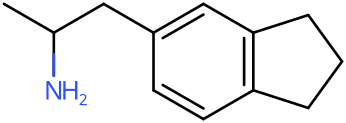
5-APDI Stats & Data
CC(N)Cc1ccc2CCCc2c1QYVNZHBQYJRLEX-UHFFFAOYSA-NReceptor Profile
Receptor Actions
Effect Profile
Curated + 9 ReportsMild auditory effects with low visuals and body load
Moderate stimulation with mild empathy, euphoria, and sensory enhancement
Mild stimulation and euphoria with moderate anxiety/jitters
Tolerance & Pharmacokinetics
drugs.wikiTolerance Decay
Rapid acute tolerance is frequently reported with SRAs; spacing of several weeks is prudent by analogy to MDMA. Estimates are heuristic and based on anecdotal patterns rather than formal PK/PD studies.
Cross-Tolerances
Experience Report Analysis
ErowidDemographics
Gender Distribution
Too few reports for a chart: gender is known from 16 reports, and a split is drawn only from 20 reports or more. Counts are shown instead. Why 20?
- Male 14 of 16
- Not Specified 1 of 16
- Female 1 of 16
Age Distribution
Reports Over Time
Effect Analysis
ErowidEffects aggregated from 9 experience reports (9 single-substance Erowid)
Effect Sentiment Distribution
Confidence Distribution
Each bar is the share of reports mentioning the effect; its whisker, and the band on the rows below, is the 95% interval: where the share could plausibly be with other reports of the same kind.
Too few reports for bars: these effects come from 9 single-substance Erowid reports, and a bar is drawn only from 20 reports or more. With fewer, a percentage cannot tell a common effect from a rare one. Counts are shown instead. Why 20?
Positive Effects 6
Adverse Effects 3
Dosage Distribution
Dose distribution from experience reports, one dose per report (the first listed). Doses above Q3 + 3×IQR, far above what people typically take, are left out of the median and range and listed under each route: most are real heavy doses or overdoses, not mistakes.
Real-World Dose Distribution
ErowidFrom 17 of 21 recorded dose entries: those that state a weight (mg, g or µg), in routes with at least five of them. Values above Q3 + 3×IQR, far above what people typically take, are left out; they can include real heavy doses and overdoses, not only mistakes.
Oral (n=16)
Common Combinations
Most co-occurring substances, as a share of all 16 reports filed under 5-APDI
Too few reports for bars: these combinations come from 16 reports, and a bar is drawn only from 20 reports or more. With fewer, a percentage cannot tell a common effect from a rare one. Counts are shown instead. Why 20?
- Alcohol 3 of 16
- THC 3 of 16
Form / Preparation
Most common forms and preparations, as a share of the 14 reports that give one
Too few reports for bars: these forms come from 14 reports, and a bar is drawn only from 20 reports or more. With fewer, a percentage cannot tell a common effect from a rare one. Counts are shown instead. Why 20?
- Powder / Crystals 9 of 14
- Capsule 4 of 14
Body-Weight Dosing
Dose per kg of body weight, one dose per report (the first listed), from reports giving a weight of 30–250 kg. Doses above Q3 + 3×IQR, far above what people typically take, are left out of the median and range and listed under each route.
Redose Patterns
Redosing behavior across 14 reports
Too few reports for a chart: redosing is known from 14 reports, and a split is drawn only from 20 reports or more. Counts are shown instead. Why 20?
- Single dose 10 of 14
- Redosed 4 of 14
Harm Reduction
drugs.wikiIdentity/mislabelling risk: “IAP/5‑IAP/5‑APDI” has been inconsistently named and sometimes mis-sold; historical misrepresentation (e.g., 5‑IAI fiasco) underscores the need for GC/MS drug checking over reagent kits alone. Purity and identity should be verified where possible. Slow onset and long tail make premature redosing risky; tolerance can build intra‑session, leading to greater side‑effects with little added benefit. As a serotonergic releaser, it carries serotonin syndrome risk—especially with MAOIs, SSRIs/SNRIs, tramadol/meperidine, linezolid, and other SRAs. Hyperthermia is possible in warm, crowded settings; take cooling breaks, avoid vigorous exertion, and maintain light, spaced fluids. Conversely, overhydration can cause hyponatraemia; sip small amounts regularly and consider electrolytes rather than rapid overconsumption of water. GI side‑effects (nausea, cramping, diarrhoea) are common with serotonergic drugs given the high proportion of peripheral 5‑HT in the gut. Cardiovascular strain (tachycardia, sweating) and bruxism are frequently reported; avoid combining with other stimulants. Insufflation increases local irritation; avoid repeated lines. Intravenous use is strongly discouraged due to unknown solubility/excipients and lack of clinical formulation. Space sessions widely (several weeks) to reduce tolerance and mood after‑effects, by analogy to MDMA‑like agents. Use a thermometer if active for long periods; if overheating or severe agitation/confusion/tremor/clonus occur, seek medical help; benzodiazepines and external cooling are standard first‑aid while awaiting care.
References
Data Sources
Cited References
- Bluelight: The Big & Dandy IAP / 5-APDI Thread
- Cayman Chemical: 5-APDI (hydrochloride) Product Data
- Erowid: IAP Vault - Dosage, Effects & Experience Reports
- Monte et al. (1993): Synthesis and pharmacological examination of benzofuran, indan, and tetralin analogues of 3,4-(methylenedioxy)amphetamine
- TripSit: 5-APDI Factsheet
- Cayman Chemical – 5-APDI (hydrochloride) Product Data
Additional references
- Erowid IAP (IndanylAminoPropane, 5-APDI, 5-IAP) Vault
- Erowid/DrugsData – Project overview (lab drug checking)
- Bluelight — Vendors, suppliers and the 5‑IAI mislabeling discussion
- Bluelight — 5‑IAI mostly counterfeit discussion (context for mislabeling risk)
- Drugs‑Forum — IAP / 5‑APDI discussion (dose variability across users)
- TripSit — Drug combinations chart (general interaction framework)
- StatPearls — Serotonin Syndrome (pathophysiology, high‑risk combinations)
- StatPearls — Linezolid monograph (MAOI activity; SS risk)
- Hi‑Ground — Antidepressants (MAOI/SSRI/SNRI warnings with serotonergics)
- DrugWise — Leah Betts hyponatraemia context (overhydration risk)
- Erowid MDMA info (hyperthermia and hyponatraemia guidance)
- StatPearls — Biochemistry, Serotonin (enteric 5‑HT predominance)
- TripSit — Tramadol (seizure/serotonergic risk)
- Toronto Drug Checking (program reports; lab confirmation value)