
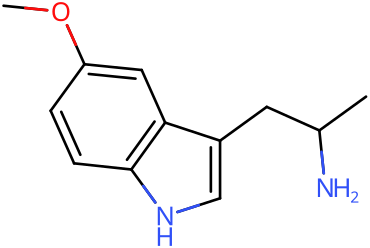
5-MeO-AMT Stats & Data
COc1ccc2ncc(CC(C)N)c2c1OGNJZVNNKBZFRM-QMMMGPOBSA-NEffect Profile
Curated + 96 ReportsStrong visuals and auditory effects with strong body load, low headspace
Strong empathy, sensory enhancement, stimulation, and euphoria
Strong stimulation with strong anxiety/jitters, moderate euphoria, low focus
Duration Timeline
BluelightEmpirical Duration
Erowid ReportsMedian times after the dose that Erowid reports state. A curve is drawn only when reports state all four points (onset, peak begins, comedown begins, back to baseline) and the medians fall in that order. No point is estimated from another.
No curve: fewer than 5 reports state the return to baseline, and no point is estimated from another.
Tolerance & Pharmacokinetics
drugs.wikiTolerance Decay
Animal data show rapid tolerance to head-twitch with repeated dosing; users commonly report diminished effects for several days after use with partial recovery by ~3 days and near-baseline after ~10–14 days. Cross-tolerance with classic psychedelics is expected given shared 5‑HT2A agonism, but human quantification is lacking.
Cross-Tolerances
Demographics
Gender Distribution
Age Distribution
Reports Over Time
Effect Analysis
Erowid + BluelightEffects aggregated from 96 experience reports (88 single-substance Erowid + 8 Bluelight)
Effect Sentiment Distribution
Confidence Distribution
Each bar is the share of reports mentioning the effect; its whisker, and the band on the rows below, is the 95% interval: where the share could plausibly be with other reports of the same kind.
Rows resting on fewer than 20 reports show a count (“3 of 7”) instead of a bar. Why 20?
Positive Effects 33
Adverse Effects 44
Show 23 more adverse effects
Show 8 neutral or unclassified mentions
Also reported in combinations. In the 48 5-MeO-AMT reports where another drug was taken too, 6 (12.5%) mention hospital, emergency services or an overdose, 0 (0.0%) a seizure and 1 (2.1%) psychosis. In the 88 single-substance reports: 21.6%, 4.5% and 4.5%. These are not in the figures above: they cannot be put down to 5-MeO-AMT alone, and a mention is not always something that happened to the writer.
Dose-Response Correlation
How effect frequency changes across dose levels. Whiskers, and the numbers' hover text, give each figure's 95% interval.
View data table
| Effect | Heavy (n=27) |
|---|---|
| Visual Distortions | 88.9% (95% interval 72 to 96 percent) |
| Nausea | 74.1% (95% interval 55 to 87 percent) |
| Anxiety | 63.0% (95% interval 44 to 78 percent) |
| Color Enhancement | 48.1% (95% interval 31 to 66 percent) |
| Stimulation | 40.7% (95% interval 24 to 59 percent) |
| Confusion | 37.0% (95% interval 22 to 56 percent) |
| Auditory Effects | 37.0% (95% interval 22 to 56 percent) |
| Music Enhancement | 29.6% (95% interval 16 to 48 percent) |
| Sedation | 25.9% (95% interval 13 to 45 percent) |
| Empathy | 22.2% (95% interval 11 to 41 percent) |
| Euphoria | 22.2% (95% interval 11 to 41 percent) |
| Pupil Dilation | 18.5% (95% interval 8 to 37 percent) |
| Hospital | 18.5% (95% interval 8 to 37 percent) |
| Closed-Eye Visuals | 14.8% (95% interval 6 to 32 percent) |
| Open-Eye Visuals | 14.8% (95% interval 6 to 32 percent) |
Subjective Effect Ontology
Experience ReportsStructured effect tags extracted from 144 Erowid & Bluelight experience reports using a controlled vocabulary of 220+ canonical effects across 15 domains.
Visual
Dose–Effect Mapping
Experience ReportsHow reported effects shift across dose tiers, based on 88 single-substance experience reports. The shaded band on each bar is its 95% interval. An arrow (↑ ↓) marks a change between the lowest and highest tier that count an effect only when the gap is bigger than chance would explain; ~ means no clear change. How changes are called
Limited tier coverage — most reports fall within the Heavy range. Effects at other dose levels may not be represented.
| Effect | Heavy (n=27) | Change with dose |
|---|---|---|
| visual distortions | ||
| nausea | ||
| anxiety | ||
| color enhancement | ||
| stimulation | ||
| confusion | ||
| auditory effects | ||
| music enhancement | ||
| sedation | ||
| empathy | ||
| euphoria | ||
| pupil dilation | ||
| hospital | ||
| closed-eye visuals | ||
| open-eye visuals | ||
| ego dissolution | ||
| motor impairment | ||
| headache | ||
| introspection | ||
| muscle tension |
Showing top 20 of 27 effects
Dosage Distribution
Dose distribution from experience reports, one dose per report (the first listed). Doses above Q3 + 3×IQR, far above what people typically take, are left out of the median and range and listed under each route: most are real heavy doses or overdoses, not mistakes.
Oral
1 report gave a dose above the typical range (50 mg), so it is not in the figures above. It mentions hospital, emergency services or an overdose. Listing a dose here does not mean it is safe.
Show the report
- 50 mg · mentions hospital, emergency services or an overdose
Insufflated
1 report gave a dose above the typical range (100 mg), so it is not in the figures above. It mentions hospital, emergency services or an overdose. Listing a dose here does not mean it is safe.
Show the report
- 100 mg · mentions hospital, emergency services or an overdose
Real-World Dose Distribution
ErowidFrom 144 of 159 recorded dose entries: those that state a weight (mg, g or µg), in routes with at least five of them. Values above Q3 + 3×IQR, far above what people typically take, are left out; they can include real heavy doses and overdoses, not only mistakes.
Insufflated (n=21)
Oral (n=118)
Common Combinations
Most co-occurring substances, as a share of all 136 reports filed under 5-MeO-AMT; whiskers are 95% intervals
Form / Preparation
Most common forms and preparations, as a share of the 106 reports that give one; whiskers are 95% intervals
Body-Weight Dosing
Dose per kg of body weight, one dose per report (the first listed), from reports giving a weight of 30–250 kg. Doses above Q3 + 3×IQR, far above what people typically take, are left out of the median and range and listed under each route.
Oral
1 report gave a dose above the typical range (0.847 mg/kg), so it is not in the figures above. It mentions hospital, emergency services or an overdose. Listing a dose here does not mean it is safe.
Show the report
- 0.847 mg/kg · mentions hospital, emergency services or an overdose
Insufflated
1 report gave a dose above the typical range (1.471 mg/kg), so it is not in the figures above. It mentions hospital, emergency services or an overdose. Listing a dose here does not mean it is safe.
Show the report
- 1.471 mg/kg · mentions hospital, emergency services or an overdose
Redose Patterns
Redosing behavior across 109 reports
Harm Reduction
drugs.wiki• Dose sensitivity is extreme at the milligram level; 5–8 mg oral has been associated with medical emergencies in community reports. Use a calibrated 0.001 g (milligram) scale and avoid volumetric errors. • Onset can be delayed to 90–120 minutes orally; redosing during the come-up is a common error that can produce protracted, dysphoric overstimulation and medical crises. • Insufflation is overrepresented in problem reports and can cause severe local irritation and systemic side effects; if used at all, doses must be markedly reduced compared with oral. • Material has been mis-sold as LSD or confused with AMT; paper blotter or drops have historically contained 5‑MeO‑AMT. Always reagent-test and, where available, use laboratory drug checking before ingestion. • Sympathomimetic effects (tachycardia, mydriasis, sweating, tremor, hypertension) are common; those with cardiovascular disease, seizure history, or uncontrolled hypertension should avoid. • Avoid combinations with MAOIs, MDMA, DXM, and serotonergic antidepressant stacks due to serotonin toxicity/hyperthermia risks; several severe intoxications and at least one death have been linked to high/unknown-dose 5‑MeO‑AMT, sometimes initially misattributed to LSD. • Plan for a very long tail of stimulation and potential insomnia; do not drive or operate machinery until fully baseline (commonly the day after, or longer at higher doses). • If severe agitation, hyperthermia, chest pain, confusion, or seizures occur, seek emergency care promptly; do not attempt to self-treat with additional substances. • Repeated administration over days shows rapid tolerance in animals; practical cross-tolerance with classic psychedelics is likely—space sessions by at least 10–14 days. • Because human pharmacokinetics are uncharacterized, start low, avoid stacked doses, and ensure a trusted sober sitter and a cool environment with hydration. • Where possible, use professional drug checking services to confirm identity/purity; field reagents (Ehrlich/Hofmann) can help rule in indoles and rule out NBOMes on blotter but are not definitive. • Avoid mixing with heavy exercise, hot environments, or dehydration, which can increase hyperthermia risk. • Store securely and label clearly to prevent confusion with AMT or other tryptamines.
References
Cited references
- Erowid 5‑MeO‑AMT Basics (duration, onset, problems, slang)
- Erowid 5‑MeO‑AMT Vault (general, synonyms)
- Erowid 5‑MeO‑AMT: Hospitalizations & Possible Deaths (overdose reports incl. ~8 mg oral)
- Erowid LSD Vault: Reported “LSD Overdose” Not LSD (2005 Spokane case; identified 5‑MeO‑AMT)
- Abiero et al., 2019. 5‑MeO‑AMT induces HTR via 5‑HT2A; tolerance with repeated dosing (mouse).
- Nelson et al., 2011. Abuse liability profile of substituted tryptamines (receptor/SERT data; discrimination).
- TripSit Drug Combinations wiki (overview; 5‑MeO‑xxT rows; MAOI/SSRI/stimulant cautions).
- Erowid: The Importance of Measured Doses (milligram scale guidance).
- Erowid Crew Blog: On‑site drug checking and reagent testing guidance (Ehrlich/Hofmann).
- Hi‑Ground (AU): Drug‑checking service flyer (what can be checked incl. powders/pills/crystals/blotter).