
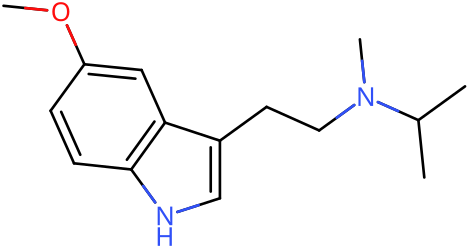
5-MeO-MiPT Stats & Data
COc1ccc2ncc(CCN(C)C(C)C)c2c1HEDOODBJFVUQMS-UHFFFAOYSA-NReceptor Profile
Receptor Actions
Receptor Binding
History & Culture
5-MeO-MiPT, commonly known as "Moxy," was first synthesized and characterized in 1985 when David Repke, Donald Grotjahn, and Alexander Shulgin published its synthesis and pharmacological profile in the Journal of Medicinal Chemistry. This publication represented the first known documentation of the compound, establishing that it had no prior history of human usage before this academic work. Shulgin later documented the substance more extensively in his influential book TiHKAL ("Tryptamines I Have Known and Loved"), which described its effects in humans and contributed to broader awareness within the psychedelic research community. Following its initial characterization, 5-MeO-MiPT remained relatively obscure until it began appearing as a novel designer drug around 2005. Since then, it has circulated primarily through the research chemical market rather than traditional street drug channels. The compound is used both recreationally and as an entheogen, typically obtained through online vendors operating in regulatory grey areas rather than through in-person distribution networks. Its presence in the research chemical market has continued for approximately two decades since its emergence into wider use.
Subjective Effects
Physical
The physical effects of 5-MeO-MiPT can be broken down into three components all of which progressively intensify proportional to dosage.
- Spontaneous tactile sensations: The body high of 5-MeO-MiPT can be described as a pleasurable, warm, soft and all encompassing glow. There is also a cold, sharp tingling sensation that is manifested spontaneously at different unpredictable points throughout the trip but for others it can maintain a consistent presence that steadily rises with the onset and hits its limit once the peak has been reached.
- Stimulation and Sedation: In terms of its effects on the physical energy levels of the tripper, 5-MeO-MiPT can be both sedating and stimulating. The physical energy levels seem to manifest themselves in waves in an unpredictable pattern. This seems to be partially setting dependent and during physically strenuous situations such as running or dancing it can become stimulating and energetic. In contrast however, in calm environments such as darkened rooms with comfortable seating it can become relaxing, peaceful and even moderately sedating.
- Nausea: As the tripper begins to come up, nausea is not uncommon and can sometimes result in initial vomiting, but passes once this over or the trip begins to fully set in. In comparison to other psychedelics such as psilocin, LSD, and 2C-E, this could actually be very considered very mild in its intensity.
Cognitive
The head space of 5-MeO-MiPT is described by many as one which is both insightful and moderately relaxing, but at some points quite stimulating.
- Introspection: This component is consistently manifested only in the context of a non-social setting in which the user is alone.
- Increased empathy, love and sociability: This component is consistently manifested only in the context of social settings in which one is within the company of others. These feelings of sociability, love and empathy are a little weaker and less sharp than those found on substances such as MDMA and 2C-B but still prove strong enough to provide long lasting therapeutic effects.
- Acceleration of thought
- Connectivity of thought
- Time distortion
- Feelings of fascination, importance and awe
- Conceptual thinking
- Enhancement of current mind state
- Removal of cultural filter
- Ego suppression, loss and death
Sensory
- Auditory enhancements
- Auditory distortions
- Auditory hallucinations
- Visual drifting: (melting, breathing, warping and flowing) - In comparison to other psychedelics, this effect can be described as highly detailed, slow and smooth in motion and static in appearance.
- Tracers
- After images
- Texture repetition
- Colour shifting
- Scenery slicing
- Increased visual acuity
- Enhancement of colours
- Enhanced pattern recognition
5-MeO-MiPT produces a full range of high level hallucinatory states in a fashion that is more consistent and reproducible than that of many other commonly used psychedelics.
- External hallucinations
- Internal hallucinations: In comparison to other psychedelics such as LSD, 5-MeO-MiPT is extremely high in hallucinations embedded within visual geometry. This particular effect commonly contains hallucinations with scenarios, settings, concepts and autonomous entity contact. They are more common within dark environments and can be described as internal in their manifestation, lucid in believability, interactive in style and almost exclusively of religious, spiritual, mystical or a transcendental nature in their overall theme.
Forked from Subjective Effect Documentation by Josie Kins, December 2013. Via dose.wiki (CC0).
Toxicity
PsychonautWikiAlmost nothing is known about the long-term effects of 5-MeO-MiPT. Alongside of this, the exact toxic dosage is unknown. This is because 5-MeO-MiPT is a research chemical with very little history of human use. A preliminary study on mice has shown that a normal dose of 5-MeO-MiPT (0.27 mg/kg) was unable to produce any measurable toxic effects. However, doses of 5-MeO-MiPT way above the normal dosage range (2.7 mg/kg) have been shown to produce cell toxicity by triggering programmed cell death in the brain, liver and kidneys.
Effect Profile
Curated + 88 ReportsStrong visuals, headspace, and auditory effects with strong body load
Strong empathy, stimulation, sensory enhancement, and euphoria
Duration Timeline
BluelightTolerance & Pharmacokinetics
drugs.wikiTolerance Decay
Based on Erowid’s basics page indicating a short tolerance window with near‑baseline by 5–7+ days; quantitative values are heuristic for planning gaps, not pharmacokinetic measurements. Cross‑tolerance pattern inferred from general psychedelic class behavior (TripSit).
Cross-Tolerances
Demographics
Gender Distribution
Age Distribution
Reports Over Time
Effect Analysis
Erowid + BluelightEffects aggregated from 88 experience reports (60 single-substance Erowid + 28 Bluelight)
Effect Sentiment Distribution
Confidence Distribution
Each bar is the share of reports mentioning the effect; its whisker, and the band on the rows below, is the 95% interval: where the share could plausibly be with other reports of the same kind.
Positive Effects 61
Adverse Effects 47
Show 27 more adverse effects
Show 21 neutral or unclassified mentions
Also reported in combinations. In the 45 5-MeO-MiPT reports where another drug was taken too, 3 (6.7%) mention hospital, emergency services or an overdose, 1 (2.2%) a seizure and 1 (2.2%) psychosis. In the 60 single-substance reports: 15.0%, 1.7% and 1.7%. These are not in the figures above: they cannot be put down to 5-MeO-MiPT alone, and a mention is not always something that happened to the writer.
Dose-Response Correlation
How effect frequency changes across dose levels. Whiskers, and the numbers' hover text, give each figure's 95% interval.
Not drawn, too few reports (a dose tier needs 20): Oral Common (n=13). Why 20?
Dosage Distribution
Dose distribution from experience reports, one dose per report (the first listed). Doses above Q3 + 3×IQR, far above what people typically take, are left out of the median and range and listed under each route: most are real heavy doses or overdoses, not mistakes.
1 report gave a dose above the typical range (40 mg), so it is not in the figures above. Listing a dose here does not mean it is safe.
Show the report
Real-World Dose Distribution
ErowidFrom 110 of 116 recorded dose entries: those that state a weight (mg, g or µg), in routes with at least five of them. Values above Q3 + 3×IQR, far above what people typically take, are left out; they can include real heavy doses and overdoses, not only mistakes.
Smoked (n=8)
Oral (n=86)
Insufflated (n=5)
Sublingual (n=8)
Common Combinations
Most co-occurring substances, as a share of all 105 reports filed under 5-MeO-MiPT; whiskers are 95% intervals
Form / Preparation
Most common forms and preparations, as a share of the 72 reports that give one; whiskers are 95% intervals
Body-Weight Dosing
Dose per kg of body weight, one dose per report (the first listed), from reports giving a weight of 30–250 kg. Doses above Q3 + 3×IQR, far above what people typically take, are left out of the median and range and listed under each route.
1 report gave a dose above the typical range (0.551 mg/kg), so it is not in the figures above. Listing a dose here does not mean it is safe.
Show the report
Redose Patterns
Redosing behavior across 77 reports
Legal Status
| Country | Status | Notes |
|---|---|---|
| Australia | Potentially illegal (analogue) | Could be treated as an illicit analogue under national drug legislation, though not explicitly scheduled. |
| Austria | Illegal (NPSG) | Prohibited under the Neue Psychoaktive Substanzen Gesetz (New Psychoactive Substances Act). Possession, production, and sale are illegal, though offenders with no intent to distribute may not face prosecution. |
| Brazil | Illegal | Production, sale, and possession are prohibited under Portaria SVS/MS nº 344. |
| Canada | Unscheduled | Not a scheduled substance, but illegal if sold for human consumption or recreational use. |
| China | Category I psychotropic substance | Controlled as of September 2015. Illegal to sell, buy, import, export, and manufacture. |
| Finland | Illegal | Banned in December 2014 as part of a government regulation prohibiting over 100 psychoactive chemicals from the consumer market. |
| Germany | Illegal (NpSG) | Controlled under the Neue-psychoaktive-Stoffe-Gesetz (New Psychoactive Substances Act) as of July 18, 2019. Production, import with intent to market, administration to others, marketing, and trading are punishable offenses. Possession is illegal but not subject to criminal penalties. |
| Japan | Designated Substance (Shitei-Yakubutsu) | Controlled under the Pharmaceutical Affairs Law. Possession and sale are prohibited. |
| Latvia | Schedule I | Classified as a Schedule I controlled substance under national drug legislation. |
| Luxembourg | Not prohibited | Not listed among prohibited substances, making it technically legal though in a regulatory gray area. |
| New Zealand | Class C | Treated as an analogue of DMT under the Misuse of Drugs Act, classifying it as a Class C controlled drug. |
| Romania | Illegal | Prohibited along with other tryptamine derivatives as of January 2011. |
| Switzerland | Controlled (Verzeichnis E) | Specifically named as a controlled substance under Verzeichnis E of Swiss drug regulations. |
| Turkey | Illegal | Classified as a drug. Possession, production, supply, and import are prohibited. |
| United Kingdom | Class A | Controlled under the Misuse of Drugs Act 1971 as an ether of 5-HO-MiPT, which falls under the tryptamine catch-all clause. Class A substances carry the most severe penalties. |
| United States | Unscheduled (Federal); Schedule I in some states | Not scheduled at the federal level, but may be prosecuted under the Federal Analogue Act as an analog of 5-MeO-DiPT (Schedule I) if sold for human consumption. The DEA proposed scheduling in the 2020s but withdrew the proposal amid public opposition. Explicitly Schedule I in Florida, Louisiana (since June 2013), and Minnesota. |
Harm Reduction
drugs.wiki• Potency varies widely; Erowid and TIHKAL document active effects in some people at 1–2 mg orally, while others need higher doses. Because 5‑MeO‑MiPT has a steep response curve and sub‑10 mg dosing, use a calibrated milligram scale and consider volumetric dosing to avoid accidental multi‑x overdoses. • Duration commonly spans 4–7 hours orally with an early body‑energized onset and residual stimulation that can delay sleep; some users report insomnia for several hours after baseline. Plan set/setting accordingly and avoid redosing to sleep. • Prominent body effects include anxious stimulation, muscle tension, tremor, and GI upset (gas/diarrhea/cramps); rare reports describe uncomfortable vasoconstriction—people with cardiovascular disease should be cautious and start low. Hydrate regularly, especially if dancing or in warm environments. • Interactions: combining with MAOIs can sharply increase serotonergic exposure (and caused strong potentiation with related tryptamines); avoid this combination. Stacking with stimulants or MDMA raises cardiovascular and anxiety risks; tramadol/DXM add serotonergic and seizure risk. If a calming agent is needed, use a single, known‑dose benzodiazepine cautiously and never with alcohol. • Identity/adulteration risks exist in the RC market; mislabeling as other compounds (e.g., stimulants) has been reported. Use reagent tests as a first pass (Ehrlich positive for indoles; Mecke/Mandelin often red‑brown/yellow‑brown for 5‑MeO tryptamines) and prioritize lab testing where available. Do not assume blotters/pills are correctly labeled. • Salt vs freebase: the HCl (or fumarate) salt is water‑soluble; freebase is poorly water‑soluble and intended for vaporization. If material won’t dissolve in water, it may be freebase or misidentified—do not force oral use; converting freebase to a salt requires proper acid/base handling. • Smoking/vaporizing uses larger masses than oral and produces an immediate rush followed by hours of trippiness; because data are limited and the inhaled route can feel more anxious/harsh, titrate very conservatively. Avoid open flame and overheating to limit degradation. • Tolerance rises acutely and typically diminishes over several days; spacing sessions by at least 5–7 days reduces attenuation and helps integration. Cross‑tolerance with classical psychedelics is likely. • Individuals with seizure histories, serious heart disease, or a family history of psychosis should be especially cautious; psychedelics can unmask latent vulnerabilities. Avoid driving or hazardous tasks during and after use due to impairments in attention, coordination, and visual processing. • Sexual/tactile enhancement is common but can encourage redosing; keep doses modest, maintain hydration/electrolytes, and communicate about consent as judgment can fluctuate under entactogenic effects.
References
Data Sources
Cited References
- Chemical Collective 5-MeO-MiPT Product Information
- Nagai et al. 2007: Effects on Monoamine Neurotransmission
- Pharmaco-toxicological Effects Study (PMC)
- Repke et al. 1985: Psychotomimetic N-methyl-N-isopropyltryptamines
- Shulgin & Shulgin 1997: TiHKAL #40
- TripSit Factsheet: 5-MeO-MiPT
- TripSit Factsheet
Additional references
- Erowid 5‑MeO‑MiPT Dosage
- Erowid 5‑MeO‑MiPT Effects & Duration
- Erowid 5‑MeO‑MiPT Basics
- TIHKAL #40: 5‑MeO‑MiPT
- TripSit Drug Combinations (5‑MeO‑xxT sections)
- TripSit Psychedelics Tolerance Overview
- Bluelight: Severe vasoconstriction with 5‑MeO‑MiPT (user reports)
- EffectIndex 5‑MeO‑MiPT trip report index
- Reddit: 5‑MeO‑MiPT fumarate reagent outcomes (community testing)
- Reddit: 5‑MeO‑MiPT not dissolving in water (freebase vs salt)