
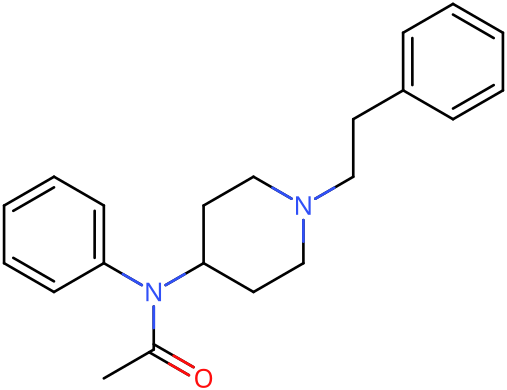
Acetylfentanyl Stats & Data
CC(=O)N(c1ccccc1)C1CCN(CCc2ccccc2)CC1FYIUUQUPOKIKNI-UHFFFAOYSA-NReceptor Profile
Receptor Actions
Receptor Binding
History & Culture
1960s–1980s
Acetylfentanyl was first described in patents from Research Laboratorium Dr. C. Janssen (Janssen Pharmaceutica), a Belgian pharmaceutical company. Its analgesic activity was characterized in a 1968 patent by Paul Janssen, the company's founder. The compound was discovered contemporaneously with fentanyl itself during Janssen's extensive research into piperidine-based analgesics. Despite its discovery alongside fentanyl, acetylfentanyl was never developed for therapeutic applications or licensed for medical use. During the late 1980s, the compound appeared occasionally on illicit drug markets but remained uncommon compared to other opioids available at the time.
2012–2015
Acetylfentanyl's modern history began in 2012 when online discussion about the substance increased and reports of seizures appeared. Initial reports of recreational use emerged from Russia, where the compound was detected in smoking "spices" (synthetic cannabinoid products). At least twelve deaths associated with acetylfentanyl, some involving morphine as a co-intoxicant, were reported in this region. By 2013, the substance had spread more widely. In late April 2013, police in Montreal, Canada conducted raids on seven locations and recovered approximately 300,000 drug tablets, of which 11,000 were found to contain acetylfentanyl. A separate three kilograms of acetylfentanyl powder was also confiscated during these operations. In the United States, the first laboratory submission involving acetylfentanyl occurred in Maine in April 2013. The drug was frequently mixed with heroin or sold in its place, contributing to unexpected overdoses among users unaware of its presence. The compound continued to proliferate through 2014 and 2015. According to the EU Early Warning System Network, the first European Union seizure was reported in Poland in 2014, followed by three seizures in Finland—two originating from China and one from Belgium. Japan first identified acetylfentanyl in drug products in 2014. In November 2015, the substance was seized for the first time in Western Australia, where it was found pressed into tablets designed to resemble PEZ candies. Most large shipment seizures during this period involved packages originating in China.
2013–2015
The proliferation of acetylfentanyl precipitated a significant public health crisis, particularly in the United States and Europe. Between March and May 2013, the Centers for Disease Control and Prevention issued a health alert following fourteen overdose deaths among intravenous drug users in Rhode Island, with victims ranging in age from 19 to 57 years. Pennsylvania experienced a pronounced outbreak, prompting state authorities to request that coroners and medical examiners screen for acetylfentanyl. This investigation attributed at least fifty fatalities to either fentanyl or acetylfentanyl during the first half of 2013. Florida similarly reported a rise in fentanyl and acetylfentanyl-related deaths beginning in late 2013. By July 2015, the DEA had confirmed fifty-two fatalities involving acetylfentanyl in the United States between 2013 and 2015. In Europe, acetylfentanyl was analytically confirmed in thirty-two fatalities across four member states between 2013 and August 2015, with Sweden recording twenty-seven deaths, the United Kingdom two, Germany two, and Poland one. The European Monitoring Centre for Drugs and Drug Addiction issued an alert about the drug in September 2015 following twenty-two confirmed deaths. More broadly, fentanyl analogs have been responsible for hundreds of deaths throughout Europe and the former Soviet republics since a resurgence in their use began in Estonia in the early 2000s.
Toxicity
PsychonautWikiFentanyl analogs have killed hundreds of people throughout Europe and the former Soviet republics since the most recent resurgence in use began in Estonia in the early 2000s, and novel derivatives continue to appear. The United States Drug Enforcement Administration reported in July of 2015 that at least 52 confirmed fatalities involving acetylfentanyl in the United States had occurred between 2013-2015. Ten fatalities attributed to acetylfentanyl overdose were reported during March of 2013 alone in Rhode Island. Fentanyl is potentially fatal at heavy dosages and even those with opiate tolerances are at high risk for overdoses. Once the acetylfentanyl is in the user's system, it is extremely difficult to stop its course because of the nature of absorption.
Effect Profile
Curated + 4 ReportsStrong euphoria and pain relief with moderate sedation, mild itching/nausea
Tolerance & Pharmacokinetics
drugs.wikiNo tolerance chart. Our decay curves for opioids were estimates, and a curve can make tolerance look longer-lasting than it is, which is the dangerous direction.
Opioid tolerance drops fast when you stop, and even a few days off can be enough, so a dose that used to be normal can now stop your breathing. Overdose deaths rise sharply after prison, detox or leaving treatment, and tolerance also falls during a hospital stay. After any break, start with a much smaller amount, try a test dose first, don't use alone, and keep naloxone within reach. Alcohol, benzodiazepines, gabapentinoids and other sedatives make an opioid overdose much more likely.
Sources: FRANK: heroin · National Harm Reduction Coalition · WHO: opioid overdose · Merrall et al. 2010 · Binswanger et al. 2007 · Strang et al. 2003 · FDA 2019: gabapentinoids and breathing
Experience Report Analysis
ErowidDemographics
Gender Distribution
Too few reports for a chart: gender is known from 5 reports, and a split is drawn only from 20 reports or more. Counts are shown instead. Why 20?
- Male 4 of 5
- Not Specified 1 of 5
Age Distribution
Reports Over Time
Form / Preparation
Most common forms and preparations, as a share of the 4 reports that give one
Too few reports for bars: these forms come from 4 reports, and a bar is drawn only from 20 reports or more. With fewer, a percentage cannot tell a common effect from a rare one. Counts are shown instead. Why 20?
- Powder / Crystals 2 of 4
Legal Status
| Country | Status | Notes |
|---|---|---|
| Austria | Controlled (SMG) | Listed in Annex 1 of the Narcotic Substances Regulation under the Suchtmittelgesetz (Narcotics Act). |
| Canada | Schedule I (CDSA) | Controlled as an analog of fentanyl under the Controlled Drugs and Substances Act. Manufacturing, possession, and distribution are prohibited. |
| China | Category I Psychotropic Substance | Controlled since October 1, 2015. Illegal to sell, buy, import, export, and manufacture. |
| Cyprus | Controlled | Controlled since 2013 via Regulatory Administrative Act 162/13 within updates to law L29/77. Falls under a generic clause addressing all fentanyl chemical groups. |
| Estonia | Controlled | Added to national drug control legislation on June 8, 2015. |
| Finland | Liite 4 (Annex 4) | Controlled as a narcotic substance under Annex 4 of drug control legislation since September 28, 2015. |
| Germany | Anlage II BtMG | Controlled under Anlage II of the Betäubungsmittelgesetz (Narcotics Act) since June 20, 2017. Manufacturing, possession, import, export, purchase, sale, procurement, and dispensing without a license is prohibited. |
| Ireland | Schedule I | Controlled under Schedule I of the Misuse of Drugs Regulation 1988 (S.I. 328 of 1988). |
| Japan | Controlled | Listed as a controlled substance under Japanese drug control legislation. |
| Latvia | List I | Included in the first list of Cabinet Regulation N 847, which governs narcotic substances, psychotropic substances, and precursors controlled in Latvia. |
| Lithuania | Controlled | Placed under control pursuant to Republic of Lithuania Minister of Health Order No V-1062 (September 21, 2015), amending the narcotic and psychotropic substances lists. |
| Norway | Controlled | Regulated under the Medicines Act (Legemiddelloven). |
| Poland | Controlled (Substitute Drug) | Controlled under the definition of 'substitute drug' per the Act of October 8, 2010 amending the Act on counteracting drug addiction. Article 44b prohibits manufacturing or introducing substitute drugs to trade. |
| Russia | Schedule I | Classified as a Schedule I controlled substance. Possession, production, and distribution are prohibited. |
| Sweden | Controlled | Regulated as a controlled substance since August 2015. |
| Switzerland | Verzeichnis D | Specifically named as a controlled substance under Verzeichnis D of Swiss narcotics legislation. |
| Turkey | Illegal | Prohibited since February 2016 under Turkish drug control legislation. |
| United Kingdom | Class A | Made a Class A controlled substance in 1986 as an analogue of fentanyl under the Misuse of Drugs Act 1971 (Modification) Order 1986. Class A substances carry the most severe penalties under UK law. |
| United States | Schedule I | Temporarily placed in Schedule I on July 17, 2015 via Federal Register notice and subsequently permanently scheduled. Classified as having high abuse potential with no accepted medical use. Federal prosecutions for distribution have resulted in multi-year prison sentences. |
References
Data Sources
Cited References
- ChemSpider: Acetylfentanyl
- DanceSafe: Fentanyl Information
- Erowid: Acetylfentanyl Vault
- Fentanyl and its derivatives: Pain-killers or man-killers? (Heliyon 2024)
- Higashikawa & Suzuki 2008 - Structure-analgesic activity relationship
- Janssen & Van der Eycken 1968 - Drugs affecting the central nervous system
- TripSit: Drug Combinations Chart
- TripSit: Drug Combinations Wiki
- US DEA Acetylfentanyl Report
- World Health Organization Acetylfentanyl Critical Review