
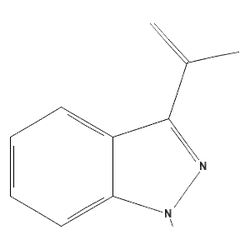
ADB-INACA Stats & Data
NC(=O)C(NC(=O)c1nnc2ccccc12)C(C)(C)CUFECWXZSRFBSHC-LLVKDONJSA-NTolerance & Pharmacokinetics
drugs.wikiTolerance Decay
Rapid tolerance build with repeated/daily use is commonly reported for SCRA class; decay appears slower than build and incomplete for weeks. Data quality is low and largely anecdotal across varying compounds/products.
Cross-Tolerances
Harm Reduction
drugs.wikiADB-INACA is an indazole-3-carboxamide reported in seized material; real-world harms often reflect co-formulation and product variability across the SCRA class rather than a single pure compound. Treat any unknown SCRA as if it could be a nanomolar CB1 agonist: do not eyeball, prefer volumetric dosing, take a single test puff or very low oral dose, and wait through the full peak before redosing. Sprayed plant matter/papers can have ‘hot spots’; thorough homogenization and highly dilute solutions reduce per-puff variability and overdose risk. Synthetic cannabinoids have been linked to severe agitation, psychosis, seizures, and serious cardiovascular events (including MI, arrhythmia, QTc issues); risks escalate with polydrug use, dehydration, heat, or underlying heart/psychiatric conditions. Unlike THC, some SCRAs can suppress breathing; combining with opioids or other depressants (benzodiazepines, Z‑drugs, alcohol, sedating antihistamines, high‑dose gabapentinoids) markedly increases risk of dangerous respiratory and cardiovascular depression. Clinically, severe SCRA agitation is often managed with benzodiazepines, but recreational co-use increases sedation/airway risks—do not pre- or co-load with depressants outside medical care. Routine immunoassay drug screens usually do not detect SCRAs; only mass spectrometry (LC/GC‑MS) confirms identity, and products sold as ‘cannabis’ or even ‘fentanyl’ have been found adulterated with ultrapotent SCRAs. Cardiac warning: case reports and in‑silico data support possible hERG blockade/QT prolongation with some SCRAs; avoid if you have known QT issues, are on QT‑prolonging drugs, or have electrolyte abnormalities. Plan conservative set/setting, do not drive until well after the tail, pace hydration/electrolytes, and pre‑commit session caps to limit compulsive redosing.
References
Cited references
- PubChem Compound Summary for ADB-INACA
- Systematic review: Toxicity of synthetic cannabinoids (2023, Brain Sciences)
- Review: Synthetic cannabinoid toxicities include arrhythmia, MI, seizures, AKI (2019)
- SCRA withdrawal profile more severe than cannabis (2022)
- Cardiovascular emergencies linked to SCRAs (2023)
- hERG/QT risk predictions for novel SCRAs incl. ADB‑5Br‑INACA (2023)
- Seizures after JWH‑018 ingestion: case report (2011)
- Drug checking alert: AMB‑FUBINACA found with opioids; vitals suppression risk
- Drug checking alert: ACHMINACA with fentanyl/heroin; risks noted
- EUDA European Drug Report 2024 highlights: adulteration with potent SCRAs
- Erowid Spice Product vault (variability/mislabelling context)