
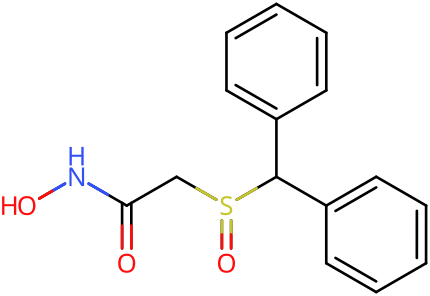
Adrafinil Stats & Data
ONC(=O)CS(=O)C(c1ccccc1)c1ccccc1CGNMLOKEMNBUAI-UHFFFAOYSA-NPharmacology
DrugBankDescription
Adrafinil is a mild central nervous system stimulating drug typically employed to relieve excessive sleepiness and inattention in geriatric patients. It is also been used off-label to prevent fatigue or falling asleep for extended periods of time. Adrafinil does not currently have FDA approval and is thus unregulated in the United States. It was marketed in France and elsewhere in Europe under the trade name Olmifon until September 2011 when France's FDA equivalent reassessed the drug and withdrew marketing permission. Adrafinil is metabolized to modafinil.
Pharmacodynamics
Adrafinil is a prodrug; it is primarily metabolized in vivo to modafinil, resulting in nearly identical pharmacological effects. Unlike modafinil, the active metabolite must accumulate before the drug is able to act. Oral adrafinil without food usually begins to act within 45 minutes to 1 hour.
Indication
Used to relieve excessive sleepiness and inattention in elderly patients.
Receptor Profile
Receptor Actions
History & Culture
1974–1985
Adrafinil was discovered in 1974 by two chemists working at the French pharmaceutical company Laboratoires Lafon. The compound emerged unexpectedly during a screening program aimed at identifying novel analgesic agents. Rather than demonstrating pain-relieving properties, pharmacological studies revealed that adrafinil produced psychostimulant-like effects in animals, including hyperactivity and sustained wakefulness. Two years after the initial discovery, in 1976, researchers identified modafinil as the primary active metabolite responsible for adrafinil's wakefulness-promoting effects. Modafinil demonstrated greater potency than its parent compound in animal studies and was subsequently selected for parallel clinical development alongside adrafinil. The first human trials of adrafinil were conducted between 1977 and 1978, specifically investigating its potential for treating narcolepsy. Alexander Shulgin published the first detailed account of the compound's synthesis and pharmacology in 1980 in the journal Communications in Psychopharmacology. Despite this publication, adrafinil remained an extremely obscure chemical for nearly two decades. The drug reached the French market in 1984 under the trade name Olmifon, with approval for narcolepsy treatment following in 1985.
1994–2011
While adrafinil was establishing its presence in European markets, its more potent metabolite modafinil continued through clinical development, receiving approval in France in 1994 and subsequently in the United States in 1998. Both compounds were marketed simultaneously, though modafinil gained significantly more international traction. In 2001, the American pharmaceutical company Cephalon acquired Laboratoires Lafon, gaining control of both adrafinil and modafinil products. A decade later, in September 2011, Cephalon voluntarily discontinued Olmifon following a reassessment by French regulatory authorities that determined the drug had an unfavorable risk-benefit ratio. While adrafinil was withdrawn from the legitimate pharmaceutical market, modafinil continued to be marketed globally. Following its pharmaceutical discontinuation, adrafinil gained renewed attention in the late 1990s and early 2000s as a commercially produced research chemical and purported nootropic supplement, particularly in markets where it remained unscheduled.
Toxicity
PsychonautWikiThe long-term safety and effectiveness of modafinil (adrafinil's active component) as a drug of regular usage have not been determined. Anecdotal reports from people who have tried modafinil within the community suggest that there do not seem to be any negative health effects attributed to simply trying this substance at low to moderate doses by itself and using it sparingly (but nothing can be completely guaranteed). Adrafinil is more harmful than modafinil due to slight hepatotoxicity, as adrafinil must be processed by the liver. Stomach pain, skin irritation, anxiety, and elevated liver enzymes may occur with prolonged use and have been associated with Adrafinil, specifically. It is strongly recommended that one use harm reduction practices when using this substance.
Effect Profile
Curated + 28 ReportsStrong stimulation and focus with strong anxiety/jitters, low euphoria
Experience Report Analysis
ErowidDemographics
Gender Distribution
Age Distribution
Reports Over Time
Effect Analysis
ErowidEffects aggregated from 28 experience reports (28 single-substance Erowid)
Effect Sentiment Distribution
Confidence Distribution
Each bar is the share of reports mentioning the effect; its whisker, and the band on the rows below, is the 95% interval: where the share could plausibly be with other reports of the same kind.
Positive Effects 3
Adverse Effects 3
Show 1 neutral or unclassified mention
Also reported in combinations. In the 14 Adrafinil reports where another drug was taken too, 0 mention hospital, emergency services or an overdose, 1 a seizure and 1 psychosis (too few reports for percentages). In the 28 single-substance reports: 0.0%, 0.0% and 3.6%. These are not in the figures above: they cannot be put down to Adrafinil alone, and a mention is not always something that happened to the writer.
Dosage Distribution
Dose distribution from experience reports, one dose per report (the first listed). Doses above Q3 + 3×IQR, far above what people typically take, are left out of the median and range and listed under each route: most are real heavy doses or overdoses, not mistakes.
Real-World Dose Distribution
ErowidFrom 39 of 45 recorded dose entries: those that state a weight (mg, g or µg), in routes with at least five of them. Values above Q3 + 3×IQR, far above what people typically take, are left out; they can include real heavy doses and overdoses, not only mistakes.
Oral (n=39)
Common Combinations
Most co-occurring substances, as a share of all 42 reports filed under Adrafinil; whiskers are 95% intervals
Form / Preparation
Most common forms and preparations, as a share of the 24 reports that give one; whiskers are 95% intervals
Body-Weight Dosing
Dose per kg of body weight, one dose per report (the first listed), from reports giving a weight of 30–250 kg. Doses above Q3 + 3×IQR, far above what people typically take, are left out of the median and range and listed under each route.
Redose Patterns
Redosing behavior across 27 reports
Legal Status
| Country | Status | Notes |
|---|---|---|
| France | Withdrawn from market | Originally approved for sale in 1981 and marketed under the trade name Olmifon as a prescription medication. In September 2011, the French regulatory authority (ANSM) reassessed the drug and withdrew marketing permission due to an unfavorable risk-benefit ratio. |
| Laos | Unregulated | Reportedly available over-the-counter, though uncommon in practice. |
| New Zealand | Prescription only | Classified as a prescription medicine following a 2005 recommendation by the Medical Classification Committee to MEDSAFE NZ, partly due to concerns about potential misuse as a party drug. |
| South Africa | Unregulated | Reportedly available over-the-counter, though uncommon in practice. |
| United States | Unscheduled | Not a controlled substance, meaning possession without a prescription or license is legal. However, the FDA considers adrafinil an unapproved drug and has taken multiple enforcement actions against companies selling it. In 2017, the FDA rejected a New Dietary Ingredient pre-market notification, stating it could not be concluded safe. Warning letters were issued in 2019, and criminal actions were undertaken in 2019 and 2022 against sellers. In 2023, an Arizona company was fined $2.4 million for introducing misbranded drugs including adrafinil into interstate commerce. Products containing adrafinil are subject to FDA import alerts, and the Department of Defense prohibits military service members from using adrafinil-containing products. |