
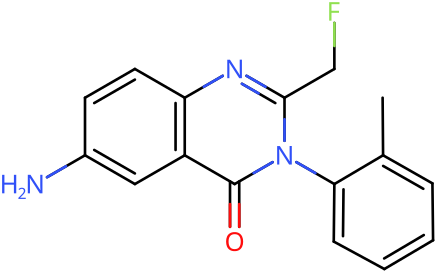
Afloqualone Stats & Data
FCc1nc2ccc(N)cc2c(=O)n1c1ccccc1CVDOSWXIDETXFET-UHFFFAOYSA-NPharmacology
DrugBankMetabolism
Afloqualone has known human metabolites that include Afloqualone N-glucuronide.
Receptor Profile
Receptor Actions
Tolerance & Pharmacokinetics
drugs.wikiNo tolerance chart. Our decay curves for these drugs were estimates, and a curve can make tolerance look longer-lasting than it is, which is the dangerous direction.
How fast tolerance to these drugs fades after a break has not been measured well enough to draw, so don't count on a dose you used to take still being safe: after time off, start with a much smaller amount and don't use alone. Mixing sedatives with each other, with alcohol or with opioids sharply raises the risk of a fatal overdose. If you've been using regularly, don't stop suddenly: withdrawal from benzodiazepines, alcohol or GHB/GBL can cause seizures or delirium, so get medical help to cut down gradually.
Sources: FRANK: benzodiazepines · Alcohol and Drug Foundation: GHB · FDA 2020: benzodiazepine boxed warning · FDA 2019: gabapentinoids and breathing · NHS: alcohol use disorder
Cross-Tolerances
Harm Reduction
drugs.wiki• Strong photosensitizer: drugbank classifies afloqualone under photosensitizing and radiation‑sensitizing agents; minimize UVA/UVB exposure during use and for at least 24–48 h after, wear protective clothing, and use broad‑spectrum high‑SPF sunscreen. Severe phototoxic or photoallergic dermatitis can occur; discontinue and seek medical care if rash or blistering appears. • As a CNS depressant and centrally acting muscle relaxant, it can synergize dangerously with other depressants (alcohol, opioids, GHB, benzodiazepines, barbiturates, carisoprodol, and Z‑drugs), markedly increasing risk of respiratory depression, aspiration, and loss of consciousness. • Do not drive, swim, climb, or operate machinery on the day of use; ataxia and delayed psychomotor impairment are common at moderate/high doses and have been associated with falls and accidents in the broader GABAergic class. • Tramadol is specifically risky due to its pro‑convulsant and serotonergic properties; avoid co‑use. • Consider additive photosensitivity if taking other photosensitizing medicines (e.g., tetracyclines, quinolones, thiazide diuretics, retinoids, psoralens); avoid tanning beds and medical phototherapy around dosing. • Human pharmacokinetics are poorly characterized in standard references; half‑life and active metabolites are not well established, so redosing can unpredictably increase sedation the following hours. • Treat suspected overdose with supportive care (airway, breathing, circulation); naloxone will not help (non‑opioid). Flumazenil reverses benzodiazepines at the BZD site and is generally ineffective against non‑benzodiazepine GABA_A modulators; routine use is not recommended due to seizure risk. • As an obscure/RC compound, identity and potency can vary; prefer lab testing where available. If only reagents are available, note that methaqualone‑class reagents are limited and may be non‑specific—interpret cautiously. • Best‑practice dosing includes an allergy test (1–5 mg) and accurate measurement (milligram scale or volumetric dosing) to avoid inadvertent overdosing.
References
Data Sources
Cited References
- Bluelight: discussion - Afloqualone thread (user reports, 2015)
- Kawamura et al., Coma and seizure caused by afloqualone overdose, Pediatrics International 2019
- Nishimura et al., Photosensitizing Activities of Afloqualone, Jpn. J. Pharmacol. 1984
- Ochiai & Ishida, Pharmacological studies on afloqualone, Jpn. J. Pharmacol. 1982
- PubChem: CID 234274 - Afloqualone compound summary
- TripSit: data sheet – Afloqualone
- Reddit: /r/ObscureDrugs – Afloqualone experiences (2023)
Additional references
- DrugBank – Afloqualone monograph (DB21759)
- DrugBank – Photosensitizing & Radiation‑sensitizing agent categories
- TripSit – main site and factsheets index
- Reddit r/ObscureDrugs – Afloqualone experiences (2020, 2023)
- Bluelight – Afloqualone/qualone threads (user reports, 2015–2024)
- NCBI Bookshelf – Benzodiazepine toxicity/overdose & flumazenil limitations
- DrugBank – Flumazenil pharmacodynamics
- StatPearls – Physiology, GABA (respiratory depression with multiple GABA modulators)
- StatPearls – Tramadol (seizure risk, serotonin syndrome; respiratory depression)
- NCBI Bookshelf – Medicines with photosensitising effect (examples by class)
- StatPearls – Polymorphic Light Eruption (UVA often causative; general phototoxicity precautions)