
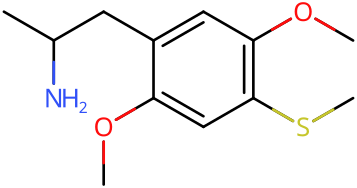
ALEPH Stats & Data
COc1cc(CC(C)N)c(OC)cc1SCCOBYBOVXXDQRAU-UHFFFAOYSA-NReceptor Profile
Receptor Actions
History & Culture
ALEPH holds a notable place in psychedelic chemistry as the first sulfur-containing phenethylamine to be evaluated for central nervous system activity, specifically for its potential stimulant or psychedelic properties. This pioneering incorporation of a methylthio group at the 4-position of the amphetamine structure opened a new avenue of exploration in psychoactive compound development. The substance derives its name from the first letter of the Hebrew alphabet, a designation chosen to reflect the potentially extraordinary properties shared by this structural class. Despite its historical significance as a founding member of this series, ALEPH itself remains relatively unexplored compared to its derivatives. The compound has two positional isomers, known as ortho-DOT and meta-DOT, though these have received even less investigation. The structural insights gained from ALEPH proved more valuable than the compound itself. Three higher homologues in the ALEPH series received more thorough examination, but the most significant developments came from exploring the two-carbon homologues, which led to the creation of the 2C-T family of compounds.
Effect Profile
Curated + 2 ReportsStrong visuals with moderate body load, mild headspace
Strong euphoria and sensory enhancement with moderate stimulation, low empathy
Strong euphoria with strong anxiety/jitters, mild stimulation and focus
Tolerance & Pharmacokinetics
drugs.wikiTolerance Decay
Pattern inferred from general classic psychedelic tolerance (rapid acute tolerance; partial cross-tolerance), sparse ALEPH-specific data; schedule ≥7–14 days between uses to reduce blunted effects.
Cross-Tolerances
Experience Report Analysis
ErowidDemographics
Gender Distribution
Too few reports for a chart: gender is known from 3 reports, and a split is drawn only from 20 reports or more. Counts are shown instead. Why 20?
- Not Specified 1 of 3
- Male 2 of 3
Age Distribution
Reports Over Time
Harm Reduction
drugs.wikiEvidence base is minimal: PiHKAL reports 5–10 mg oral with 6–8 h; plan conservatively and expect variability. The ALEPH family (e.g., ALEPH-2) shows erratic dose–response between individuals, so precise measurement and allergy testing (≤1 mg) are prudent. Slow onset (often >60 min) means redosing early can inadvertently create an overlong, overintense experience; wait at least 3–4 h before any change in dose. Driving and hazard work should be avoided for the entire active period and until baseline the next day—Shulgin notes basic tasks became ‘impossible’ at 10 mg. As a substituted amphetamine, sympathetic effects (tachycardia, mild hypertension, mydriasis, jaw tension) can occur; people with cardiovascular disease, uncontrolled hypertension, or a seizure disorder should avoid. Avoid non-oral routes; some sulfur-containing phenethylamines (e.g., 2C‑T‑7) have produced severe events and deaths when insufflated—while not the same drug, this signals risk for this structural family and argues strongly against nasal/IM/IV use. Combining with MAOIs is dangerous (unpredictable potentiation of monoamine effects); tramadol raises seizure and serotonin-syndrome risk; lithium and tricyclics have produced dangerous reactions with classical psychedelics—avoid. Because the substance is rare and markets are unregulated, adulteration/mislabeling is a significant risk: use professional drug checking (FTIR/GC-MS) where available; reagent kits are only preliminary screens. Set, setting, sleep, and nutrition matter: plan 12–24 h with no obligations, maintain light electrolytes, sip water regularly but avoid overhydration, and have a trusted sober sitter for first trials. Tolerance builds acutely and partially cross-tolerates with other psychedelics; allow at least 7–14 days between sessions to regain sensitivity. Very little pharmacokinetic data exist; half-life is unknown, so avoid stacking doses or combining with other stimulants.
References
Data Sources
Cited References
- Acuna-Castillo et al. 2000 - ALEPH-2 5-HT2a and 5-HT2c receptor agonism
- Cassels et al. 2005 - MAO-A inhibitory activity study
- Erowid PiHKAL Entry #3: ALEPH
- Halberstadt 2023 - DOx compounds structure-activity relationships
- PsychonautWiki: DOx
- Wikipedia: Aleph (psychedelic)
- IsomerDesign PiHKAL: Aleph
- Isomer Design: 3
Additional references
- PiHKAL #3 ALEPH (dose 5–10 mg; duration 6–8 h; qualitative notes incl. ‘driving would be impossible’)
- PiHKAL #4 ALEPH‑2 (notes erratic dose–response across the ALEPH family)
- Erowid MAOI Vault – Drugs to Avoid (serotonergic combinations, serotonin syndrome risk)
- TripSit Drug Combinations (DOx/cannabis caution; dissociatives potentiate; tramadol unsafe; stimulants caution)
- TripSit LSD factsheet (dangerous reactions reported with lithium and tricyclic antidepressants—general psychedelic caution)
- Erowid 2C‑T‑7 – Insufflation fatalities and warnings (structural family caution re: non‑oral ROAs)
- Erowid 2C‑T‑7 – death reports and pharmacology discussion (convulsions/seizure concerns when insufflated)
- Erowid Experience Vaults: ALEPH (rarity; limited human data)
- Drug checking services (Ontario/Canada) – FTIR/GC-MS overview and access points