
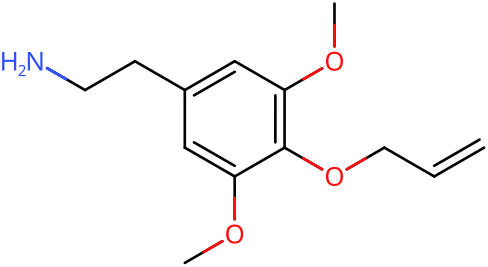
Allylescaline Stats & Data
NCCc1cc(OC)c(OCC=C)c(OC)c1JNUAYHHGCXYBHX-UHFFFAOYSA-NReceptor Profile
Receptor Actions
History & Culture
Allylescaline was first documented in the scientific literature by Czech chemist Otakar Leminger in 1972. The compound received broader attention when American chemist Alexander Shulgin synthesized and characterized its psychoactive effects, publishing his findings in the 1991 book PiHKAL: A Chemical Love Story. In PiHKAL, Shulgin described allylescaline's subjective effects and established dosage parameters based on his bioassay methodology. The compound remained relatively obscure for over two decades following PiHKAL's publication. It emerged on the research chemical market in 2013, when it was identified as a novel designer drug being sold online. This appearance prompted regulatory responses in several countries during the mid-2010s.
Subjective Effects
Physical
- Spontaneous tactile sensations
- Stimulation
- Nausea
- Tactile enhancement
- Bodily control enhancement
- Pupil dilation
- Wakefulness
- Physical euphoria
Cognitive
- Emotion enhancement
- Thought acceleration
- Novelty enhancement
- Time distortion
- Analysis enhancement
- Personal bias suppression
- Conceptual thinking
- Immersion enhancement
- Memory suppression
- Thought loops
- Thought disorganization
- Unity and interconnectedness
Sensory
- Enhancements
- Distortions
- Hallucinations
- Drifting: (melting, flowing, breathing and morphing)
- Tracers
- After images
- Symmetrical texture repetition
- Colour shifting
- Acuity enhancement
- Colour enhancement
- Pattern recognition enhancement
- Transformations
Forked from Subjective Effect Documentation work by Josie Kins, August 2016. Via dose.wiki (CC0).
Toxicity
PsychonautWikiThe toxicity and long-term health effects of recreational allylescaline use do not seem to have been studied in any scientific context and the exact toxic dose is unknown. This is because allylescaline is a research chemical with very little history of human usage. Anecdotal evidence from people within the psychonaut community who have tried allylescaline suggests that there are no negative health effects attributed to simply trying the drug by itself at low to moderate doses and using it very sparingly (but nothing can be completely guaranteed). Independent research should always be done to ensure that a combination of two or more substances is safe before consumption. It is strongly recommended that one use harm reduction practices when using this drug.
Effect Profile
Curated + 8 ReportsStrong visuals, headspace, and auditory effects with moderate body load
Tolerance & Pharmacokinetics
drugs.wikiTolerance Decay
Experience Report Analysis
ErowidDemographics
Gender Distribution
Age Distribution
Reports Over Time
Effect Analysis
ErowidEffects aggregated from 8 experience reports (8 single-substance Erowid)
Effect Sentiment Distribution
Confidence Distribution
Each bar is the share of reports mentioning the effect; its whisker, and the band on the rows below, is the 95% interval: where the share could plausibly be with other reports of the same kind.
Too few reports for bars: these effects come from 8 single-substance Erowid reports, and a bar is drawn only from 20 reports or more. With fewer, a percentage cannot tell a common effect from a rare one. Counts are shown instead. Why 20?
Positive Effects 6
Adverse Effects 1
Also reported in combinations. In the 12 Allylescaline reports where another drug was taken too, 1 mentions hospital, emergency services or an overdose, 0 a seizure and 1 psychosis (too few reports for percentages). In the 8 single-substance reports: 1, 0 and 1. These are not in the figures above: they cannot be put down to Allylescaline alone, and a mention is not always something that happened to the writer.
Dosage Distribution
Dose distribution from experience reports, one dose per report (the first listed). Doses above Q3 + 3×IQR, far above what people typically take, are left out of the median and range and listed under each route: most are real heavy doses or overdoses, not mistakes.
Real-World Dose Distribution
ErowidFrom 32 of 33 recorded dose entries: those that state a weight (mg, g or µg), in routes with at least five of them. Values above Q3 + 3×IQR, far above what people typically take, are left out; they can include real heavy doses and overdoses, not only mistakes.
Oral (n=30)
Common Combinations
Most co-occurring substances, as a share of all 20 reports filed under Allylescaline; whiskers are 95% intervals
Form / Preparation
Most common forms and preparations, as a share of the 15 reports that give one
Too few reports for bars: these forms come from 15 reports, and a bar is drawn only from 20 reports or more. With fewer, a percentage cannot tell a common effect from a rare one. Counts are shown instead. Why 20?
- Powder / Crystals 7 of 15
- Capsule 6 of 15
- Liquid 2 of 15
Body-Weight Dosing
Dose per kg of body weight, one dose per report (the first listed), from reports giving a weight of 30–250 kg. Doses above Q3 + 3×IQR, far above what people typically take, are left out of the median and range and listed under each route.
Redose Patterns
Redosing behavior across 15 reports
Too few reports for a chart: redosing is known from 15 reports, and a split is drawn only from 20 reports or more. Counts are shown instead. Why 20?
- Single dose 11 of 15
- Redosed 4 of 15
Legal Status
| Country | Status | Notes |
|---|---|---|
| Germany | Anlage I BtMG | Controlled under the Narcotics Act (Betäubungsmittelgesetz) Schedule I since February 1, 1997, listed as '4-Allyloxy-3,5-dimethoxy-phenethylazan'. Manufacturing, possession, import, export, purchase, sale, procurement, and dispensation without a license are prohibited. |
| Japan | Controlled substance | Designated as a controlled substance effective March 25, 2015. |
| Sweden | Illegal | Classified as an illegal substance since January 2016. |
| Switzerland | Controlled (Verzeichnis E) | Specifically named and controlled under Verzeichnis E of Swiss narcotics legislation. |
| United Kingdom | Illegal (Psychoactive Substances Act) | Production, supply, and import prohibited under the Psychoactive Substances Act 2016, which came into effect on May 26, 2016. |
| United States | Unscheduled | Not directly scheduled under the Controlled Substances Act. However, due to structural similarities with mescaline, sale for human consumption or use for illicit purposes could potentially be prosecuted under the Federal Analogue Act. |