
Amitriptyline Stats & Data
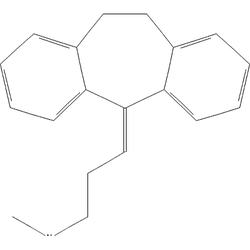
CN(C)CCC=C1c2ccccc2CCc2ccccc12KRMDCWKBEZIMAB-UHFFFAOYSA-NPharmacology
DrugBankDescription
Amitriptyline hydrochloride, also known as _Elavil_, is a tricyclic antidepressant (TCA) with analgesic properties, widely used to treat depression and neuropathic pain . It was originally approved by the FDA in 1977 and manufactured by Sandoz .
Mechanism of Action
The mechanism of action of this drug is not fully elucidated. It is suggested that amitriptyline inhibits the membrane pump mechanism responsible for the re-uptake of transmitter amines, such as norepinephrine and serotonin, thereby increasing their concentration at the synaptic clefts of the brain , . These amines are important in regulating mood. The monoamine hypothesis in depression, one of the oldest hypotheses, postulates that deficiencies of serotonin (5-HT) and/or norepinephrine (NE) neurotransmission in the brain lead to depressive effects . This drug counteracts these mechanisms, and this may be the mechanism of amitriptyline in improving depressive symptoms. Whether its analgesic effects are related to its mood-altering activities or attributable to a different, less obvious pharmacological action (or a combination of both) is unknown .
Pharmacodynamics
**Effects in pain and depression** Amitriptyline is a tricyclic antidepressant and an analgesic. It has anticholinergic and sedative properties . Clinical studies have shown that oral amitriptyline achieves, at a minimum, good to moderate response in up to 2/3 of patients diagnosed with post-herpetic neuralgia and 3/4 of patients diagnosed with diabetic neuropathic pain, and neurogenic pain syndromes that are frequently unresponsive to narcotic analgesics. Amitriptyline has also shown efficacy in diverse groups of patients with chronic non-malignant pain. There have also been some studies showing efficacy in managing fibromyalgia (an off-label use of this drug) , . **Cardiovascular and Anticholinergic Effects** Amitriptyline has strong anticholinergic properties and may cause ECG changes and quinidine-like effects on the heart . Amitriptyline may inhibit ion channels, which are necessary for cardiac repolarization (hERG channels), in the upper micromolar range of therapeutic plasma concentrations. Therefore, amitriptyline may increase the risk for cardiac arrhythmia . Orthostatic hypotension and tachycardia can be a problem in elderly patients receiving this drug at normal doses for depression. There is evidence in the literature that these effects may occur, rarely, at the lower dosages utilized in the treatment of pain.
Metabolism
In vitro, the metabolism of amitriptyline occurs mainly by demethylation (CYP2C19, CYP3A4) as well as hydroxylation (CYP2D6) followed by conjugation with glucuronic acid. Other isozymes involved in amitriptyline metabolism are CYP1A2 and CYP2C9. The metabolism of this drug is subject to genetic polymorphisms. The main active metabolite is the secondary amine, _nortriptyline_ . Nortriptyline is a stronger inhibitor of noradrenaline than of serotonin uptake, while amitriptyline inhibits the uptake of noradrenaline and serotonin with equal efficacy. Other metabolites such as _cis-_ and _trans-10-hydroxyamitriptyline_ and _cis-_ and _trans-10-hydroxynortriptyline_ have the same pharmacologic profile as nortriptyline but are significantly weaker. _Demethylnortriptyline_ and amitriptyline N oxide are only present in plasma in negligible amounts; the latter is mostly inactive .
Absorption
Rapidly absorbed following oral administration (bioavailability is 30-60% due to first pass metabolism). Peak plasma concentrations are reached 2-12 hours after oral or intramuscular administration . Steady-state plasma concentrations vary greatly and this variation may be due to genetic differences .
Indication
This drug in indicated for the following conditions : Major depressive disorder in adults Management of neuropathic pain in adults Prophylactic treatment of chronic tension-type headache (CTTH) in adults Prophylactic treatment of migraine in adults Treatment of nocturnal enuresis in children aged 6 years and above when organic pathology, including spina bifida and related disorders, have been excluded and no response has been achieved to all other non-drug and drug treatments, including antispasmodics and vasopressin-related products. This product should only be prescribed by a healthcare professional with expertise in the management of persistent enuresis Off-label uses: irritable bowel syndrome, sleep disorders, diabetic neuropathy, agitation, fibromyalgia, and insomnia
Half-life
The elimination half-life (t1⁄2 β) amitriptyline after peroral administration is about 25 hours (24.65 ± 6.31 hours; range 16.49-40.36 hours) .
Protein Binding
Very highly protein bound (95%) in plasma and tissues .
Elimination
Amitriptyline and its metabolites are mainly excreted in the urine. Virtually the entire dose is excreted as glucuronide or sulfate conjugate of metabolites, with approximately 2% of unchanged drug appearing in the urine . 25-50% of a single orally administered dose is excreted in urine as inactive metabolites within 24 hours . Small amounts are excreted in feces via biliary elimination .
Volume of Distribution
The apparent volume of distribution (Vd)β estimated after intravenous administration is 1221 L±280 L; range 769-1702 L (16±3 L/kg) . It is found widely distributed throughout the body . Amitriptyline and the main metabolite _nortriptyline_ pass across the placental barrier and small amounts are present in breast milk .
Clearance
The mean systemic clearance (Cls) is 39.24 ± 10.18 L/h (range: 24.53-53.73 L/h) . No clear effect of older age on the pharmacokinetics of amitriptyline has been determined, although it is possible that clearance may be decreased .
Measured Affinities
Guide to PHARMACOLOGYMeasured binding and functional data for amitriptyline, curated by the IUPHAR/BPS Guide to PHARMACOLOGY. Each row cites the paper it came from. Lower concentrations mean tighter binding — a value in the sub-nanomolar range indicates a very potent interaction.
| Target | Action | Measure | Value | Concentration | Species | Source |
|---|---|---|---|---|---|---|
| H1 receptor HRH1 | Antagonist | pKi | 9.3 | 0.501 nM | Human | PMID 16782354 |
| 5-HT2A receptor Htr2a | Antagonist | pKi | 8.4 | 3.98 nM | Rat | PMID 8876023 |
| α1A-adrenoceptor ADRA1A | Antagonist | pKi | 8.2 | 6.31 nM | Human | PMID 32608144 |
| M4 receptor CHRM4 | Antagonist | pKi | 8.14 | 7.24 nM | Human | PMID 8100134 |
| 5-HT2C receptor Htr2c | Antagonist | pKi | 8.1 | 7.94 nM | Rat | PMID 10379421 |
| 5-HT2A receptor Htr2a | Antagonist | pKi | 7.96 | 10.96 nM | Rat | PMID 10379421 |
| M2 receptor CHRM2 | Antagonist | pKi | 7.93 | 11.75 nM | Human | PMID 8100134 |
| M3 receptor CHRM3 | Antagonist | pKi | 7.89 | 12.88 nM | Human | PMID 8100134 |
| M1 receptor CHRM1 | Antagonist | pKi | 7.83 | 14.79 nM | Human | PMID 8100134 |
| M5 receptor CHRM5 | Antagonist | pKi | 7.8 | 15.85 nM | Human | PMID 8100134 |
| SERT SLC6A4 | Inhibition | pKi | 6.85 | 141.25 nM | Human | PMID 23602445 |
| NET SLC6A2 | Inhibition | pKi | 6.48 | 331.13 nM | Human | PMID 23602445 |
| 5-HT7 receptor Htr7 | Antagonist | pKi | 6.4 | 398.11 nM | Mouse | PMID 8394987 |
| LPA1 receptor LPAR1 | Antagonist | pIC50 | 6.22 | 602.56 nM | Human | PMID 32007501 |
| Kir3.2 Kcnj6 | Antagonist | pIC50 | 4 | 100,000 nM | Mouse | PMID 15150531 |
| Kir3.4 Kcnj5 | Antagonist | pIC50 | 3.6 | 251,189 nM | Mouse | PMID 15150531 |
| 5-HT6 receptor Htr6 | Antagonist | pKi | — | — | Rat | — |
| 5-HT6 receptor HTR6 | Antagonist | pKi | — | — | Human | — |
| 5-HT7 receptor Htr7 | Antagonist | pKi | — | — | Rat | PMID 8394362 |
Reading this. pKi, pEC50 and pIC50 are negative log molar values, so a higher number means a tighter interaction; the concentration column converts them for you. Values from non-human species are laboratory measurements and do not translate directly to human effect. Receptor affinity is not a dose — it describes what a molecule binds, not how much of it is safe to take.
Receptor data from the IUPHAR/BPS Guide to PHARMACOLOGY (v2026.2), licensed CC BY-SA 4.0. Matched to this substance by InChIKey.
Symptoms of overdose/poisoning may include the following: hypothermia, respiratory depression, seizures, abnormal tendon reflexes, disorientation, agitation, myoclonic jerks, coma, pyramidal signs, arrhythmias, bundle branch block, cardiac arrest, hypotension, circulatory collapse, mydriasis, blurred vision, tachycardia, vasodilation, urinary retention, decreased gastrointestinal motility, decreased bronchial secretions, and dry mucous membranes and skin.
LD50
LD50: 350 mg/kg (Oral, Mouse) (A308)
Carcinogenicity
No indication of carcinogenicity to humans (not listed by IARC).
Health effects (PubChem excerpts)
Some rare side effects include tinnitus, hypotension, mania, psychosis, heart block, arrhythmias, lip and mouth ulcers, extrapyramidal symptoms, depression, and hepatic toxicity.Amitriptyline exhibits strong anticholinergic activity, cardiovascular effects including orthostatic hypotension, changes in heart rhythm and conduction, and a lowering of the seizure threshold (A308, L1032).
Tolerance & Pharmacokinetics
drugs.wikiTolerance Decay
Experience Report Analysis
ErowidDemographics
Gender Distribution
Age Distribution
Reports Over Time
Effect Analysis
ErowidEffects aggregated from 25 experience reports (25 single-substance Erowid)
Effect Sentiment Distribution
Confidence Distribution
Each bar is the share of reports mentioning the effect; its whisker, and the band on the rows below, is the 95% interval: where the share could plausibly be with other reports of the same kind.
Positive Effects 5
Adverse Effects 4
Show 1 neutral or unclassified mention
Also reported in combinations. In the 14 Amitriptyline reports where another drug was taken too, 3 mention hospital, emergency services or an overdose, 1 a seizure and 1 psychosis (too few reports for percentages). In the 25 single-substance reports: 8.0%, 0.0% and 0.0%. These are not in the figures above: they cannot be put down to Amitriptyline alone, and a mention is not always something that happened to the writer.
Dosage Distribution
Dose distribution from experience reports, one dose per report (the first listed). Doses above Q3 + 3×IQR, far above what people typically take, are left out of the median and range and listed under each route: most are real heavy doses or overdoses, not mistakes.
3 reports gave a dose above the typical range (700–875 mg), so they are not in the figures above. 3 of them mention hospital, emergency services or an overdose. Listing a dose here does not mean it is safe.
Real-World Dose Distribution
ErowidFrom 101 of 111 recorded dose entries: those that state a weight (mg, g or µg), in routes with at least five of them. Values above Q3 + 3×IQR, far above what people typically take, are left out; they can include real heavy doses and overdoses, not only mistakes.
Oral (n=95)
Common Combinations
Most co-occurring substances, as a share of all 39 reports filed under Amitriptyline; whiskers are 95% intervals
Form / Preparation
Most common forms and preparations, as a share of the 22 reports that give one; whiskers are 95% intervals
Body-Weight Dosing
Dose per kg of body weight, one dose per report (the first listed), from reports giving a weight of 30–250 kg. Doses above Q3 + 3×IQR, far above what people typically take, are left out of the median and range and listed under each route.
2 reports gave a dose above the typical range (8.816–11.698 mg/kg), so they are not in the figures above. 2 of them mention hospital, emergency services or an overdose. Listing a dose here does not mean it is safe.
Show the reports
- 11.698 mg/kg · another drug taken too · mentions hospital, emergency services or an overdose
- 8.816 mg/kg · mentions hospital, emergency services or an overdose
Redose Patterns
Redosing behavior across 36 reports