
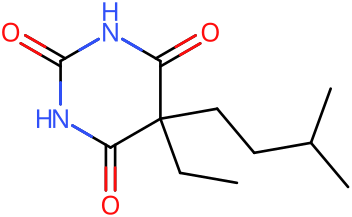
Amobarbital Stats & Data
VIROVYVQCGLCII-UHFFFAOYSA-NPharmacology
DrugBankDescription
A barbiturate with hypnotic and sedative properties (but not antianxiety). Adverse effects are mainly a consequence of dose-related CNS depression and the risk of dependence with continued use is high. (From Martindale, The Extra Pharmacopoeia, 30th ed, p565)
Mechanism of Action
Amobarbital (like all barbiturates) works by binding to the GABAA receptor at either the alpha or the beta sub unit. These are binding sites that are distinct from GABA itself and also distinct from the benzodiazepine binding site. Like benzodiazepines, barbiturates potentiate the effect of GABA at this receptor. This GABAA receptor binding decreases input resistance, depresses burst and tonic firing, especially in ventrobasal and intralaminar neurons, while at the same time increasing burst duration and mean conductance at individual chloride channels; this increases both the amplitude and decay time of inhibitory postsynaptic currents. In addition to this GABA-ergic effect, barbiturates also block the AMPA receptor, a subtype of glutamate receptor. Glutamate is the principal excitatory neurotransmitter in the mammalian CNS. Amobarbital also appears to bind neuronal nicotinic acetylcholine receptors.
Receptor Profile
Receptor Actions
Receptor Binding
History & Culture
1923–1980s
Amobarbital was first synthesized in Germany in 1923, emerging as a short to intermediate acting barbiturate derivative. The compound gained commercial prominence through Eli Lilly and Company, which manufactured it in the United States under the brand name Amytal. The medication was distinctively presented in bright blue bullet-shaped capsules called Pulvules, as well as pink tablets known as Diskets. Eli Lilly also produced Tuinal, a combination product containing equal quantities of amobarbital and secobarbital, which remained in production until the late 1990s. The standalone Amytal product was discontinued in the 1980s as benzodiazepines emerged as the preferred class of sedative-hypnotic medications.
When administered slowly by intravenous route, sodium amobarbital developed a reputation as a so-called "truth serum." This application was first employed clinically by William Bleckwenn at the University of Wisconsin, who used the drug to circumvent inhibitions in psychiatric patients during therapeutic sessions. The United States armed forces utilized amobarbital during World War II in attempts to treat shell shock, with the goal of returning affected soldiers to front-line duties. This military application was subsequently discontinued.
Amobarbital became associated with several notable deaths in the entertainment industry. On the night of August 28, 1951, American actor Robert Walker died at 32 years old after his psychiatrist administered amobarbital for sedation while Walker was allegedly drinking. In 1968, British actor and comedian Tony Hancock died by suicide in Australia using amobarbital in combination with alcohol. The drug was widely abused during its period of commercial availability. Its distinctive blue capsules gave rise to numerous street names including "blues," "blue angels," "blue birds," "blue devils," and "blue heavens."
Toxicity
PubChemAmobarbital (like all barbiturates) works by binding to the GABAA receptor at either the alpha or the beta sub unit. These are binding sites that are distinct from GABA itself and also distinct from the benzodiazepine binding site.
Carcinogenicity
No indication of carcinogenicity to humans (not listed by IARC).
Tolerance & Pharmacokinetics
drugs.wikiNo tolerance chart. Our decay curves for these drugs were estimates, and a curve can make tolerance look longer-lasting than it is, which is the dangerous direction.
How fast tolerance to these drugs fades after a break has not been measured well enough to draw, so don't count on a dose you used to take still being safe: after time off, start with a much smaller amount and don't use alone. Mixing sedatives with each other, with alcohol or with opioids sharply raises the risk of a fatal overdose. If you've been using regularly, don't stop suddenly: withdrawal from benzodiazepines, alcohol or GHB/GBL can cause seizures or delirium, so get medical help to cut down gradually. With barbiturates, you get used to the effects much more than to a dangerous dose, so the gap between a dose that works and one that kills shrinks the more you use. Stopping suddenly after regular use can cause convulsions and delirium.
Sources: FRANK: benzodiazepines · Alcohol and Drug Foundation: GHB · FDA 2020: benzodiazepine boxed warning · FDA 2019: gabapentinoids and breathing · NHS: alcohol use disorder · Phenobarbital label: drug abuse and dependence
Cross-Tolerances
Legal Status
| Country | Status | Notes |
|---|---|---|
| Canada | Controlled substance (historical prescription use) | Previously marketed as combination products (Tuinal) containing amobarbital sodium with secobarbital sodium. These products were discontinued in 2004. Current status follows standard controlled substance scheduling for barbiturates. |
| United States | Controlled substance (prescription only) | Classified as 'Approved' and 'Illicit' in pharmaceutical databases, indicating recognized medical use alongside controlled substance status. Marketed as Amytal Sodium, a prescription injectable product for intramuscular and intravenous administration. |
Harm Reduction
drugs.wikiAmobarbital (formerly sold as Amytal and as half of Tuinal) is an intermediate-acting barbiturate that potentiates and directly activates GABA_A receptors. The therapeutic index is narrow, and short-acting/intermediate barbiturates (incl. amobarbital) have caused fatal respiratory depression at gram-level doses; historical data place lethal doses around 2–3 g without other depressants. Because elimination is variable (reports spanning roughly 8–40 h), next-day cognitive/motor impairment is common; EU drugs data warn that impairment of judgment and fine motor skills (e.g., driving) can persist up to ~22 h after a hypnotic dose. Combining with any CNS depressant dramatically amplifies overdose risk, and there is no specific antidote for barbiturates; naloxone only helps if an opioid was also taken. In suspected overdose, do not attempt to ‘wake’ someone with stimulants; place them in the recovery position, monitor breathing, and call emergency services; clinicians may give naloxone if opioid co‑ingestion is suspected and provide airway/ventilatory support. Parenteral sodium amobarbital is alkaline; IM injections should be deep in large muscles to avoid local necrosis, and IV extravasation can cause tissue injury. Barbiturates induce CYP enzymes (notably CYP1A2, 2B6, 2C9, 3A4); this can reduce the effectiveness of many medicines including systemic hormonal contraception—use reliable non‑hormonal backup. Barbiturates can precipitate attacks in acute porphyria; avoid entirely if there is a history of porphyria. Repeated daily use for a week or more can generate severe dependence; abrupt cessation requires a medically supervised taper to prevent life‑threatening withdrawal. Barbiturates readily cross the placenta and enter breast milk; neonatal sedation/withdrawal has been reported—avoid in pregnancy/breastfeeding unless explicitly indicated and monitored.
References
Cited References
- Bluelight: Amobarbital 25 mg tablets, recommended dose?
- Clarke's Analysis of Drugs and Poisons, 4th Ed.
- DailyMed: Amytal Sodium (amobarbital) label
- Drugs.com – Amytal Sodium Package Insert
- Erowid: Amobarbital Vault
- PubChem: Amobarbital (CID 2164)
- PsychonautWiki: Barbiturates
- PsychonautWiki: Dangerous Combinations
- TripSit: Amobarbital
- DrugBank: Amobarbital (DB00321)
Additional references
- Barbiturate Toxicity – StatPearls (Last updated Feb 28, 2024)
- Barbiturates – StatPearls (includes amobarbital dosing, enzyme induction, injection guidance)
- EUDA (EMCDDA) Drug Profile – Barbiturates (overdose lethality, residual impairment)
- TripSit – Drug combinations chart (general depressant interaction risks)
- Erowid – Types of Barbiturates (names/branding, class)
- Erowid – Barbiturates Drug Testing (urine detection windows)
- hi‑ground – Safer injecting notes (wheel filters, sterile technique)