
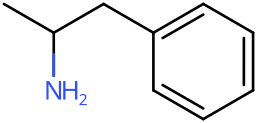
Amphetamine Stats & Data
CC(CC1=CC=CC=C1)NKWTSXDURSIMDCE-UHFFFAOYSA-NInteraction Warnings
Amphetamine can be potentially dangerous in combination with other stimulants as it can increase one's heart rate and blood pressure to dangerous levels.
Amphetamine may increase the effects of tricyclic antidepressants to dangerous levels.
The neurotoxic effects of MDMA may be increased when combined with amphetamines.
This combination may increase strain on the heart.
Pharmacology
DrugBankDescription
Amphetamine, a compound discovered over 100 years ago, is one of the more restricted controlled drugs. It was previously used for a large variety of conditions and this changed until this point where its use is highly restricted. Amphetamine, with the chemical formula alpha-methylphenethylamine, was discovered in 1910 and first synthesized by 1927. After being proven to reduce drug-induced anesthesia and produce arousal and insomnia, amphetamine racemic mix was registered by Smith, Kline and French in 1935. Amphetamine structure presents one chiral center and it exists in the form of dextro- and levo-isomers. The first product of Smith, Kline and French was approved by the FDA on 1976. During World War II, amphetamine was used to promote wakefulness in the soldiers. This use derived into a large overproduction of amphetamine and all the surplus after the war finalized ended up in the black market, producing the initiation of the illicit abuse.
Mechanism of Action
It is important to consider that amphetamine has a very similar structure to the catecholamine neurotransmitters mainly on the presence of a long planar conformation, the presence of an aromatic ring and nitrogen in the aryl side chain. Amphetamine, as well as other catecholamines, is taken into presynaptic nerve terminals by the association with two sodium ions and one chloride ion. The complex of the amphetamine with the ions is actively transported by monoamine reuptake transporters. As amphetamine acts competitively with the endogenous monoamines, the greater the number of amphetamines the more internalized amphetamine will be found. Once inside the presynaptic terminal, amphetamine displaces other monoamines to be stored by VMAT2 which produces the pumping of the neurotransmitters into the synapse by a process called retro-transport. This process of release of neurotransmitters is approximately fourfold more potent in the d-isomer for the release of dopamine. The mechanism of action of amphetamine is complemented by the inhibition of the reuptake and of monoamine oxidase which acts synergistically to produce a significant increase the monoamine concentration. This activity is not done as an inhibitor per se but more as a competitive substrate and thus, amphetamine is known to be a weak dopamine reuptake inhibitor, moderate noradrenaline reuptake inhibitor and very weak serotonin reuptake inhibitor.
Pharmacodynamics
From its mechanism of action, it has been demonstrated that amphetamine augments the concentration of noradrenaline in the prefrontal cortex and dopamine in the striatum on a dose and time-dependent manner. The indistinct release of neurotransmitters which include adrenaline is known to produce cardiovascular side effects. There are old reports of a cognitive enhancement related to the administration of amphetamine in which improvements in intelligence test scores were reported. In ADHD, amphetamine has been largely showed to produce remarkable improvements in school performance, behavior, and demeanor. The effect was shown to be produced through both racemic forms and to this date, the use of racemic forms 3:1 (D:L) is very common. The therapeutic effect of amphetamine on serotonin does not seem to have a significant clinical effect on ADHD as observed on comparative studies with amphetamine and fenfluramine, a powerful serotonin releasing factor. However, the indirect effect on serotonin might have an effect on the depression and anxiety profile of ADHD. Studies regarding the illicit use of amphetamine in which heavy consumers were studied proved the generation of a paranoid state which flagged this drug as a psychiatric danger compound. This observation was supported by the continuous reports of misuse in patients under depression.
Metabolism
Amphetamine is known to be metabolized by the liver under the action of the CYP2D6. The metabolic pathway of amphetamine is mainly defined by aromatic hydroxylation, aliphatic hydroxylation, and n-dealkylation. The formed metabolites in this pathway are 4-hydroxyamphetamine, 4-hydroxynorephedrine, hippuric acid, benzoic acid, benzyl methyl ketone, and p-hydroxyamphetamine which is known to be a potent hallucinogen. However, a significant part of the original compound remains unchanged.
Absorption
Amphetamine is well absorbed in the gut and as it is a weak base hence the more basic the environment the more of the drug is found in a lipid-soluble form and the absorption through lipid-rich cell membranes is highly favored. The peak response of amphetamine occurs 1-3 hours after oral administration and approximately 15 minutes after injection and it presents a bioavailability of over 75%. Complete amphetamine absorption is usually done after 4-6 hours.
Indication
Amphetamine is indicated for the treatment of attention-deficit/hyperactivity disorders (ADHD) as well as for the treatment of central nervous system disorders such as narcolepsy. ADHD is a complex disorder associated with the substantial heterogeneity in etiology, clinical presentation, and treatment outcome. ADHD comes from a complex interplay between interdependent genetic and non-genetic factors which cause complex mental disorders in children and teenagers. On the other hand, narcolepsy is a chronic sleep disorder typically resenting during adolescence and characterized by excessive daytime sleepiness. Amphetamine is also being used nowadays off-label for the treatment of obesity, depression and chronic pain.
Half-life
The half-life of amphetamine highly depends on the isomer. For d-amphetamine, the reported half-life is of approximately 9-11 hours while for l-amphetamine the half-life is reported to be of 11-14 hours. The urine pH can modify this pharmacokinetic parameter which can vary from 7 hours in acid urine to 34 hours for alkaline urine.
Protein Binding
The reported protein binding of amphetamine is relatively low and register to be of 20%.
Elimination
The elimination of amphetamine is mainly via the urine from which about 40% of the excreted dose is found as unchanged amphetamine. About 90% of the administered amphetamine is eliminated 3 days after oral administration. The rate of elimination of amphetamine highly depends on the urine pH in which acidic pH will produce a higher excretion of amphetamine and basic pH produces a lower excretion.
Volume of Distribution
Amphetamine is reported to have a high volume of distribution of 4 L/kg.
Clearance
The reported normal clearance rate is of 0.7 L.h/kg. This clearance has been shown to get significantly reduced in patients with renal impairment reaching a value of 0.4 L.h/kg.
Receptor Profile
Receptor Actions
Receptor Binding
Measured Affinities
Guide to PHARMACOLOGYMeasured binding and functional data for amphetamine, curated by the IUPHAR/BPS Guide to PHARMACOLOGY. Each row cites the paper it came from. Lower concentrations mean tighter binding — a value in the sub-nanomolar range indicates a very potent interaction.
| Target | Action | Measure | Value | Concentration | Species | Source |
|---|---|---|---|---|---|---|
| carbonic anhydrase 5A CA5A | Activation | - | — | — | Human | PMID 30928874 |
| carbonic anhydrase 7 CA7 | Activation | - | — | — | Human | PMID 30928874 |
Reading this. pKi, pEC50 and pIC50 are negative log molar values, so a higher number means a tighter interaction; the concentration column converts them for you. Values from non-human species are laboratory measurements and do not translate directly to human effect. Receptor affinity is not a dose — it describes what a molecule binds, not how much of it is safe to take.
Receptor data from the IUPHAR/BPS Guide to PHARMACOLOGY (v2026.2), licensed CC BY-SA 4.0. Matched to this substance by InChIKey.
History & Culture
1887–1927
Amphetamine was first synthesized in 1887 by Romanian chemist Lazăr Edeleanu while working in Germany. Edeleanu originally named the compound phenylisopropylamine, though its central nervous system effects remained entirely unknown for the next four decades. The substance's stimulant properties were not discovered until 1927, when American chemist Gordon Alles independently resynthesized the compound while searching for a replacement for ephedrine. Alles subsequently reported that the drug possessed significant sympathomimetic properties, marking the beginning of scientific interest in amphetamine's potential applications.
1932–1937
Following the discovery of its stimulant effects, amphetamine quickly moved toward commercial development. In 1932, the pharmaceutical company Smith, Kline & French introduced the Benzedrine inhaler, initially marketed as a nasal decongestant. By 1934, the company had expanded sales of the volatile salt form for this purpose. Medical applications broadened rapidly during this period. The first report describing amphetamine's therapeutic use for narcolepsy appeared in 1935, the same year Smith, Kline and French registered the racemic mixture. In 1937, researcher Charles Bradley published findings demonstrating that amphetamine could effectively treat behavioral problems in children, representing one of the earliest documented uses of stimulant medication for what would later be recognized as attention deficit disorders.
1939–1945
During World War II, amphetamine and methamphetamine saw widespread deployment among military forces on both sides of the conflict. Allied and Axis powers alike distributed these stimulants to soldiers to promote wakefulness, combat fatigue, and enhance performance during extended operations. The wartime demand led to massive overproduction of amphetamine. When hostilities concluded, the substantial surplus that had accumulated found its way into black markets, catalyzing the beginning of widespread illicit amphetamine abuse. As the addictive properties of the drug became increasingly apparent through this post-war period, governments around the world began implementing strict controls on its manufacture and sale.
1996–2002
Contemporary medical use of amphetamine centers largely on combination formulations developed for attention deficit hyperactivity disorder and narcolepsy. Adderall, a preparation containing dextroamphetamine and levoamphetamine in a 75% to 25% ratio, was introduced in 1996. A generic version of this formulation received approval in 2002, expanding accessibility to amphetamine-based treatment for these conditions.
Subjective Effects
Physical
The physical effects of amphetamine can be broken down into several components which progressively intensify proportional to dosage.
- Stimulation: In terms of its effects on the physical energy levels of the user, amphetamine is usually considered to be extremely energetic and stimulating in a fashion that is identical to that of methamphetamine, but stronger than that of modafinil, caffeine, and MDMA. It is similar, yet distinct, from the stimulation experienced on MDMA, encouraging physical activities such as dancing, socializing, running, or cleaning. The particular style of stimulation which amphetamine presents can be described as forced. This means that, at higher dosages, it becomes difficult or impossible to keep still as jaw clenching, involuntarily bodily shakes and vibrations become present, resulting in extreme shaking of the entire body, unsteadiness of the hands, and a general lack of motor control.
- Increased heart rate
- Dehydration
- Appetite suppression
- Nausea
- Frequent urination
- Abnormal heartbeat
- Vasoconstriction
- Temporary erectile dysfunction
- Bronchodilation
- Increased perspiration
- Increased blood pressure
Cognitive
The cognitive effects of amphetamine can be broken down into several components which progressively intensify proportional to dosage. The general head space of amphetamine is described by many as one of extreme mental stimulation, increased focus, and powerful euphoria. It contains a large number of typical stimulant cognitive effects. Although negative side effects are usually mild at low to moderate dosages, they become increasingly likely to manifest themselves with higher amounts or extended usage. This particularly holds true during the offset of the experience.
- Focus enhancement: This component is most effective at low to moderate doses as anything higher will usually impair concentration.
- Thought acceleration
- Analysis enhancement
- Wakefulness
- Memory enhancement
- Motivation enhancement
- Cognitive euphoria
- Anxiety
- Depression
- Compulsive redosing
- Cognitive fatigue: This component can occur during the offset of this compound as a rebound effect which is usually equal in its intensity to the enhancements which occurred before it.
Forked from Subjective Effect Documentation by Josie Kins, September 2015. Via dose.wiki (CC0).
As of March 2014, there is no evidence that amphetamine is directly neurotoxic in humans. However, high-dose amphetamine can cause indirect neurotoxicity as a result of increased oxidative stress from reactive oxygen species and autoxidation of dopamine. In rodents and primates, sufficiently high doses of amphetamine causes damage to dopamine neurons, characterized as reduced transporter and receptor function. Animal models of neurotoxicity from high-dose amphetamine exposure indicate that the occurrence of hyperpyrexia (i.e., core body temperature ≥ 40 °C) is necessary for the development of amphetamine-induced neurotoxicity. Melatonin has been shown to prevent (if used 30min+ before dosing) and reverse amphetamine induced neurotoxicity of TH-pSer40 and calpastatin levels in the Substantia Nigra of rats.
LD50
LD50: 180 mg/kg (Subcutaneous, Rat) (A308)
Carcinogenicity
No indication of carcinogenicity to humans (not listed by IARC).
Addiction & dependence
Amphetamine has high abuse potential and can cause psychological dependence with chronic use. When dependence has developed, cravings and withdrawal effects may occur if use is suddenly discontinued. Withdrawal symptoms include paranoia, depression, dream potentiation, anxiety, itching, mood swings, irritability, fatigue, insomnia, an intense craving for more amphetamine or other stimulants.
Effect Profile
Curated + 380 ReportsStrong focus with moderate stimulation, mild euphoria and anxiety/jitters
User Experiences
Duration Timeline
BluelightEmpirical Duration
Erowid ReportsMedian times after the dose that Erowid reports state. A curve is drawn only when reports state all four points (onset, peak begins, comedown begins, back to baseline) and the medians fall in that order. No point is estimated from another.
No curve: fewer than 5 reports state the return to baseline, and no point is estimated from another.
Community Effects
TripSitTolerance & Pharmacokinetics
drugs.wikiTolerance Decay
Subjective tolerance to euphoria and focus builds quickly with consecutive‑day use and can take weeks to meaningfully recede; cross‑tolerance exists across amphetamine congeners. Data are primarily from user communities rather than controlled trials.
Cross-Tolerances
Demographics
Gender Distribution
Age Distribution
Reports Over Time
Effect Analysis
Erowid + BluelightEffects aggregated from 350 experience reports (300 single-substance Erowid + 80 Bluelight)
Effect Sentiment Distribution
Confidence Distribution
Each bar is the share of reports mentioning the effect; its whisker, and the band on the rows below, is the 95% interval: where the share could plausibly be with other reports of the same kind.
Positive Effects 48
Adverse Effects 75
Show 52 more adverse effects
Show 21 neutral or unclassified mentions
Also reported in combinations. In the 245 Amphetamine reports where another drug was taken too, 27 (11.0%) mention hospital, emergency services or an overdose, 7 (2.9%) a seizure and 20 (8.2%) psychosis. In the 300 single-substance reports: 7.3%, 1.0% and 6.3%. One or more of the three comes up more often in the combination reports (19.6% against 12.3%), by more than chance would explain; that does not show the combination caused it. These are not in the figures above: they cannot be put down to Amphetamine alone, and a mention is not always something that happened to the writer.
Dose-Response Correlation
How effect frequency changes across dose levels. Whiskers, and the numbers' hover text, give each figure's 95% interval.
View data table
| Effect | Common (n=39) | Strong (n=49) | Heavy (n=49) |
|---|---|---|---|
| Stimulation | 66.7% (95% interval 51 to 79 percent) | 55.1% (95% interval 41 to 68 percent) | 55.1% (95% interval 41 to 68 percent) |
| Anxiety | 46.2% (95% interval 32 to 61 percent) | 42.9% (95% interval 30 to 57 percent) | 55.1% (95% interval 41 to 68 percent) |
| Euphoria | 28.2% (95% interval 16 to 44 percent) | 55.1% (95% interval 41 to 68 percent) | 40.8% (95% interval 28 to 55 percent) |
| Focus Enhancement | 41.0% (95% interval 27 to 57 percent) | 30.6% (95% interval 20 to 44 percent) | 16.3% (95% interval 8 to 29 percent) |
| Sedation | 30.8% (95% interval 19 to 46 percent) | 36.7% (95% interval 25 to 51 percent) | 22.4% (95% interval 13 to 36 percent) |
| Empathy | 15.4% (95% interval 7 to 30 percent) | 30.6% (95% interval 20 to 44 percent) | 26.5% (95% interval 16 to 40 percent) |
| Confusion | 7.7% (95% interval 3 to 20 percent) | 26.5% (95% interval 16 to 40 percent) | 22.4% (95% interval 13 to 36 percent) |
| Music Enhancement | 17.9% (95% interval 9 to 33 percent) | 18.4% (95% interval 10 to 31 percent) | 22.4% (95% interval 13 to 36 percent) |
| Body High | 5.1% (95% interval 1 to 17 percent) | 22.4% (95% interval 13 to 36 percent) | 20.4% (95% interval 12 to 34 percent) |
| Increased Heart Rate | 20.5% (95% interval 11 to 36 percent) | 16.3% (95% interval 8 to 29 percent) | 16.3% (95% interval 8 to 29 percent) |
| Tactile Enhancement | 5.1% (95% interval 1 to 17 percent) | 8.2% (95% interval 3 to 19 percent) | 16.3% (95% interval 8 to 29 percent) |
| Nausea | 5.1% (95% interval 1 to 17 percent) | 8.2% (95% interval 3 to 19 percent) | 14.3% (95% interval 7 to 27 percent) |
| Appetite Suppression | 12.8% (95% interval 6 to 27 percent) | 4.1% (95% interval 1 to 14 percent) | — |
| Headache | 12.8% (95% interval 6 to 27 percent) | 8.2% (95% interval 3 to 19 percent) | 8.2% (95% interval 3 to 19 percent) |
| Hospital | — | 6.1% (95% interval 2 to 16 percent) | 12.2% (95% interval 6 to 24 percent) |
Subjective Effect Ontology
Experience ReportsStructured effect tags extracted from 595 Erowid & Bluelight experience reports using a controlled vocabulary of 220+ canonical effects across 15 domains.
Auditory
Cognitive
Emotional
Motor
Dose–Effect Mapping
Experience ReportsHow reported effects shift across dose tiers, based on 300 single-substance experience reports. The shaded band on each bar is its 95% interval. An arrow (↑ ↓) marks a change between the lowest and highest tier that count an effect only when the gap is bigger than chance would explain; ~ means no clear change. How changes are called
| Effect | Common (n=39) | Strong (n=49) | Heavy (n=49) | Change with dose |
|---|---|---|---|---|
| stimulation | (no clear change: −12 points from Common to Heavy, 95% interval −30 to +9) | |||
| anxiety | (no clear change: +9 points from Common to Heavy, 95% interval −12 to +28) | |||
| euphoria | (no clear change: +13 points from Common to Heavy, 95% interval −7 to +31) | |||
| focus enhancement | (−25 points from Common to Heavy, 95% interval −42 to −6) | |||
| sedation | (no clear change: −8 points from Common to Heavy, 95% interval −27 to +10) | |||
| empathy | (no clear change: +11 points from Common to Heavy, 95% interval −6 to +27) | |||
| confusion | (no clear change: +15 points from Common to Heavy, 95% interval −1 to +29) | |||
| music enhancement | (no clear change: +4 points from Common to Heavy, 95% interval −13 to +21) | |||
| body high | (+15 points from Common to Heavy, 95% interval +0.5 to +29) | |||
| increased heart rate | (no clear change: −4 points from Common to Heavy, 95% interval −21 to +12) | |||
| tactile enhancement | (no clear change: +11 points from Common to Heavy, 95% interval −3 to +24) | |||
| nausea | (no clear change: +9 points from Common to Heavy, 95% interval −5 to +22) | |||
| appetite suppression | — | (no clear change: −9 points from Common to Strong, 95% interval −23 to +3) | ||
| headache | (no clear change: −5 points from Common to Heavy, 95% interval −19 to +8) | |||
| hospital | — | (no clear change: +6 points from Strong to Heavy, 95% interval −6 to +19) | ||
| introspection | (no clear change: −4 points from Common to Heavy, 95% interval −18 to +8) | |||
| memory suppression | (no clear change: −2 points from Common to Heavy, 95% interval −16 to +11) | |||
| sweating | (no clear change: +2 points from Common to Heavy, 95% interval −11 to +15) | |||
| pupil dilation | (no clear change: +2 points from Common to Heavy, 95% interval −11 to +15) | |||
| auditory effects | (no clear change: +2 points from Common to Heavy, 95% interval −11 to +15) |
Showing top 20 of 31 effects
Risk Escalation
Sentiment AnalysisAverage frequency of positive vs adverse effects across dose tiers. A tier's average is the mean share of the effects counted in that tier, not a share of reports, and its range is a deliberately wide 95% interval. A tier with more reports also counts rarer effects, which pulls its average down, so compare single effects in the breakdown rather than these averages. There, the shaded band on each bar is its 95% interval, and Change is marked up or down only when the gap between two tiers is bigger than chance would explain. How changes are called
View effect breakdown
Adverse Effects
| Effect | Common (n=39) | Strong (n=49) | Heavy (n=49) | Change |
|---|---|---|---|---|
| Anxiety | no clear change (no clear change: +9 points from Common to Heavy, 95% interval −12 to +28) | |||
| Confusion | no clear change (no clear change: +15 points from Common to Heavy, 95% interval −1 to +29) | |||
| Increased Heart Rate | no clear change (no clear change: −4 points from Common to Heavy, 95% interval −21 to +12) | |||
| Nausea | no clear change (no clear change: +9 points from Common to Heavy, 95% interval −5 to +22) | |||
| Appetite Suppression | — | no clear change (no clear change: −9 points from Common to Strong, 95% interval −23 to +3) | ||
| Headache | no clear change (no clear change: −5 points from Common to Heavy, 95% interval −19 to +8) | |||
| Memory Suppression | no clear change (no clear change: −2 points from Common to Heavy, 95% interval −16 to +11) | |||
| Sweating | no clear change (no clear change: +2 points from Common to Heavy, 95% interval −11 to +15) | |||
| Pupil Dilation | no clear change (no clear change: +2 points from Common to Heavy, 95% interval −11 to +15) | |||
| Jaw Clenching | — | no clear change (no clear change: +4 points from Strong to Heavy, 95% interval −8 to +16) | ||
| Motor Impairment | — | — | — | |
| Psychosis | — | no clear change (no clear change: −2 points from Strong to Heavy, 95% interval −13 to +8) | ||
| Muscle Tension | — | — | — |
Positive Effects
| Effect | Common (n=39) | Strong (n=49) | Heavy (n=49) | Change |
|---|---|---|---|---|
| Stimulation | no clear change (no clear change: −12 points from Common to Heavy, 95% interval −30 to +9) | |||
| Euphoria | no clear change (no clear change: +13 points from Common to Heavy, 95% interval −7 to +31) | |||
| Focus Enhancement | −25 pts (−25 points from Common to Heavy, 95% interval −42 to −6) | |||
| Empathy | no clear change (no clear change: +11 points from Common to Heavy, 95% interval −6 to +27) | |||
| Music Enhancement | no clear change (no clear change: +4 points from Common to Heavy, 95% interval −13 to +21) | |||
| Body High | +15 pts (+15 points from Common to Heavy, 95% interval +0.5 to +29) | |||
| Tactile Enhancement | no clear change (no clear change: +11 points from Common to Heavy, 95% interval −3 to +24) | |||
| Introspection | no clear change (no clear change: −4 points from Common to Heavy, 95% interval −18 to +8) | |||
| Creativity Enhancement | — | no clear change (no clear change: −2 points from Common to Strong, 95% interval −15 to +10) | ||
| Color Enhancement | — | no clear change (no clear change: 0 points from Strong to Heavy, 95% interval −11 to +11) |
Dosage Distribution
Dose distribution from experience reports, one dose per report (the first listed). Doses above Q3 + 3×IQR, far above what people typically take, are left out of the median and range and listed under each route: most are real heavy doses or overdoses, not mistakes.
Oral
2 reports gave a dose above the typical range (350–420 mg), so they are not in the figures above. 1 of them mentions hospital, emergency services or an overdose. Listing a dose here does not mean it is safe.
1 dose more than 50 times the median may be a typing or unit error and is not in the figures either: check the report.
Insufflated
2 reports gave a dose above the typical range (200–600 mg), so they are not in the figures above. 1 of them mentions hospital, emergency services or an overdose. Listing a dose here does not mean it is safe.
Real-World Dose Distribution
ErowidFrom 882 of 935 recorded dose entries: those that state a weight (mg, g or µg), in routes with at least five of them. Values above Q3 + 3×IQR, far above what people typically take, are left out; they can include real heavy doses and overdoses, not only mistakes.
Oral (n=640)
Rectal (n=57)
Insufflated (n=145)
Smoked (n=5)
Common Combinations
Most co-occurring substances, as a share of all 545 reports filed under Amphetamine; whiskers are 95% intervals
Form / Preparation
Most common forms and preparations, as a share of the 318 reports that give one; whiskers are 95% intervals
Body-Weight Dosing
Dose per kg of body weight, one dose per report (the first listed), from reports giving a weight of 30–250 kg. Doses above Q3 + 3×IQR, far above what people typically take, are left out of the median and range and listed under each route.
Oral
5 reports gave a dose above the typical range (2.353–5.785 mg/kg), so they are not in the figures above. 1 of them mentions hospital, emergency services or an overdose. Listing a dose here does not mean it is safe.
1 dose more than 50 times the median may be a typing or unit error and is not in the figures either: check the report.
Show the reports
- 5.785 mg/kg · mentions hospital, emergency services or an overdose
- 5.512 mg/kg · another drug taken too
- 2.941 mg/kg
- 2.479 mg/kg
- 2.353 mg/kg
Possibly a typing or unit error:
- 54.016 mg/kg · mentions hospital, emergency services or an overdose
Insufflated
2 reports gave a dose above the typical range (2.865–10.909 mg/kg), so they are not in the figures above. 1 of them mentions hospital, emergency services or an overdose. Listing a dose here does not mean it is safe.
Show the reports
- 10.909 mg/kg · another drug taken too · mentions hospital, emergency services or an overdose
- 2.865 mg/kg · another drug taken too
Unknown
Redose Patterns
Redosing behavior across 443 reports
Legal Status
| Country | Status | Notes |
|---|---|---|
| Australia | Schedule 8 | Controlled substance under national scheduling. Personal quantities under 1.5 grams were decriminalized in the Australian Capital Territory as of October 28, 2023. |
| Austria | Illegal (SMG) | Prohibited under the Suchtmittelgesetz (Narcotic Substances Act). Possession, production, and sale are illegal without authorization. |
| Brazil | Class A3 | Classified as a psychoactive substance requiring a prescription for purchase and a license to sell. |
| Canada | Schedule I (CDSA) | Controlled under the Controlled Drugs and Substances Act. Reclassified from Schedule III to Schedule I in 2012. Approved for ADHD treatment in children aged 6-12 and adults 18 and older. |
| China | Prohibited | Disallowed as a prescription drug with limited exceptions for tourists carrying prescriptions from other countries. Chinese pharmacies do not stock amphetamine-based medicines. Long-term visitors may import prescriptions by mail with complex administrative approval. |
| Finland | Prohibited | Controlled under the Finnish Narcotics Act. Possession, purchase, sale, and manufacture are illegal. |
| France | Stupéfiant | Scheduled as a recognized drug of abuse. Possession, purchase, sale, and manufacture are prohibited, and the substance is not available by prescription. |
| Germany | Anlage III BtMG | Added to the Opiumgesetz (Opium Act) in 1941 and reformed under the Betäubungsmittelgesetz (Narcotics Act) in 1981. Can only be prescribed using a special narcotic prescription form. |
| Israel | Prohibited | Banned in July 2010 as part of legislation targeting amphetamines and their derivatives. The rules were designed to preemptively prohibit new substances before they reach the market. |
| Japan | Prohibited | Amphetamine is banned even for medical use, making it unavailable for any therapeutic purpose within the country. |
| Luxembourg | Prohibited (recreational) | Recreational use is prohibited under national drug legislation. |
| Netherlands | List I (Opiumwet) | Controlled under the Opium Act as a List I substance. Possession, distribution, and production without authorization are illegal. |
| New Zealand | Class B1 | Reclassified from Class B2 to the more restrictive Class B1 controlled substance category on August 2, 2005. |
| Norway | Schedule II | Controlled substance under Norwegian drug legislation. Purchase and possession without a valid prescription are prohibited. |
| Poland | Group II-P | Listed in Appendix II-P of the Narcotic Drugs and Psychotropic Substances Law. Buying, selling, possessing, and using without authorization are criminal offenses. |
| Portugal | Decriminalized (personal use) | Personal use decriminalized under Law 30/2000, effective July 2001. Possession under 1 gram is not a criminal offense, though the substance may be seized and the individual referred to mandatory treatment. Sale and possession of larger quantities remain criminal offenses. |
| South Korea | Prohibited | Banned even for medical use in compliance with the United Nations Convention on Psychotropic Substances. |
| Sweden | Schedule II | Classified as a controlled drug and included in List II under Swedish law, corresponding to List P II of the 1971 Psychotropic Convention. |
| Switzerland | Verzeichnis A | Specifically named as a controlled substance under Schedule A of Swiss drug legislation. Medicinal use is permitted with appropriate authorization. |
| Thailand | Category 1 Narcotic | Classified under the Thai Narcotic Act of 2012. Category 1 represents the most restricted classification with severe penalties. |
| United Kingdom | Class B (Schedule 2) | Controlled under the Misuse of Drugs Act 1971. Possession without prescription is illegal. Notably, UK law elevates any Class B drug to Class A status when prepared for injection, significantly increasing penalties. |
| United States | Schedule II | Controlled under the Controlled Substances Act. Classified as having high abuse potential with accepted medical use. Illegal to sell without DEA licensure and illegal to possess without a valid prescription. |
Harm Reduction
drugs.wiki• Urinary pH strongly controls amphetamine clearance: acidic urine shortens the half‑life and alkaline urine can extend it into the 20–30+ hour range; antacids and bicarbonate can therefore increase exposure unpredictably. Avoid intentional pH manipulation for dosing. • Amphetamine is primarily metabolized by CYP2D6; potent CYP2D6 inhibitors (e.g., paroxetine, fluoxetine, quinidine, ritonavir) can raise blood levels and side‑effects—dose cautiously and avoid stacking with such inhibitors. • Combining with MAOIs is dangerous (hypertensive crisis/serotonin toxicity); observe a minimum 14‑day washout. • Intranasal use damages nasal mucosa over time; to reduce harm, finely powder, use small, spaced lines, alternate nostrils, and rinse with sterile saline afterward. Persistent bleeding/crusting warrants a break. • Stimulant use increases heart rate, blood pressure, and body temperature; hot environments, intense exercise, or prolonged dancing further raise hyperthermia and rhabdomyolysis risk—take cool breaks, avoid overheating, and sip fluids regularly without overhydrating. • Redosing to chase euphoria rapidly elevates plasma levels due to the long half‑life, worsening anxiety, insomnia, and psychosis risk while providing diminishing returns; set a session cut‑off and prioritize sleep and nutrition. • Antihypertensives may work less effectively during stimulant use; those with cardiovascular disease or uncontrolled hypertension should avoid nonmedical use. • Test unknown powders and avoid mixed batches: street “speed” may contain other stimulants or contaminants; use drug‑checking services where available. • Mixing with DXM, tramadol, or triptans increases serotonin‑toxicity risk; know early symptoms (agitation, clonus, hyperthermia) and seek urgent care if they appear. • Sleep deprivation itself can precipitate stimulant psychosis; spacing use by weeks and keeping doses modest lowers this risk.
References
Data Sources
Cited References
Additional references
- DrugBank: Amphetamine profile (mechanism, metabolism, renal pH effect, half‑life)
- Erowid health article (psychostimulant interactions; urinary alkalinisers; antihypertensives; seizure threshold)
- TripSit Wiki: Amphetamine & Methamphetamine timelines/interactions (community HR)
- Hi‑Ground: Amphetamine page (route‑specific durations and HR tips)
- Drugs‑Forum: Amphetamine information & MAOI warning; intranasal harms (community HR)