
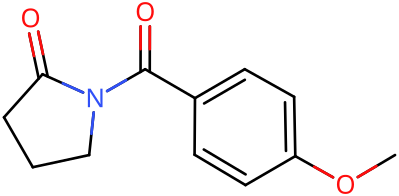
Aniracetam Stats & Data
COc1ccc(cc1)C(=O)N1CCCC1=OZXNRTKGTQJPIJK-UHFFFAOYSA-NPharmacology
DrugBankDescription
Compound with anti-depressive properties used as a mental performance enhancer.
Pharmacodynamics
Aniracetam possesses a wide range of anxiolytic properties, which may be mediated by an interaction between cholinergic, dopaminergic and serotonergic systems.
Receptor Profile
Receptor Actions
Toxicity
PsychonautWikiSeveral studies suggest that this substance is safe even when high doses are consumed for a long period of time. although it is worth noting that the exact toxic dosage is unknown. Anecdotal evidence from people who have tried aniracetam within the community suggest that there do not seem to be any negative health effects attributed to simply trying this drug at low to moderate doses by itself and using it sparingly. However, nothing can be completely guaranteed. Despite its presumed safety, it is still strongly recommended that one use harm reduction practices when using this drug.
Tolerance & Pharmacokinetics
drugs.wikiTolerance Decay
Patterns are largely anecdotal. Many users rotate racetams or limit use to 2–4 days/week to preserve effects. Headache propensity appears linked to individual cholinergic sensitivity. Evidence base: community reports and Erowid experience summaries.
Cross-Tolerances
Experience Report Analysis
ErowidDemographics
Gender Distribution
Too few reports for a chart: gender is known from 18 reports, and a split is drawn only from 20 reports or more. Counts are shown instead. Why 20?
- Male 15 of 18
- Not Specified 2 of 18
- Female 1 of 18
Age Distribution
Reports Over Time
Effect Analysis
ErowidEffects aggregated from 9 experience reports (9 single-substance Erowid)
Effect Sentiment Distribution
Confidence Distribution
Each bar is the share of reports mentioning the effect; its whisker, and the band on the rows below, is the 95% interval: where the share could plausibly be with other reports of the same kind.
Too few reports for bars: these effects come from 9 single-substance Erowid reports, and a bar is drawn only from 20 reports or more. With fewer, a percentage cannot tell a common effect from a rare one. Counts are shown instead. Why 20?
Positive Effects 2
Adverse Effects 1
Also reported in combinations. In the 9 Aniracetam reports where another drug was taken too, 1 mentions hospital, emergency services or an overdose, 0 a seizure and 1 psychosis (too few reports for percentages). In the 9 single-substance reports: 1, 0 and 0. These are not in the figures above: they cannot be put down to Aniracetam alone, and a mention is not always something that happened to the writer.
Real-World Dose Distribution
ErowidFrom 24 of 25 recorded dose entries: those that state a weight (mg, g or µg), in routes with at least five of them. Values above Q3 + 3×IQR, far above what people typically take, are left out; they can include real heavy doses and overdoses, not only mistakes.
Oral (n=24)
Form / Preparation
Most common forms and preparations, as a share of the 5 reports that give one
Too few reports for bars: these forms come from 5 reports, and a bar is drawn only from 20 reports or more. With fewer, a percentage cannot tell a common effect from a rare one. Counts are shown instead. Why 20?
- Capsule 3 of 5
- Powder / Crystals 2 of 5
Redose Patterns
Redosing behavior across 13 reports
Too few reports for a chart: redosing is known from 13 reports, and a split is drawn only from 20 reports or more. Counts are shown instead. Why 20?
- Single dose 12 of 13
- Redosed 1 of 13
Legal Status
| Country | Status | Notes |
|---|---|---|
| Australia | Aniracetam is a schedule 4 substance in Australia under the Poisons Standard (February 2020). | A schedule 4 substance is classified as "Prescription Only Medicine, or Prescription Animal Remedy – Substances, the use or supply of which should be by or on the order of persons permitted by state or territory legislation to prescribe and should be available from a pharmacist on prescription." |
Harm Reduction
drugs.wiki• Short elimination half‑life (about 1–2.5 h) often necessitates divided dosing (e.g., 750 mg twice daily) to maintain steady effects. Evidence: DrugBank half‑life; Erowid suggests 750 mg BID as common use.
• Mechanism: positive allosteric modulation of AMPA receptors; slows channel closing and reduces desensitization—plausibly explaining alertness and cognitive effects.
• Anxiolysis seen in animal models appears partly mediated by metabolites (e.g., p‑anisic acid) with contributions from nicotinic ACh, 5‑HT2A, and D2 pathways; translation to humans is suggestive but not definitive—dose conservatively.
• Divided dosing and taking near a normal meal are common user practices to improve tolerability and perceived consistency; many report better effects with some dietary fat (anecdotal). Start low and assess individual response.
• Onset is typically 30–60 min orally and faster sublingually per user reports; prominent effects often last 3–4 h with a milder tail thereafter. Avoid redosing too soon to reduce jitteriness or brain‑fog.
• Regulatory status: not FDA‑approved in the United States; DrugBank lists “US Approved: NO; Other Approved: YES.” Products sold online vary in quality—seek third‑party tested sources and avoid combining with unknown ‘research blends’.
• Common side effects: headache, GI upset, irritability, or fatigue; vivid dreams are reported by some users. Discontinue and seek medical advice if severe agitation, persistent insomnia, or unusual visual symptoms occur.
References
Data Sources
Cited References
- Cumin et al. 1982 - Effects of aniracetam on impaired learning and memory in rodents
- DrugBank: Aniracetam (DB04599)
- Erowid: Aniracetam Vault
- Examine: .com - Aniracetam overview
- Kaneko et al. 1991 - Effects of cerebroprotective drugs on NMDA channel function
- Lee & Benfield 1994 - Aniracetam: pharmacodynamic and pharmacokinetic properties review
- Ling & Benardo 2005 - Nootropic agents enhance fast GABA inhibition in neocortex
- Nakamura & Kurasawa 2001 - Anxiolytic effects of aniracetam in mouse models
- Nakamura et al. 2000 - Pharmacokinetics of aniracetam in healthy volunteers
- Paterniti et al. 2010 - Aniracetam as an anxiolytic AMPAkine
- PubChem: Aniracetam (CID 2196)
- Stancheva & Alova 1988 - Effect of aniracetam on monoamine oxidase activity
- Zhao et al. 2001 - Nootropic drug modulation of nicotinic acetylcholine receptors
- DrugBank: Aniracetam (DB03913)
- PubChem: 2159
Additional references
- DrugBank – Aniracetam (DB04599)
- DrugBank article summary – Aniracetam reduces AMPA desensitization (Mol Pharmacol 2003)
- DrugBank article summary – Anxiolysis and metabolite involvement
- Erowid Aniracetam Basics (dose patterns)
- Erowid Aniracetam Vault (names, reports)
- Erowid Experience Vaults – Aniracetam combinations (illustrative user reports)
- Reddit r/Nootropics – Onset/duration and dosing timing (user reports)
- Reddit r/Nootropics – Typical duration after 750 mg (user reports)