
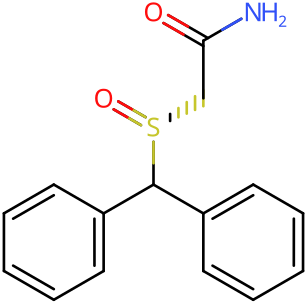
Armodafinil Stats & Data
YFGHCGITMMYXAQ-LJQANCHMSA-NPharmacology
DrugBankDescription
Armodafinil is the enantiopure of the wakefulness-promoting agent modafinil (Provigil), and is indicated to improve wakefulness in adult patients with excessive sleepiness associated with obstructive sleep apnea (OSA), narcolepsy, or shift work disorder (SWD). Research has shown that armodafinil significantly improves driving simulator performance in patients with SWD. Armodafinil consists of the (−)-R-enantiomer of the racemic modafinil. Armodafinil is produced by the pharmaceutical company Cephalon Inc. (a wholly owned subsidiary of Teva Pharmaceutical Industries Ltd.) and was approved by the U.S. Food and Drug Administration (FDA) in June 2007.
Mechanism of Action
Nuvigil (armodafinil) is a single-isomer of modafinil. The exact mechanism of action is unknown. Armodafinil belongs to a class of drugs known as eugeroics, which are stimulants that provide long-lasting mental arousal. Pharmacologically, armodafinil does not bind to or inhibit several receptors and enzymes potentially relevant for sleep/wake regulation. Armodafinil is not a direct- or indirect-acting dopamine receptor agonist. However, in vitro, both armodafinil and modafinil bind to the dopamine transporter and inhibit dopamine reuptake. Medilexicon
Metabolism
In vitro and in vivo data show that armodafinil undergoes hydrolytic deamidation, S-oxidation, and aromatic ring hydroxylation, with subsequent glucuronide conjugation of the hydroxylated products. Amide hydrolysis is the single most prominent metabolic pathway, with sulfone formation by cytochrome P450 (CYP) 3A4/5 being next in importance. The other oxidative products are formed too slowly in vitro to enable identification of the enzyme(s) responsible. Only two metabolites reach appreciable concentrations in plasma (i.e., R-modafinil acid and modafinil sulfone). Data specific to armodafinil disposition are not available.
Absorption
Tmax is 2 hours when fasted and can be delayed approximately 2-4 hours by food, potentially affecting the onset of action.
Indication
Investigated for use/treatment in sleep disorders, obstructive sleep apnea, schizophrenia and schizoaffective disorders, depression, and bipolar disorders.
Protein Binding
Specific data unavailable. Similar to modafinil: approximately 60%, primarily to albumin.
Clearance
The oral clearance of armodafinil is approximately 33 mL/min.
Receptor Profile
Receptor Actions
Receptor Binding
History & Culture
Armodafinil is the isolated R-enantiomer of the racemic wakefulness-promoting agent modafinil. It was developed by Cephalon Inc., a pharmaceutical company that later became a wholly owned subsidiary of Teva Pharmaceutical Industries Ltd. The compound received approval from the United States Food and Drug Administration in June 2007 for the treatment of excessive sleepiness associated with obstructive sleep apnea, narcolepsy, and shift work disorder. It was marketed under the brand name Nuvigil. In 2016, the FDA granted Mylan the rights to produce and market the first generic version of armodafinil in the United States, expanding access to the medication beyond the original branded formulation.
The long-term safety and effectiveness of armodafinil has not been determined. Anecdotal evidence suggests a lack of adverse health effects when sparingly used at small to moderate doses, although this must not be assumed. This compound is a commonly prescribed prescription medication, thus is considerably less likely to have adverse health effects than that of a typical research chemical. It is strongly recommended that one use harm reduction practices when using this substance.
Liver injury risk
Ambiguous (limited data)
Effect Profile
Curated + 7 ReportsStrong focus with strong anxiety/jitters, mild stimulation, low euphoria
Tolerance & Pharmacokinetics
drugs.wikiTolerance Decay
Users report some loss of effect with continuous daily use over weeks; spacing doses (e.g., weekends off) may slow tolerance. Empirical, anecdotal data only; no robust human PK/PD tolerance studies specific to armodafinil. Prioritise sleep hygiene to reduce compensatory dose escalation.
Cross-Tolerances
Experience Report Analysis
ErowidDemographics
Gender Distribution
Age Distribution
Reports Over Time
Effect Analysis
ErowidEffects aggregated from 7 experience reports (7 single-substance Erowid)
Effect Sentiment Distribution
Confidence Distribution
Each bar is the share of reports mentioning the effect; its whisker, and the band on the rows below, is the 95% interval: where the share could plausibly be with other reports of the same kind.
Too few reports for bars: these effects come from 7 single-substance Erowid reports, and a bar is drawn only from 20 reports or more. With fewer, a percentage cannot tell a common effect from a rare one. Counts are shown instead. Why 20?
Positive Effects 3
Adverse Effects 2
Show 1 neutral or unclassified mention
Also reported in combinations. In the 13 Armodafinil reports where another drug was taken too, 3 mention hospital, emergency services or an overdose, 0 a seizure and 0 psychosis (too few reports for percentages). In the 7 single-substance reports: 0, 0 and 0. These are not in the figures above: they cannot be put down to Armodafinil alone, and a mention is not always something that happened to the writer.
Dosage Distribution
Dose distribution from experience reports, one dose per report (the first listed). Doses above Q3 + 3×IQR, far above what people typically take, are left out of the median and range and listed under each route: most are real heavy doses or overdoses, not mistakes.
1 report gave a dose above the typical range (500 mg), so it is not in the figures above. Listing a dose here does not mean it is safe.
Show the report
- 500 mg · another drug taken too
Real-World Dose Distribution
ErowidFrom 27 of 30 recorded dose entries: those that state a weight (mg, g or µg), in routes with at least five of them. Values above Q3 + 3×IQR, far above what people typically take, are left out; they can include real heavy doses and overdoses, not only mistakes.
Oral (n=27)
Common Combinations
Most co-occurring substances, as a share of all 20 reports filed under Armodafinil; whiskers are 95% intervals
Form / Preparation
Most common forms and preparations, as a share of the 5 reports that give one
Too few reports for bars: these forms come from 5 reports, and a bar is drawn only from 20 reports or more. With fewer, a percentage cannot tell a common effect from a rare one. Counts are shown instead. Why 20?
- Pill / Tablet 5 of 5
Body-Weight Dosing
Dose per kg of body weight, one dose per report (the first listed), from reports giving a weight of 30–250 kg. Doses above Q3 + 3×IQR, far above what people typically take, are left out of the median and range and listed under each route.
Redose Patterns
Redosing behavior across 13 reports
Too few reports for a chart: redosing is known from 13 reports, and a split is drawn only from 20 reports or more. Counts are shown instead. Why 20?
- Single dose 9 of 13
- Redosed 4 of 13
Legal Status
| Country | Status | Notes |
|---|---|---|
| Australia | Schedule 4 | Classified as a prescription-only medicine or prescription animal remedy under the Poisons Standard. Defined as a substance whose use or supply should be by or on the order of persons permitted by State or Territory legislation to prescribe, available only from a pharmacist on prescription. |
| Canada | Schedule F (Prescription Drug) | Listed as a Schedule F prescription drug under the Food and Drug Regulations. May be lawfully prescribed for both human and veterinary use. |
| Germany | Prescription-only (Anlage 1 AMVV) | Listed in Anlage 1 of the Arzneimittelverschreibungsverordnung (AMVV), the German Prescription Ordinance. Legal possession and dispensing requires a valid prescription from an authorized prescriber. |
| Romania | Regulated (as modafinil enantiomer) | Not directly scheduled as of 2021, but considered related to modafinil which is classified as a doping agent and will appear on laboratory tests. Simple possession is not a criminal offense but carries administrative penalties including fines and confiscation. Importing or exporting without a valid medical prescription constitutes a criminal offense punishable by two to seven years imprisonment. |
| United Kingdom | Unscheduled (ambiguous) | Not a licensed medicine and not controlled under the Misuse of Drugs Act 1971. Legal status under the Psychoactive Substances Act 2016 remains uncertain, as racemic modafinil is a licensed prescription-only medicine in the UK. Personal possession without prescription may not constitute a criminal offense, and legal import for personal use may be permissible under Section 13 of the Medicines Act 1968. |
| United States | Schedule IV | Controlled under the Controlled Substances Act as a Schedule IV substance, indicating accepted medical use with low potential for abuse relative to Schedule III drugs. Purchasing, selling, or possessing armodafinil without a valid prescription or DEA license is illegal. |
Harm Reduction
drugs.wikiReasoning for key harm-reduction additions before JSON changes:
• Longer action vs racemic modafinil and delayed peak: Armodafinil is the R-enantiomer with a mean terminal half-life ≈15 h and Tmax ~2 h (fasted). This increases late-day exposure and insomnia risk; dosing early and avoiding evening redoses reduces sleep disruption. Evidence: DrugBank monograph and clinical PK work.
• Contraception warning and timing: Modafinil-class drugs induce CYP3A and reduce steroidal contraceptive efficacy; label-derived guidance specifies backup/non-hormonal contraception during use and for 1 month after stopping. Erowid’s label excerpt states exactly “for one month after discontinuation”; armodafinil has the same mechanism (CYP3A induction), so the same precaution is applied. Clinical DDI work confirms CYP3A induction with midazolam.
• Enzyme interaction profile: Human studies show armodafinil moderately induces CYP3A4 (↓ midazolam AUC ~32% PO; ~17% IV) and inhibits CYP2C19 (↑ omeprazole AUC ~38%); it does not induce CYP1A2 (no caffeine PK change). This underpins dose/monitoring advice for CYP3A/CYP2C19 substrates.
• Antipsychotic interaction: Pretreatment with armodafinil 250 mg/day reduced aripiprazole exposure (AUC ↓ ~34%); efficacy of some antipsychotics may drop. Monitor and adjust as needed.
• Pregnancy and serious idiosyncratic reactions: Serious rashes (SJS/TEN, DRESS), psychiatric reactions (mania, psychosis), and CV events are rare but documented for modafinil/armodafinil; avoid in pregnancy and stop immediately if rash or severe psych symptoms occur. LiverTox and StatPearls summarise these risks.
• Persistent sleepiness and driving: Even with armodafinil, patients can remain sleepy; clinicians advise monitoring alertness and avoiding driving or hazardous work if impaired.
• Caffeine and stimulants: Although armodafinil does not induce CYP1A2 (no caffeine PK change), combined stimulatory effects can increase anxiety, tachycardia, and insomnia—hence conservative caffeine intake is prudent.
• Dose adjustments in hepatic impairment, older adults: Lower or half-doses recommended in severe hepatic impairment; older adults may need lower doses. (These cautions are standard across modafinil-class references.)
• Seizure risk context: Controlled data are limited; animal data are mixed and human case reports/anecdotes exist. As a HR measure with uncertain but plausible risk, combine cautiously with seizure‑threshold–lowering agents (e.g., tramadol, bupropion), prioritising sleep hygiene since sleep loss itself lowers seizure threshold. Evidence base: animal study suggesting complex pro/anticonvulsant profiles; community reports; clinician caution.
• Tolerance: Clinical texts note low abuse potential, but users report some tolerance with daily use; cycling days off can help. Data are mostly anecdotal; mark data quality accordingly.
• SWD timing and typical adult dosing: Armodafinil 150–250 mg once daily (morning; or ~1 h before shift in SWD) is standard in sleep medicine references; this anchors the “common” range and early-day dosing advice.
Harm-reduction additions integrated into JSON above reflect these points: earlier dosing, contraception backup for 1 month after, explicit CYP3A/CYP2C19 interaction guidance, psychiatric/CV monitoring, hepatic/geriatric dose reduction, conservative combination strategy with other stimulants/caffeine, and clearly annotated data quality for tolerance.
• Additional HR details:
– Hydration and periodic BP/HR checks can reduce common adverse effects like headache and palpitations; insomnia management via early dosing and sleep hygiene. Serious rash, chest pain, or psychosis warrant immediate discontinuation and medical evaluation.
– Not a substitute for adequate sleep; plan rest after prolonged wakefulness.
References
Data Sources
Cited References
- Bluelight: Discussion – Is it possible to abuse armodafinil?
- Darwish et al., Clinical Pharmacokinetics of Armodafinil, Clin Pharmacokinet 2009
- Darwish et al., Pharmacokinetics of armodafinil and modafinil after single and multiple doses, 2010
- Drugs.com – Armodafinil Monograph
- Erowid: Armodafinil Experience Vault
- Loland et al., R-modafinil (armodafinil): A unique dopamine uptake inhibitor, 2012
- Nuvigil (armodafinil) US Prescribing Information
- DrugBank: Armodafinil (DB06208)
Additional references
- LiverTox: Modafinil/Armodafinil overview (safety signals incl. SJS/TEN, psychiatric)
- StatPearls (Modafinil): cautions (driving if sleepy), psychiatric/cardiac warnings, hepatic dose reduction
- DrugBank – Armodafinil DB06413 (half-life, Tmax, pharmacology)
- Darwish et al. 2008 – Armodafinil induces CYP3A4 and inhibits CYP2C19; no CYP1A2 induction (caffeine)
- Darwish et al. 2015 – Armodafinil reduces aripiprazole exposure (CYP3A4 induction)
- Erowid Modafinil label excerpt – hormonal contraceptives reduced efficacy during use and 1 month after
- Erowid Modafinil – Effects/duration (insomnia, contraceptive interaction note)
- DrugBank article – Modafinil CYP induction/inhibition profile (supports class CYP effects)