
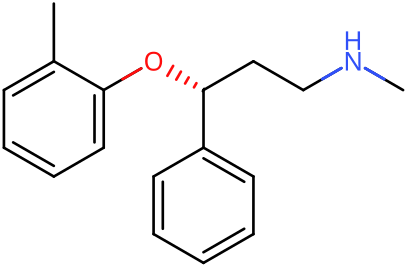
Atomoxetine Stats & Data
CNCCC(Oc1ccccc1C)c1ccccc1VHGCDTVCOLNTBX-QGZVFWFLSA-NPharmacology
DrugBankDescription
Atomoxetine is a selective norepinephrine (NE) reuptake inhibitor used for the treatment of attention deficit hyperactivity disorder (ADHD). Also known as the marketed product Strattera, atomoxetine is used with other treatment modalities (psychological, educational, cognitive behaviour therapy, etc) to improve developmentally inappropriate symptoms associated with ADHD including distractibility, short attention span, hyperactivity, emotional lability, and impulsivity. Although the underlying pathophysiology that causes ADHD remains unclear, evidence suggests that dysregulation in noradrenergic and dopaminergic pathways plays a critical role in suboptimal executive functioning within prefrontal regions of the brain, which are involved in attention and memory. Atomoxetine has been shown to specifically increase NA and DA within the prefrontal cortex, but not in the nucleus accumbens (NA) or striatum. This is beneficial in the treatment of ADHD as DA activation in the subcortical NA and striatum is associated with many stimulant-associated side effects and an increase in abuse potential, which is a limiting factor associated with the use of stimulant medications such as DB00422, DB01576, and DB01255. Use of non-stimulant medications such as atomoxetine is therefore thought to offer a clinical advantage over the use of traditional medications for the management of ADHD.
Mechanism of Action
Atomoxetine is known to be a potent and selective inhibitor of the norepinephrine transporter (NET), which prevents cellular reuptake of norepinephrine throughout the brain, which is thought to improve the symptoms of ADHD. More recently, positron emission tomography (PET) imaging studies in rhesus monkeys have shown that atomoxetine also binds to the serotonin transporter (SERT), and blocks the N-methyl-d-aspartate (NMDA) receptor, indicating a role for the glutamatergic system in the pathophysiology of ADHD.
Pharmacodynamics
Atomoxetine is a selective norepinephrine (NE) reuptake inhibitor used for the treatment of attention deficit hyperactivity disorder (ADHD). Atomoxetine has been shown to specifically increase norepinephrine and dopamine within the prefrontal cortex, which results in improved ADHD symptoms. Due to atomoxetine's noradrenergic activity, it also has effects on the cardiovascular system such as increased blood pressure and tachycardia. Sudden deaths, stroke, and myocardial infarction have been reported in patients taking atomoxetine at usual doses for ADHD. Atomoxetine should be used with caution in patients whose underlying medical conditions could be worsened by increases in blood pressure or heart rate such as certain patients with hypertension, tachycardia, or cardiovascular or cerebrovascular disease. It should not be used in patients with severe cardiac or vascular disorders whose condition would be expected to deteriorate if they experienced clinically important increases in blood pressure or heart rate. Although the role of atomoxetine in these cases is unknown, consideration should be given to not treating patients with clinically significant cardiac abnormalities. Patients who develop symptoms such as exertional chest pain, unexplained syncope, or other symptoms suggestive of cardiac disease during atomoxetine treatment should undergo a prompt cardiac evaluation.
Metabolism
Atomoxetine undergoes biotransformation primarily through the cytochrome P450 2D6 (CYP2D6) enzymatic pathway. People with reduced activity in the CYP2D6 pathway (also known as poor metabolizers or PMs) have higher plasma concentrations of atomoxetine compared with people with normal activity (also known as extensive metabolizers, or EMs). For PMs, the AUC of atomoxetine at steady-state is approximately 10-fold higher and Cmax is about 5-fold greater than for EMs. The major oxidative metabolite formed regardless of CYP2D6 status is 4-hydroxy-atomoxetine, which is rapidly glucuronidated. 4-Hydroxyatomoxetine is equipotent to atomoxetine as an inhibitor of the norepinephrine transporter, but circulates in plasma at much lower concentrations (1% of atomoxetine concentration in EMs and 0.1% of atomoxetine concentration in PMs). In individuals that lack CYP2D6 activity, 4-hydroxyatomoxetine is still the primary metabolite, but is formed by several other cytochrome P450 enzymes and at a slower rate. Another minor metabolite, N-Desmethyl-atomoxetine is formed by CYP2C19 and other cytochrome P450 enzymes, but has much less pharmacological activity than atomoxetine and lower plasma concentrations (5% of atomoxetine concentration in EMs and 45% of atomoxetine concentration in PMs).
Absorption
The pharmacokinetic profile of atomoxetine is highly dependent on cytochrome P450 2D6 genetic polymorphisms of the individual. A large fraction of the population (up to 10% of Caucasians and 2% of people of African descent and 1% of Asians) are poor metabolizers (PMs) of CYP2D6 metabolized drugs. These individuals have reduced activity in this pathway resulting in 10-fold higher AUCs, 5-fold higher peak plasma concentrations, and slower elimination (plasma half-life of 21.6 hours) of atomoxetine compared with people with normal CYP2D6 activity. Atomoxetine is rapidly absorbed after oral administration, with absolute bioavailability of about 63% in extensive metabolizers (EMs) and 94% in poor metabolizers (PMs). Mean maximal plasma concentrations (Cmax) are reached approximately 1 to 2 hours after dosing with a maximal concentration of 350 ng/ml with an AUC of 2 mcg.h/ml.
Indication
Atomoxetine is indicated for the treatment of attention deficit hyperactivity disorder (ADHD) in children and adults.
Half-life
The reported half-life depends on the CYP2D6 genetic polymorphisms of the individual and can range from 3 to 5.6 hours.
Protein Binding
At therapeutic concentrations, 98.7% of plasma atomoxetine is bound to protein, with 97.5% of that being bound to albumin, followed by alpha-1-acid glycoprotein and immunoglobulin G.
Elimination
Atomoxetine is excreted primarily as 4-hydroxyatomoxetine-O-glucuronide, mainly in the urine (greater than 80% of the dose) and to a lesser extent in the feces (less than 17% of the dose). Only a small fraction (less than 3%) of the atomoxetine dose is excreted as unchanged atomoxetine, indicating extensive biotransformation.
Volume of Distribution
The reported volume of distribution of oral atomoxetine was 1.6-2.6 L/kg. The steady-state volume of distribution of intravenous atomoxetine was approximately 0.85 L/kg.
Clearance
The clearance rate of atomoxetine depends the CYP2D6 genetic polymorphisms of the individual and can range of 0.27-0.67 L.h/kg.
Measured Affinities
Guide to PHARMACOLOGYMeasured binding and functional data for atomoxetine, curated by the IUPHAR/BPS Guide to PHARMACOLOGY. Each row cites the paper it came from. Lower concentrations mean tighter binding — a value in the sub-nanomolar range indicates a very potent interaction.
| Target | Action | Measure | Value | Concentration | Species | Source |
|---|---|---|---|---|---|---|
| NET SLC6A2 | Inhibition | pKd | 8.69 | 2.04 nM | Human | PMID 9871604 |
| SERT SLC6A4 | Inhibition | pKd | 8.05 | 8.91 nM | Human | PMID 9871604 |
| DAT SLC6A3 | Inhibition | pKd | 5.97 | 1,072 nM | Human | PMID 9871604 |
Reading this. pKi, pEC50 and pIC50 are negative log molar values, so a higher number means a tighter interaction; the concentration column converts them for you. Values from non-human species are laboratory measurements and do not translate directly to human effect. Receptor affinity is not a dose — it describes what a molecule binds, not how much of it is safe to take.
Receptor data from the IUPHAR/BPS Guide to PHARMACOLOGY (v2026.2), licensed CC BY-SA 4.0. Matched to this substance by InChIKey.
Atomoxetine increased the risk of suicidal ideation in short-term studies in children or adolescents with ADHD. Symptoms accompanying acute and chronic overdoses of atomoxetine include gastrointestinal symptoms, somnolence, dizziness, tremor, abnormal behavior, hyperactivity, agitation, and signs and symptoms consistent with mild to moderate sympathetic nervous system activation (e.g., tachycardia, blood pressure increased, mydriasis, dry mouth). * Exercise caution when prescribing atomoxetine with other medications metabolized via CYP2D6 as plasma concentrations can be significantly affected, leading to toxicity.
Carcinogenicity
No indication of carcinogenicity to humans (not listed by IARC).
Toxicity (DrugBank)
There is limited clinical trial experience with atomoxetine overdose. During postmarketing, there have been fatalities reported involving a mixed ingestion overdose of atomoxetine capsules and at least one other drug. There have been no reports of death involving overdose of atomoxetine capsules alone, including intentional overdoses at amounts up to 1400 mg. In some cases of overdose involving atomoxetine, seizures have been reported. The most commonly reported symptoms accompanying acute and chronic overdoses of atomoxetine capsules were gastrointestinal symptoms, somnolence, dizziness, tremor, and abnormal behavior. Hyperactivity and agitation have also been reported. Signs and symptoms consistent with mild to moderate sympathetic nervous system activation (e.g., tachycardia, blood pressure increased, mydriasis, dry mouth) have also been observed. Most events were mild to moderate. Less commonly, there have been reports of QT prolongation and mental changes, including disorientation and hallucinations. If symptoms of overdose are suspected, a Certified Poison Control Center should be consulted for up to date guidance and advice. Because atomoxetine is highly protein-bound, dialysis is not likely to be useful in the treatment of overdose.
Effect Profile
Curated + 21 ReportsStrong stimulation and euphoria with strong anxiety/jitters, mild focus
Tolerance & Pharmacokinetics
drugs.wikiTolerance Decay
Experience Report Analysis
ErowidDemographics
Gender Distribution
Age Distribution
Reports Over Time
Effect Analysis
ErowidEffects aggregated from 21 experience reports (21 single-substance Erowid)
Effect Sentiment Distribution
Confidence Distribution
Each bar is the share of reports mentioning the effect; its whisker, and the band on the rows below, is the 95% interval: where the share could plausibly be with other reports of the same kind.
Positive Effects 4
Adverse Effects 3
Show 2 neutral or unclassified mentions
Also reported in combinations. In the 14 Atomoxetine reports where another drug was taken too, 2 mention hospital, emergency services or an overdose, 0 a seizure and 0 psychosis (too few reports for percentages). In the 21 single-substance reports: 4.8%, 4.8% and 9.5%. These are not in the figures above: they cannot be put down to Atomoxetine alone, and a mention is not always something that happened to the writer.
Dosage Distribution
Dose distribution from experience reports, one dose per report (the first listed). Doses above Q3 + 3×IQR, far above what people typically take, are left out of the median and range and listed under each route: most are real heavy doses or overdoses, not mistakes.
Real-World Dose Distribution
ErowidFrom 39 of 43 recorded dose entries: those that state a weight (mg, g or µg), in routes with at least five of them. Values above Q3 + 3×IQR, far above what people typically take, are left out; they can include real heavy doses and overdoses, not only mistakes.
Oral (n=37)
Common Combinations
Most co-occurring substances, as a share of all 35 reports filed under Atomoxetine; whiskers are 95% intervals
Form / Preparation
Most common forms and preparations, as a share of the 13 reports that give one
Too few reports for bars: these forms come from 13 reports, and a bar is drawn only from 20 reports or more. With fewer, a percentage cannot tell a common effect from a rare one. Counts are shown instead. Why 20?
- Pill / Tablet 10 of 13
- Capsule 2 of 13
Body-Weight Dosing
Dose per kg of body weight, one dose per report (the first listed), from reports giving a weight of 30–250 kg. Doses above Q3 + 3×IQR, far above what people typically take, are left out of the median and range and listed under each route.
1 report gave a dose above the typical range (2.204 mg/kg), so it is not in the figures above. Listing a dose here does not mean it is safe.
Show the report
Redose Patterns
Redosing behavior across 28 reports