
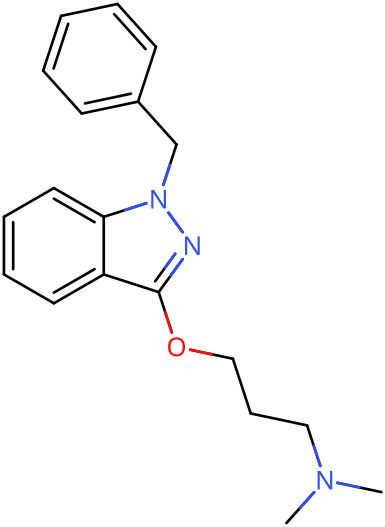
Benzydamine Stats & Data
CNBGNNVCVSKAQZ-UHFFFAOYSA-NPharmacology
DrugBankDescription
Benzydamine (also known as Tantum Verde or Difflam), available as the hydrochloride salt, is a locally-acting nonsteroidal anti-inflammatory drug (NSAID) with local anaesthetic and analgesic properties. It is used topically for pain relief and anti-inflammatory treatment of the mouth, throat, or muscoskeletal system. Although the indazole analogue benzydamine is a non-steroidal anti-inflammatory drug (NSAID), it has various physicochemical properties and pharmacologic activities that are different from those of traditional aspirin-like NSAIDs but facilitate benzydamine's mechanism of action as an effective locally-acting NSAID with local anaesthetic and analgesic properties. Moreover, unlike aspirin-like NSAIDs which are acids or metabolised to acids, benzydamine is in fact a weak base.
Mechanism of Action
Despite being categorized as a non-steroidal anti-inflammatory drug (NSAID), benzydamine demonstrates various mechanisms of action that differ from those of traditional aspirin-like NSAIDs. In particular, benzydamine predominantly acts by inhibiting the synthesis of pro inflammatory cytokines like tumour necrosis factor-alpha (TNF-α) and interleukin-1β (IL-1β) without largely affecting other pro inflammatory cytokines (ie. such as IL-6 and IL-8) or anti-inflammatory cytokines (ie. like IL-10 or IL-1 receptor antagonist). Moreover, benzydamine is largely a weak inhibitor of prostaglandin synthesis as it has been shown to effectively inhibit cyclooxygenase (COX) and lipoxygenase enzyme activity only at concentrations of 1mM or greater. Considering most contemporary usages of benzydamine are topical applications that are generally not well absorbed through the skin and/or non-specialized mucosae, benzydamine does not often achieve the kind of absorption or blood concentrations necessary to cause any extraneous distant systemic effects or COX inhibition, allowing it to localize its action. Additionally, it is also hypothesized that benzydamine is capable of inhibiting the oxidative burst of neutrophils and membrane stabilization. These actions are exhibited by the substance’s ability to inhibit the release of granules from neutrophils and to stabilize lysosomes.
Pharmacodynamics
Benzydamine is a non-steroidal anti-inflammatory drug (NSAID) designed to elicit local anesthetic and analgesic effects mainly for the mouth and throat. It specifically acts on the local mechanisms of inflammation such as pain, oedema, or granuloma. Typically applied topically, the drug demonstrates anti-inflammatory activity reducing oedema as well as exudate and granuloma formation. Moreover, benzydamine exhibits analgesic properties and local anaesthetic activity if pain is caused by an inflammatory condition. Benzydamine can be absorbed into the oral mucosa and intact skin. Once absorbed in the local area of pain or inflammation, benzydamine binds selectively to local inflamed tissues, usually allowing it to act with few adverse systemic effects. On average a period of 2 to 4 hours is necessary for the substance to reach peak plasma concentration. Benzydamine can be synthesized with the reaction of the N-benzyl derivative from methyl anthranilate with nitrous acid to give N-nitoso derivative. This is next reduced by sodium thiosulfate to give transient hydrazine. This hydrazine can then undergo spontaneous internal hydrazide formation. Treating this resultant enolate with 3-chloro-1-dimethylamkino propane ultimately yields benzydamine.
Metabolism
Benzydamine is primarily metabolized by oxidation, dealkylation, and conjugation into hydroxy, dealkylated, and N-oxide metabolites . In general, however, when used at the recommended doses the levels at which benzydamine is absorbed or exposed into the body are usually not sufficient to produce systemic pharmacological effects [L
Absorption
Oral doses of benzydamine are well absorbed and plasma drug concentrations reach a peak fairly rapidly and then decline with a half-life of approximately 13 hours. When applied topically, although the local drug concentrations are relatively large, the systemic absorption of topically applied benzydamine is relatively low compared to oral doses. This low topical absorption contributes to a decreased potential for any systemic drug side-effects when benzydamine is administered in this way.
Indication
Available predominantly as a liquid mouthwash, oromucosal spray, or topical cream, benzydamine is most frequently employed as a locally acting analgesic and anti-inflammatory treatment for the relief of painful inflammatory conditions. When formulated as a mouthwash or spray, benzydamine may be used to treat traumatic conditions like pharyngitis following tonsillectomy or the use of a naso-gastric tube, inflammatory conditions like pharyngitis, aphthous ulcers and oral ulceration due to radiation therapy, dentistry operations and procedures, or more general conditions like sore throat, sore tongue, sore gums, mouth ulcers, or discomfort caused by dentures. When used as a topical cream, benzydamine may be employed to relieve symptoms associated with painful inflammatory conditions of the muscolo-skeletal system including acute inflammatory disorders such as myalgia and bursitis or traumatic conditions like sprains, strains, bruises, sore muscles, stiff joints, or even the after-effects of fractures. L1123
Half-life
Approximately 13 h after oral administration , with a terminal half life of about 7.7 h .
Protein Binding
Benzydamine exhibits < 20% plasma protein binding after oral administration .
Elimination
The relatively high lipid solubility of the weak base benzydamine is thought to be associated with considerable passive resorption within the renal tubule, which suggests that only approximately 5% of benzydamine is excreted unchanged in the urine . At the same time however, other studies have suggested that considerably larger amounts (50-65%) of the drug is excreted unchanged in urine . While several inactive oxidized metabolites of benzydamine are excreted in urine, the benzydamine N-oxide metabolite can remain in plasma and demonstrate a half-life that is longer than the parent benzydamine compound . Nevertheless, it is generally believed that excretion occurs mainly through urine and is mostly in the form of inactive metabolites or conjugation products .
Volume of Distribution
The volume of distribution of benzydamine is 10 L .
Clearance
Benzydamine demonstrateas a systemic clearance of 170 ml/min .
Receptor Profile
Receptor Actions
Receptor Binding
Subjective Effects
Physical
- Stimulation: Insomnia and residual stimulation lasting up to 72 hours after the initial experience may occur on this substance.
- Abnormal heartbeat
- Tactile suppression
- Increased heart rate
Cognitive
- Anxiety
- Euphoria
- Depression
- Time distortion
- Thought acceleration
- Delusions
Sensory
- Hallucinations
- Distortion
- Drifting
- Visual haze
- External hallucinations: autonomous entities; settings, sceneries, and landscapes; alterations in perspective and scenarios and plots
- Visual acuity suppression
Forked from Subjective Effect Documentation by Josie Kins, August 2015. Via dose.wiki (CC0).
The vaginal douching agents such as Tantum Rosa and other products consistently contain large amounts of salt which, if consumed, can cause serious kidney damage. The toxicity and long-term health effects of recreational benzydamine use do not seem to have been studied in any scientific context and the exact toxic dose is unknown. This is because benzydamine is a research chemical with very little history of human usage. Anecdotal evidence from people within the psychonaut community who have tried benzydamine suggests that there are no negative health effects attributed to simply trying the drug by itself at low to moderate doses and using it very sparingly (but nothing can be completely guaranteed).
Toxicity (DrugBank)
A possible adverse reaction associated with the use of the mouthwash or oromucosal spray formulations of benzymadine is potential numbness and/or stinging in the mouth and/or throat . Some possible adverse reactions that tend to be associated more with topical cream formulations of benzymadine include increased sensitivity to sunlight, and localized itching, skin rash, redness, or swelling . The prescribing information for all formulations of benzymadine however, warn against the possibility of severe allergic reaction (anaphylaxis) associated with swelling of the throat and mouth, difficulty in swallowing, speaking, and breathing, or wheezing . As benzydamine is a non-steroidal anti-inflammatory drug (NSAID), it is necessary to determine if a patient is allergic to NSAIDs before considering its use . Intoxication is expected as a consequence of accidental ingestion of large quantities of benzydamine (over 300 mg ingestion). Other symptoms associated with overdose of ingested benzydamine include gastrointestinal and central nervous system symptoms like nausea, vomiting, abdominal pain, oesophageal irritation, dizziness, hallucinations, agitation, anxiety, and irritability . The official prescribing information for benzydamine generally suggest that benzydamine mouthwashes and sprays should not be used in pregnancy .
Effect Profile
Curated + 6 ReportsStrong visuals and auditory effects with mild headspace and body load
Moderate euphoria with strong anxiety/jitters, mild stimulation, low focus
Tolerance & Pharmacokinetics
drugs.wikiTolerance Decay
Experience Report Analysis
ErowidDemographics
Gender Distribution
Too few reports for a chart: gender is known from 9 reports, and a split is drawn only from 20 reports or more. Counts are shown instead. Why 20?
- Male 5 of 9
- Not Specified 2 of 9
- Female 2 of 9
Age Distribution
Reports Over Time
Effect Analysis
ErowidEffects aggregated from 6 experience reports (6 single-substance Erowid)
Effect Sentiment Distribution
Confidence Distribution
Each bar is the share of reports mentioning the effect; its whisker, and the band on the rows below, is the 95% interval: where the share could plausibly be with other reports of the same kind.
Too few reports for bars: these effects come from 6 single-substance Erowid reports, and a bar is drawn only from 20 reports or more. With fewer, a percentage cannot tell a common effect from a rare one. Counts are shown instead. Why 20?
Positive Effects 3
Adverse Effects 2
Show 2 neutral or unclassified mentions
Real-World Dose Distribution
ErowidFrom 10 of 10 recorded dose entries: those that state a weight (mg, g or µg), in routes with at least five of them. Values above Q3 + 3×IQR, far above what people typically take, are left out; they can include real heavy doses and overdoses, not only mistakes.
Oral (n=10)
Form / Preparation
Most common forms and preparations, as a share of the 4 reports that give one
Too few reports for bars: these forms come from 4 reports, and a bar is drawn only from 20 reports or more. With fewer, a percentage cannot tell a common effect from a rare one. Counts are shown instead. Why 20?
- Liquid 2 of 4
References
Cited References
- Avvisati et al. 2018 - Benzydamine Self-Administration and CB1 Mechanism
- Benzydamine—An Affordable Over-the-Counter Drug with Psychoactive Properties
- Bluelight: Benzydamine Discussion Thread
- Drugs-Forum: Benzydamine Discussion
- Erowid: Benzydamine Experience Vault
- PsychonautWiki: Benzydamine
- The Benzydamine Experience: A Systematic Review