
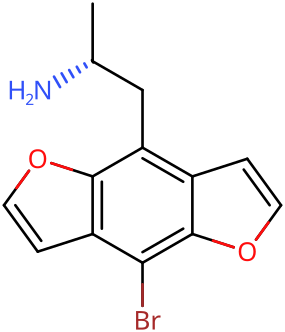
Bromo-DragonFLY Stats & Data
CC(N)Cc1c2ccoc2c(Br)c2ccoc12GIKPTWKWYXCBEC-UHFFFAOYSA-NReceptor Profile
Receptor Actions
Receptor Binding
History & Culture
1990s–1998
Bromo-DragonFLY emerged from academic research conducted at Purdue University during the mid-1990s, where it was initially developed as a novel chemical tool for studying serotonin receptor binding in rat brain tissue. The compound was formally synthesized and characterized in 1998 by Matthew Parker, who derived it from the structurally related DOB-FLY. That same year, the substance was first described in the scientific literature by David E. Nichols and colleagues, establishing its pharmacological profile and extreme potency relative to other phenethylamine psychedelics.
2005–2010
Following nearly a decade of existence solely within academic contexts, Bromo-DragonFLY transitioned into human experimental psychoactive markets in May 2005 when quantities of the compound became commercially available. By 2006, it had been encountered as a novel designer drug, marking its first documented appearance in recreational contexts. The substance briefly gained popularity within research chemical communities around 2010, though this period of availability would prove short-lived due to the serious incidents that followed.
2007–2011
The extreme potency and prolonged duration of Bromo-DragonFLY contributed to several severe adverse events that significantly impacted its availability and legal status. In September 2007, a 35-year-old Swedish man suffered catastrophic tissue necrosis following a massive overdose of unknown quantity, ultimately requiring amputation of the front portion of his feet and several fingers due to the compound's severe vasoconstrictive effects. A particularly consequential incident occurred in October 2009 when laboratory testing confirmed that a batch of Bromo-DragonFLY had been distributed mislabeled as 2C-B-FLY, a structurally related compound approximately twenty times less potent by weight. This labeling error is believed to have contributed to multiple lethal overdoses and additional hospitalizations as users inadvertently consumed doses far exceeding safe thresholds. On May 7, 2011, two young adults in the United States died and several others required hospitalization after overdosing on Bromo-DragonFLY that they believed was 2C-E. These fatal incidents, stemming largely from misidentification and mislabeling rather than informed use, led to the substance's prohibition in multiple jurisdictions and its rapid disappearance from research chemical markets.
Toxicity
PsychonautWikiBromo-DragonFLY can be considered extremely toxic at very high dosages with several deaths and numerous hospitalizations reported on overdoses. It can also have extreme vasoconstrictive effects, which can result in severe tissue damage or even limb amputation. Due to its high potency, one can easily overdose if this substance is not measured correctly ("eyeballed") or mislabeled as another substance. The toxicity and long-term health effects of recreational Bromo-DragonFLY do not seem to have been studied in any scientific context and the exact toxic dose is unknown. This is because Bromo-DragonFLY is a research chemical with very little history of human usage.
Overdose
The risk of Bromo-DragonFLY overdose is unknown at the time, suggesting that there may not be a safe dosage. Non-oral routes also seem to exhibit a higher chance of overdosing, perhaps owing to differences in bioavailability, potency and unpredictability of dosage and effects. Overdose effects of typically include bizarre, delusional and sometimes violent behavior, amnesia, numbness, confusion and anxiety.
Effect Profile
Curated + 31 ReportsStrong visuals, headspace, and auditory effects with strong body load
Strong stimulation with strong anxiety/jitters, moderate euphoria, mild focus
Tolerance & Pharmacokinetics
drugs.wikiTolerance Decay
Experience Report Analysis
ErowidDemographics
Gender Distribution
Age Distribution
Reports Over Time
Effect Analysis
ErowidEffects aggregated from 31 experience reports (31 single-substance Erowid)
Effect Sentiment Distribution
Confidence Distribution
Each bar is the share of reports mentioning the effect; its whisker, and the band on the rows below, is the 95% interval: where the share could plausibly be with other reports of the same kind.
Positive Effects 11
Adverse Effects 7
Show 5 neutral or unclassified mentions
Also reported in combinations. In the 14 Bromo-DragonFLY reports where another drug was taken too, 3 mention hospital, emergency services or an overdose, 1 a seizure and 1 psychosis (too few reports for percentages). In the 31 single-substance reports: 19.4%, 0.0% and 9.7%. These are not in the figures above: they cannot be put down to Bromo-DragonFLY alone, and a mention is not always something that happened to the writer.
Dosage Distribution
Dose distribution from experience reports, one dose per report (the first listed). Doses above Q3 + 3×IQR, far above what people typically take, are left out of the median and range and listed under each route: most are real heavy doses or overdoses, not mistakes.
1 report gave a dose above the typical range (4,000 µg), so it is not in the figures above. It mentions hospital, emergency services or an overdose. Listing a dose here does not mean it is safe.
Show the report
- 4,000 µg · mentions hospital, emergency services or an overdose
Real-World Dose Distribution
ErowidFrom 23 of 46 recorded dose entries: those that state a weight (mg, g or µg), in routes with at least five of them. Values above Q3 + 3×IQR, far above what people typically take, are left out; they can include real heavy doses and overdoses, not only mistakes.
Oral (n=22)
Common Combinations
Most co-occurring substances, as a share of all 45 reports filed under Bromo-DragonFLY; whiskers are 95% intervals
Form / Preparation
Most common forms and preparations, as a share of the 30 reports that give one; whiskers are 95% intervals
Body-Weight Dosing
Dose per kg of body weight, one dose per report (the first listed), from reports giving a weight of 30–250 kg. Doses above Q3 + 3×IQR, far above what people typically take, are left out of the median and range and listed under each route.
1 report gave a dose above the typical range (0.084 mg/kg), so it is not in the figures above. It mentions hospital, emergency services or an overdose. Listing a dose here does not mean it is safe.
Show the report
- 0.084 mg/kg · mentions hospital, emergency services or an overdose
Redose Patterns
Redosing behavior across 30 reports
Legal Status
| Country | Status | Notes |
|---|---|---|
| Australia | Schedule 9 (Prohibited) | Listed under Schedule 9 of the Poisons Standard nationally since February 2009, making possession, production, and sale illegal. Additionally added to Schedule 2 of the Queensland Drugs Misuse Regulation 1987 as of September 9, 2011. |
| Canada | Schedule III (CDSA) | Added to Schedule III of the Controlled Drugs and Substances Act on October 12, 2016, under the broad classification of '2C-phenethylamines and their salts, derivatives, isomers and salts of derivatives and isomers' which encompasses compounds with a 2,5-dimethoxyphenethylamine core. |
| Denmark | Illegal (Narcotic) | Banned on December 3, 2007, following recommendations from the Danish Health Ministry. Classified as a dangerous narcotic substance, prohibiting possession, manufacture, importation, supply, and usage. |
| Finland | Illegal | Classified as an illegal designer drug as of March 12, 2012. Added to the national list of controlled substances. |
| Germany | Controlled (NpSG) | Controlled under the Neue-psychoaktive-Stoffe-Gesetz (New Psychoactive Substances Act) as a derivative of 2-phenethylamine. Production and sale are prohibited; however, possession and import are not penalized when intended solely for personal consumption. |
| Japan | Controlled | Designated as a controlled substance effective August 19, 2015. |
| Norway | Narcotic | Listed on the Norwegian narcotics list and controlled under the 'Derivatbestemmelsen,' an analogue act-type provision that regulates structurally similar compounds. |
| Poland | Uncontrolled | Not currently scheduled or controlled under Polish drug legislation. |
| Romania | Illegal | Added as an illegal substance under Law 143/2000 on February 10, 2010. Possession, production, and sale are prohibited. |
| Sweden | Schedule IV (Narcotic) | Listed as a Schedule IV narcotic substance as of January 3, 2008, under Medical Products Agency regulation LVFS 2007:14. Previously classified as a 'health hazard' on July 15, 2007, under SFS 2007:600, which prohibited sale, purchase, retail, and possession. |
| Switzerland | Likely Illegal (Uncertain) | Legal status remains ambiguous. May potentially fall under Verzeichnis E point 130 or Buchstabe C of controlled substances regulations due to structural relationships with controlled amphetamine derivatives, though the exact scope of these definitions is unclear. |
| Turkey | Illegal | Classified as a controlled drug. Possession, production, supply, and importation are prohibited. |
| United Kingdom | Psychoactive Substances Act 2016 / Class A (Unclear) | Not explicitly named in the Misuse of Drugs Act 1971. Coverage under the phenylethylamine Class A catch-all clause is disputed due to its benzodifuran structure. Definitively covered by the Psychoactive Substances Act 2016 when sold or traded for human consumption. |
| United States | Unscheduled (Federal) / Schedule I (Oklahoma) | Not scheduled at the federal level. The Federal Analogue Act may apply if sold for human consumption due to structural similarities with DOB and 2C-B. Listed as a Schedule I controlled substance in the state of Oklahoma. |