
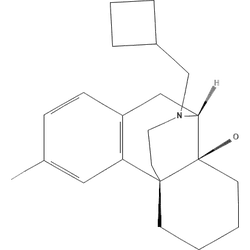
Butorphanol Stats & Data
Oc1ccc2CC3N(CC4CCC4)CCC4(CCCCC34O)c2c1IFKLAQQSCNILHL-QHAWAJNXSA-NPharmacology
DrugBankDescription
A synthetic morphinan analgesic with narcotic antagonist action. It is used in the management of severe pain.
Mechanism of Action
The exact mechanism of action is unknown, but is believed to interact with an opiate receptor site in the CNS (probably in or associated with the limbic system). The opiate antagonistic effect may result from competitive inhibition at the opiate receptor, but may also be a result of other mechanisms. Butorphanol is a mixed agonist-antagonist that exerts antagonistic or partially antagonistic effects at mu opiate receptor sites, but is thought to exert its agonistic effects principally at the kappa and sigma opiate receptors.
Pharmacodynamics
Butorphanol is a synthetic opioid agonist-antagonist analgesic with a pharmacological and therapeutic profile that has been well established since its launch as a parenteral formulation in 1978. The introduction of a transnasal formulation of butorphanol represents a new and noninvasive presentation of an analgesic for moderate to severe pain. This route of administration bypasses the gastrointestinal tract, and this is an advantage for a drug such as butorphanol that undergoes significant first-pass metabolism after oral administration. The onset of action and systemic bioavailability of butorphanol following transnasal delivery are similar to those after parenteral administration. Butorphanol blocks pain impulses at specific sites in the brain and spinal cord.
Metabolism
Extensively metabolized in the liver. The pharmacological activity of butorphanol metabolites has not been studied in humans; in animal studies, butorphanol metabolites have demonstrated some analgesic activity.
Absorption
Rapidly absorbed after intramuscular injection and peak plasma levels are reached in 20-40 minutes. The absolute bioavailability is 60-70% and is unchanged in patients with allergic rhinitis. In patients using a nasal vasoconstrictor (oxymetazoline) the fraction of the dose absorbed was unchanged, but the rate of absorption was slowed. Oral bioavailability is only 5-17% because of extensive first-pass metabolism.
Indication
For the relief of moderate to severe pain.
Half-life
The elimination half-life of butorphanol is about 18 hours. In renally impaired patients with creatinine clearances <30 mL/min the elimination half-life is approximately doubled. After intravenous administration to patients with hepatic impairment, the elimination half-life of butorphanol was approximately tripled.
Elimination
Butorphanol is extensively metabolized in the liver. Elimination occurs by urine and fecal excretion.
Clearance
* 99 +/- 23 L/h Young with IV 2 mg * 82 +/- 21 Eldery with IV 2 mg
Measured Affinities
Guide to PHARMACOLOGYMeasured binding and functional data for butorphanol, curated by the IUPHAR/BPS Guide to PHARMACOLOGY. Each row cites the paper it came from. Lower concentrations mean tighter binding — a value in the sub-nanomolar range indicates a very potent interaction.
| Target | Action | Measure | Value | Concentration | Species | Source |
|---|---|---|---|---|---|---|
| κ receptor OPRK1 | Partial agonist | pKi | 9.92 | 0.12 nM | Human | PMID 18674902 |
| μ receptor OPRM1 | Partial agonist | pKi | 9.92 | 0.12 nM | Human | PMID 18674902 |
Reading this. pKi, pEC50 and pIC50 are negative log molar values, so a higher number means a tighter interaction; the concentration column converts them for you. Values from non-human species are laboratory measurements and do not translate directly to human effect. Receptor affinity is not a dose — it describes what a molecule binds, not how much of it is safe to take.
Receptor data from the IUPHAR/BPS Guide to PHARMACOLOGY (v2026.2), licensed CC BY-SA 4.0. Matched to this substance by InChIKey.
The exact mechanism of action is unknown, but is believed to interact with an opiate receptor site in the CNS (probably in or associated with the limbic system). The opiate antagonistic effect may result from competitive inhibition at the opiate receptor, but may also be a result of other mechanisms.
Carcinogenicity
No indication of carcinogenicity to humans (not listed by IARC).
Toxicity (DrugBank)
The clinical manifestations of butorphanol overdose are those of opioid drugs in general. The most serious symptoms are hypoventilation, cardiovascular insufficiency, coma, and death.
Health effects (PubChem excerpts)
Medical problems can include congested lungs, liver disease, tetanus, infection of the heart valves, skin abscesses, anemia and pneumonia. Death can occur from overdose.
Effect Profile
Curated + 6 ReportsStrong euphoria with moderate itching/nausea, mild pain relief, low sedation
Tolerance & Pharmacokinetics
drugs.wikiNo tolerance chart. Our decay curves for opioids were estimates, and a curve can make tolerance look longer-lasting than it is, which is the dangerous direction.
Opioid tolerance drops fast when you stop, and even a few days off can be enough, so a dose that used to be normal can now stop your breathing. Overdose deaths rise sharply after prison, detox or leaving treatment, and tolerance also falls during a hospital stay. After any break, start with a much smaller amount, try a test dose first, don't use alone, and keep naloxone within reach. Alcohol, benzodiazepines, gabapentinoids and other sedatives make an opioid overdose much more likely.
Sources: FRANK: heroin · National Harm Reduction Coalition · WHO: opioid overdose · Merrall et al. 2010 · Binswanger et al. 2007 · Strang et al. 2003 · FDA 2019: gabapentinoids and breathing
Cross-Tolerances
Experience Report Analysis
ErowidDemographics
Gender Distribution
Too few reports for a chart: gender is known from 12 reports, and a split is drawn only from 20 reports or more. Counts are shown instead. Why 20?
- Male 7 of 12
- Female 5 of 12
Age Distribution
Reports Over Time
Effect Analysis
ErowidEffects aggregated from 6 experience reports (6 single-substance Erowid)
Effect Sentiment Distribution
Confidence Distribution
Each bar is the share of reports mentioning the effect; its whisker, and the band on the rows below, is the 95% interval: where the share could plausibly be with other reports of the same kind.
Too few reports for bars: these effects come from 6 single-substance Erowid reports, and a bar is drawn only from 20 reports or more. With fewer, a percentage cannot tell a common effect from a rare one. Counts are shown instead. Why 20?
Positive Effects 2
Adverse Effects 1
Real-World Dose Distribution
ErowidFrom 5 of 13 recorded dose entries: those that state a weight (mg, g or µg), in routes with at least five of them. Values above Q3 + 3×IQR, far above what people typically take, are left out; they can include real heavy doses and overdoses, not only mistakes.
Oral (n=5)
Common Combinations
Most co-occurring substances, as a share of all 12 reports filed under Butorphanol
Too few reports for bars: these combinations come from 12 reports, and a bar is drawn only from 20 reports or more. With fewer, a percentage cannot tell a common effect from a rare one. Counts are shown instead. Why 20?
- THC 3 of 12
Form / Preparation
Most common forms and preparations, as a share of the 10 reports that give one
Too few reports for bars: these forms come from 10 reports, and a bar is drawn only from 20 reports or more. With fewer, a percentage cannot tell a common effect from a rare one. Counts are shown instead. Why 20?
- Liquid 3 of 10
- Pill / Tablet 3 of 10
- Ground / Crushed 3 of 10
Redose Patterns
Redosing behavior across 10 reports
Too few reports for a chart: redosing is known from 10 reports, and a split is drawn only from 20 reports or more. Counts are shown instead. Why 20?
- Single dose 5 of 10
- Redosed 5 of 10
Opioid Equivalence (MME)
NIH HEAL 2024 & CDC 2022Butorphanol 1.42 mg oral ≈ 10 mg Morphine oral
Harm Reduction
drugs.wiki- Butorphanol is a mixed agonist–antagonist opioid: κ-opioid receptor agonism with partial μ-agonist/antagonist effects. This profile can antagonize effects of full μ-agonists (morphine, oxycodone, methadone), which may precipitate acute withdrawal in physically dependent people; avoid using butorphanol to 'boost' or on top of maintenance/full agonists. Carry naloxone if opioids are used in any context.
- Intranasal bioavailability is high relative to oral (approx. 70% vs ~17%), so intranasal dosing is more potent than the same oral milligram amount. Start with the lowest effective dose and wait at least a full peak window (≥90 minutes) before redosing to avoid stacking.
- Combining with other CNS depressants (alcohol, benzodiazepines, barbiturates, gabapentinoids, Z‑drugs) markedly increases risk of respiratory depression, accidental injury, and fatal overdose. If any sedatives are on board, reduce dose substantially, avoid redosing, and do not use alone.
- κ‑agonism commonly produces dysphoria, anxiety, and ‘spacey’ or unpleasant headspace in some users; this can limit compulsive redosing but also increases risk of panic, confusion, and dangerous behavior in unfamiliar settings. Avoid operating vehicles or hazardous equipment during and after effects until fully alert.
- Effect duration is short relative to elimination; sedation and impaired coordination can outlast perceived analgesia. Plan for residual impairment (2–6 h) and avoid rapid redose cycles.
- Oral use is inefficient and unpredictable because of extensive first‑pass metabolism. If oral dosing is attempted, expect weaker, delayed effects and higher interindividual variability.
- Injection carries infection risks (skin/soft‑tissue infection, bacteremia, endocarditis). Use new sterile equipment each time, rotate sites, and avoid non‑sterile/veterinary preparations for human injection.
- Hepatic or renal impairment significantly prolongs elimination and increases exposure; use smaller doses with longer intervals or avoid non‑medical use altogether in these conditions. Older adults also clear butorphanol more slowly; start low and go slow.
- Because butorphanol can block or blunt full μ‑agonists, it may reduce the effectiveness of opioids given for emergency pain control for several hours; disclose recent use to clinicians.
- Intranasal solutions are often 10 mg/mL; product-specific sprays can deliver different mg per actuation. Verify the exact per‑spray amount before use to prevent unintended high doses.
References
Cited references
- DrugBank: Butorphanol (DB00611) – identification, mechanism, bioavailability, interactions, and half-life notes
- LactMed (NCBI Bookshelf): Butorphanol – oral (~17%) vs intranasal (~70%) bioavailability; breastfeeding safety summary (Updated Feb 15, 2025)
- LiverTox (NCBI Bookshelf): Butorphanol – mixed agonist–antagonist profile; availability; adverse effects overview; hepatic safety
- NCBI Bookshelf – Self-Administered Drug Treatments for Acute Migraine: Butorphanol adverse event profile (dizziness, drowsiness, nausea, sweating, confusion, euphoria)
- StatPearls (NCBI Bookshelf): Opioid Toxicity – additive risk with benzodiazepines and other depressants; naloxone considerations
- WHO/NCBI Bookshelf: Pharmacological management of cancer pain – note that opioid antagonists/partial agonists can precipitate opioid withdrawal
- Bluelight: Dangerous Drug Combos – anecdotal warning that agonist/antagonists (e.g., Stadol) can precipitate withdrawal in methadone‑tolerant individuals