
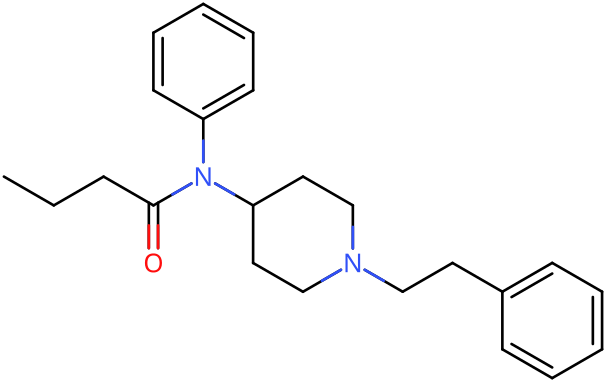
Butyrfentanyl Stats & Data
QQOMYEQLWQJRKK-UHFFFAOYSA-NPharmacology
DrugBankDescription
Butyrfentanyl or butyrylfentanyl (not to be confused with 3-methylfentanyl) is a potent short-acting synthetic opioid analgesic drug. It is an analog of fentanyl with roughly 1/30 the potency. Butyrfentanyl was first synthesized in 1961 by Janssen Pharmaceuticals as a new opioid analgesic. Butyrfentanyl has no current legitimate clinical applications, but anecdotal reports indicate it may occasionally be surfacing on the grey-market as a recreational drug. This compound is a schedule I controlled substance in the USA because it is a positional isomer of 3-Methylfentanyl. The DEA in the United States has confirmed at least 40 fatalities involving butyrfentanyl before May 2016.
Mechanism of Action
Butyrfentanyl is a µ opioid receptor agonist similar to fentanyl.
Pharmacodynamics
Data for the pharmacodynamics of butyrfentanyl are not readily available.
Metabolism
Butyrfentanyl can be N-dealkylated to nor-butyrfentanyl by CYP3A4 and CYP2D6, hydroxylated to (ω-1)-hydroxy-butyrfentanyl by CYP3A4, 4'-hydroxylated to 4'-hydroxy-butyrfentanyl, hydroxylated to ω-hydroxy-butyrfentanyl bye CYP2D6 or CYP3A4, or hydroxylated to β-hydroxy-butyrfentanyl by CYP3A4. ω-hydroxy-butyrfentanyl is further metabolized to ω-carboxy-butyrfentanyl while 4'-hydroxy-butyrfentanyl is further metabolized to 4'-hydroxy-3'-methoxy-butyrfentanyl. Many of these metabolites may undergo further conjugation reactions with glucuronic acid or sulfate.
Absorption
Data for the absorption of butyrfentanyl are not readily available.
Indication
Butyrfentanyl was investigated as a potential opioid analgesic but is no longer used for this purpose. It is more often being used as a recreational drug.
Half-life
Data for the half life of butyrfentanyl are not readily available.
Protein Binding
Protein binding studies for butyrfentanyl have not been performed but due to its structural similarity with fentanyl it is likely highly bound to serum albumin and alpha-1-acid glycoprotein in circulation.
Elimination
The route of elimination of butyrfentanyl has not been well described in the literature but most opioids are mainly eliminated in the urine.
Volume of Distribution
Data for the volume of distribution of butyrfentanyl are not readily available.
Clearance
Data for the clearance of butyrfentanyl are not readily available.
History & Culture
Butyrfentanyl first appears in scientific literature through documentation by the College on Problems of Drug Dependence, where it was referenced as an N-butyramide fentanyl analog. Pharmacological characterization of the compound—including analgesic efficacy studies, opioid receptor binding profiles, and related measures of narcotic properties—was published in 1987. Despite this early scientific description, the substance was never developed for clinical use. It later emerged as a designer drug, appearing as part of a broader resurgence of illicit fentanyl analogs that began in Estonia in the early 2000s and subsequently spread throughout Europe and former Soviet republics. This wave of novel fentanyl derivatives has been linked to hundreds of fatalities across these regions as new compounds continue to appear on unregulated markets. International scheduling efforts culminated in March 2017 when the United Nations Commission on Narcotic Drugs voted to add butyrfentanyl to Schedule I of the 1961 Single Convention on Narcotic Drugs.
Toxicity
DrugBankToxicity (DrugBank)
The LD50 of butyrfentanyl is not readily available. Patients experiencing an overdose may present with sedation, altered mental state, and difficulty breathing. Symptoms of overdose may be treated with naloxone and supportive measures.
Tolerance & Pharmacokinetics
drugs.wikiNo tolerance chart. Our decay curves for opioids were estimates, and a curve can make tolerance look longer-lasting than it is, which is the dangerous direction.
Opioid tolerance drops fast when you stop, and even a few days off can be enough, so a dose that used to be normal can now stop your breathing. Overdose deaths rise sharply after prison, detox or leaving treatment, and tolerance also falls during a hospital stay. After any break, start with a much smaller amount, try a test dose first, don't use alone, and keep naloxone within reach. Alcohol, benzodiazepines, gabapentinoids and other sedatives make an opioid overdose much more likely.
Sources: FRANK: heroin · National Harm Reduction Coalition · WHO: opioid overdose · Merrall et al. 2010 · Binswanger et al. 2007 · Strang et al. 2003 · FDA 2019: gabapentinoids and breathing
Experience Report Analysis
ErowidDemographics
Gender Distribution
Too few reports for a chart: gender is known from 1 report, and a split is drawn only from 20 reports or more. Counts are shown instead. Why 20?
- Male 1 of 1
Age Distribution
Reports Over Time
Legal Status
| Country | Status | Notes |
|---|---|---|
| China | Controlled | Designated as a controlled substance since October 2015 under national narcotics legislation. |
| Switzerland | Illegal | Prohibited since December 2015 under Swiss controlled substances regulations. |
| United Kingdom | Illegal | Controlled as a fentanyl analogue under provisions covering modifications of fentanyl through replacement of the N-propionyl group with another acyl group. |
| United States | Schedule I | Classified as a Schedule I controlled substance under federal law since May 2016. Possession, distribution, and manufacture are prohibited with no accepted medical use. |