
Clobazam Stats & Data
CXOXHMZGEKVPMT-UHFFFAOYSA-NPharmacology
DrugBankDescription
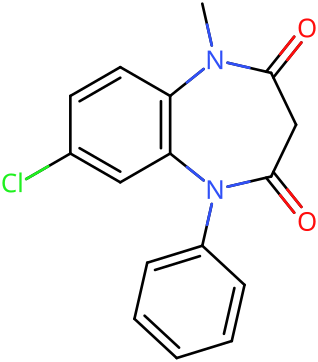
Clobazam belongs to the 1,5-benzodiazepine class of drugs and is expected to have a better side-effect profile compared to older 1,4-benzodiazepines. It has been marketed as an anxiolytic since 1975 and an anticonvulsant since 1984. The oral preparation was FDA approved on October 21, 2011. An oral suspension is expected to be available in 2013.
Mechanism of Action
Clobazam binds at distinct binding sites associated with the chloride ionopore at the post-synaptic GABA receptor. These GABA receptors are in various locations in the CNS (limbic, reticular formation) and clobazam increases the duration of time for which the chloride ionopore is open. As a result, hyper polarization and stabilization of the membrane occur as the post-synaptic inhibitory effect of GABA is enhanced.
Pharmacodynamics
Similar to other benzodiazepines, clobazam binds to the interface of the α and γ2-subunit of the GABA-A receptor. However, it is considered a partial agonist to GABA-A receptors which sets clobazam apart from 1,4-benzodiazepines which are full agonist. The significance of this difference is that one may experience less sedation with clobazam than with other benzodiazepines. Unlike the endogenous GABA ligand, clobazam binds allosterically to the GABA receptor to increase the frequency of the chloride channel opening and membrane permeability to chloride ions. Pharmacodynamic tolerance has been demonstrated in animal models.
Metabolism
Clobazam is extensively metabolized in the liver via N-demethylation and hydroxylation to form two major metabolites, N-desmethylclobazam (norclobazam) and 4'-hydroxyclobazam, respectively. N-desmethylclobazam (norclobazam) retains pharmacological activity. Norclobazam is one-fourth the potency of clobazam. The main enzyme that facilitates the process of N-demethylation is CYP3A4, and to a lesser extent by CYP2C19 and CYP2B6. Norclobazam itself is also metabolized via hydroxylation, primarily by CYP2C19. The formation of 4'-hydroxyclobazam is facilitated by CYP2C18 and CYP2C19. A factor in determining extent of metabolism is the genetic profile of the individual patient as CYP2C19 is a polymorphic enzyme.
Absorption
After oral administration of clobazam, it is almost completely absorbed (87% of dose). Bioavailability relative to solution was almost at 100%. Food does not affect absorption. Tmax = 1-3 hours.
Indication
For treatment and management of epilepsy and seizures associated with Lennox-Gastaut syndrome, a difficult-to-treat form of childhood epilepsy.
Half-life
The mean elimination half life of an oral dose of clobazam 40 mg is 32 hours. It's main metabolite, norclobazam, as a half life of 57 hours. The half life in adult patients with epilepsy are higher than those that are healthy.
Protein Binding
Clobazam is the primary circulating entity in the serum and is highly protein-bound (80-90%).
Elimination
Clobazam is eliminated via the urine (~94%) as metabolites.
Volume of Distribution
Vdss = 100 L. This high volume of distribution suggests extensive distribution to body tissues.
Receptor Profile
Receptor Actions
Receptor Binding
Overdose and intoxication with benzodiazepines, including clobazam, may lead to CNS depression, associated with drowsiness, confusion and lethargy, possibly progressing to ataxia, respiratory depression, hypotension, and, rarely, coma or death. The risk of a fatal outcome is increased in cases of combined poisoning with other CNS depressants, including alcohol. Symptoms of clobazam overdose are almost similar to other typical benzodiazepines, which include CNS depression, drowsiness, dizziness, hypotension, respiratory depression, confusion and lethargy, ataxia, and rarely coma or death.
Carcinogenicity
No indication of carcinogenicity to humans (not listed by IARC).
Liver injury risk
Ambiguous (limited data)
Toxicity (DrugBank)
The most common adverse effects include somnolence, pyrexia, upper respiratory tract infection, and lethargy.
Effect Profile
CuratedStrong anxiolysis with strong cognitive impairment, moderate euphoria, mild sedation
Tolerance & Pharmacokinetics
drugs.wikiNo tolerance chart. Our decay curves for these drugs were estimates, and a curve can make tolerance look longer-lasting than it is, which is the dangerous direction.
How fast tolerance to these drugs fades after a break has not been measured well enough to draw, so don't count on a dose you used to take still being safe: after time off, start with a much smaller amount and don't use alone. Mixing sedatives with each other, with alcohol or with opioids sharply raises the risk of a fatal overdose. If you've been using regularly, don't stop suddenly: withdrawal from benzodiazepines, alcohol or GHB/GBL can cause seizures or delirium, so get medical help to cut down gradually.
Sources: FRANK: benzodiazepines · Alcohol and Drug Foundation: GHB · FDA 2020: benzodiazepine boxed warning · FDA 2019: gabapentinoids and breathing · NHS: alcohol use disorder
Cross-Tolerances
Experience Report Analysis
ErowidDemographics
Gender Distribution
Too few reports for a chart: gender is known from 1 report, and a split is drawn only from 20 reports or more. Counts are shown instead. Why 20?
- Male 1 of 1
Age Distribution
Reports Over Time
Real-World Dose Distribution
ErowidFrom 6 of 6 recorded dose entries: those that state a weight (mg, g or µg), in routes with at least five of them. Values above Q3 + 3×IQR, far above what people typically take, are left out; they can include real heavy doses and overdoses, not only mistakes.
Oral (n=6)
Benzodiazepine Equivalence
Clobazam - 20mg ~=10mg Diazepam.
Harm Reduction
drugs.wiki• N-desmethylclobazam, the active metabolite, has a mean half-life of ~71–82 hours (longer than parent), causing accumulation, next-day sedation, and prolonged impairment with repeated dosing; effects are markedly higher in CYP2C19 poor metabolizers.
• Cannabidiol (CBD) significantly increases clobazam exposure (~60%±80%) and increases N-desmethylclobazam by roughly 3–5×, frequently causing excessive sedation; dose reductions and monitoring are recommended when combined.
• Combining benzodiazepines with opioids, alcohol, GHB/GBL, barbiturates, Z‑drugs, or gabapentinoids greatly elevates risk of respiratory depression, aspiration, blackouts, and death; avoid such combinations. Community HR charts and clinical warnings align on high risk.
• Alcohol specifically increases clobazam absorption by about 50%, further intensifying CNS depression beyond simple additivity.
• Stiripentol (for Dravet/LGS adjunct therapy) inhibits CYPs and disproportionately raises norclobazam levels; adverse effects often resolve after reducing clobazam dose.
• Avoid abrupt discontinuation after regular use; benzodiazepine withdrawal can include seizures. Gradual tapers are recommended; clinical programs commonly use 10–25% dose reductions every 2–3 weeks, individualized to symptoms.
• December 2023 FDA alert identified rare but severe DRESS (drug reaction with eosinophilia and systemic symptoms) with clobazam; seek urgent care for rash with fever or systemic symptoms.
• Next‑day driving and fall risk persist, especially in older adults, those with hepatic/respiratory disease, and with polypharmacy; plan no driving or high‑risk tasks until fully unimpaired.
• Metabolism: clobazam is mainly N‑demethylated by CYP3A4 (also 2C19/2B6) to N‑desmethylclobazam, which is cleared predominantly by CYP2C19; inhibitors/inducers of these enzymes materially change exposure.
• Pregnancy and neonatal risk: benzodiazepines cross the placenta and can cause neonatal sedation or withdrawal; both clobazam and its metabolite are present in breast milk — weigh risks/benefits and monitor infants if exposed.
References
Cited References
- DrugBank: Clobazam Pharmacology
- Epilepsy Foundation: Clobazam Information
- Erowid: Clobazam Vault
- MedlinePlus: Clobazam Drug Information
- NIH PMC: Clobazam - A Safe, Efficacious, and Newly Rediscovered Therapeutic for Epilepsy
- PubChem: Clobazam
- TripSit: Drug Combination Chart
- TripSit: List of Benzodiazepines
- DrugBank Article: Clobazam for Lennox-Gastaut syndrome
- Drug-Do: Benzos
Additional references
- DrugBank: Clobazam (DB00349) — PK, metabolism, food interaction, brand names
- StatPearls: Clobazam — PK, CBD interaction magnitude, DRESS warning, clinical cautions
- StatPearls: Cannabinoid Antiemetic Therapy — CBD raises N‑desmethylclobazam ~3×
- CADTH/NCBI Bookshelf: Stiripentol (Diacomit) — interaction raising (nor)clobazam levels
- TripSit Wiki: Drug combinations — benzodiazepines with opioids/alcohol/GHB marked dangerous
- Drugs‑Forum abstract: In vitro characterization of clobazam metabolism by recombinant CYPs
- NICE evidence review excerpts (Bookshelf): examples of benzodiazepine taper schedules (10–25% q2–3w)