
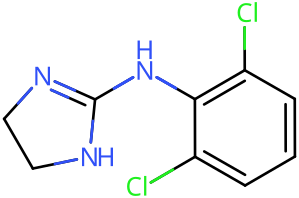
Clonidine Stats & Data
GJSURZIOUXUGAL-UHFFFAOYSA-NPharmacology
DrugBankDescription
Clonidine is an imidazole derivate that acts as an agonist of alpha-2 adrenoceptors. This activity is useful for the treatment of hypertension, severe pain, and ADHD. Clonidine was granted FDA approval on 3 September 1974.
Mechanism of Action
Clonidine is primarily an alpha-2 adrenoceptor agonist which causes central hypotensive and anti-arrhythmogenic effects. The alpha-2 adrenoceptor is coupled to the G-proteins Go and Gi. Gi inhibits adenylyl cyclase and activates opening of a potassium channel that causes hyperpolarization. Clonidine binding to the alpha-2 adrenoceptor causes structural changes in the alpha subunit of the G-protein, reducing its affinity for GDP. Magnesium catalyzes the replacement of GDP with GTP. The alpha subunit dissociates from the other subunits and associates with an effector. The stimulation of alpha-2 adrenoceptors in the locus coeruleus may be responsible for the hypnotic effects of clonidine as this region of the brain helps regulate wakefulness. Clonidine can also decrease transmission of pain signals at the spine. Finally clonidine can affect regulators of blood pressure in the ventromedial and rostral-ventrolateral areas of the medulla.
Pharmacodynamics
Clonidine functions through agonism of alpha-2 adrenoceptors which have effects such as lowering blood pressure, sedation, and hyperpolarization of nerves. It has a long duration of action as it is given twice daily and the therapeutic window is between 0.1mg and 2.4mg daily.
Metabolism
The metabolism of clonidine is poorly understood. The main reaction in clonidine metabolism is the 4-hydroxylation of clonidine by CYP2D6, CYP1A2, CYP3A4, CYP1A1, and CYP3A5. Clonidine is <50% metabolized in the liver to inactive metabolites.
Absorption
Clonidine reaches maximum concentration in 60-90 minutes after oral administration. Race and fasting status do not influence pharmacokinetics of clonidine. A 100µg oral clonidine tablet reaches a Cmax of 400.72pg/mL with an AUC of 5606.78h\*pg/mL and a bioavailability of 55-87%.
Indication
Clonidine tablets and transdermal systems are indicated for the treatment of hypertension alone or in combination with other medications. A clonidine injection is indicated for use with opiates in the treatment of severe cancer pain where opiates alone are insufficient. An extended release tablet of clonidine is indicated for the treatment of ADHD either alone or in combination with other medications. Clonidine is also used for the diagnosis of pheochromocytoma, treatment of nicotine dependance, and opiate withdrawal.
Half-life
The elimination half life after epidural administration is 30 minutes but otherwise can range from 6-23h.
Protein Binding
Clonidine is 20-40% bound to plasma proteins, especially albumin.
Elimination
Approximately 50% of a clonidine dose is excreted in the urine as the unchanged drug and 20% is eliminated in the feces.
Volume of Distribution
The volume of distribution of clonidine has been reported as 1.7-2.5L/kg, 2.9L/kg, or 2.1±0.4L/kg depending on the source.
Measured Affinities
Guide to PHARMACOLOGYMeasured binding and functional data for clonidine, curated by the IUPHAR/BPS Guide to PHARMACOLOGY. Each row cites the paper it came from. Lower concentrations mean tighter binding — a value in the sub-nanomolar range indicates a very potent interaction.
| Target | Action | Measure | Value | Concentration | Species | Source |
|---|---|---|---|---|---|---|
| α2A-adrenoceptor ADRA2A | Agonist | pEC50 | 9 | 1 nM | Human | PMID 36101495 |
| α2B-adrenoceptor ADRA2B | Agonist | pIC50 | 8.6 | 2.51 nM | Human | PMID 36101495 |
| α2A-adrenoceptor ADRA2A | Agonist | pIC50 | 8.2 | 6.31 nM | Human | PMID 36101495 |
| α2B-adrenoceptor ADRA2B | Agonist | pEC50 | 8 | 10 nM | Human | PMID 36101495 |
| α2C-adrenoceptor ADRA2C | Agonist | pEC50 | 7.8 | 15.85 nM | Human | PMID 36101495 |
| α2A-adrenoceptor ADRA2A | Agonist | pEC50 | 7.6 | 25.12 nM | Human | PMID 9605427 |
| α2B-adrenoceptor ADRA2B | Agonist | pEC50 | 7.4 | 39.81 nM | Human | PMID 36101495 |
| α1D-adrenoceptor Adra1d | Full agonist | pKi | 6.9 | 125.89 nM | Rat | PMID 7969082 |
| α2A-adrenoceptor ADRA2A | Agonist | pEC50 | 6.4 | 398.11 nM | Human | PMID 36101495 |
| Organic cation transporter 1 SLC22A1 | Inhibition | pKi | 6.26 | 549.54 nM | Human | PMID 9655880 |
| α1D-adrenoceptor ADRA1D | Agonist | pKi | 5.6 | 2,512 nM | Human | PMID 34355529 |
| HCN2 Hcn2 | Antagonist | pIC50 | 5.09 | 8,128 nM | Mouse | PMID 17261653 |
| HCN4 Hcn4 | Antagonist | pIC50 | 5.01 | 9,772 nM | Mouse | PMID 17261653 |
| HCN1 Hcn1 | Antagonist | pIC50 | 4.4 | 39,811 nM | Mouse | PMID 17261653 |
| α2A-adrenoceptor ADRA2A | Agonist | pKi | — | — | Human | — |
| α2B-adrenoceptor ADRA2B | Partial agonist | pKi | — | — | Human | — |
| α2C-adrenoceptor ADRA2C | Agonist | pIC50 | — | — | Human | — |
| α2C-adrenoceptor ADRA2C | Agonist | pEC50 | — | — | Human | PMID 25080296 |
| α2C-adrenoceptor ADRA2C | Agonist | pKi | — | — | Human | — |
Reading this. pKi, pEC50 and pIC50 are negative log molar values, so a higher number means a tighter interaction; the concentration column converts them for you. Values from non-human species are laboratory measurements and do not translate directly to human effect. Receptor affinity is not a dose — it describes what a molecule binds, not how much of it is safe to take.
Receptor data from the IUPHAR/BPS Guide to PHARMACOLOGY (v2026.2), licensed CC BY-SA 4.0. Matched to this substance by InChIKey.
At therapeutic doses (0.2-0.9 mg/d), clonidine is commonly associated with adverse effects such as dry mouth, sedation, dizziness, and constipation. While generally safe, at toxic doses clonidine can cause serious cardiopulmonary instability and central nervous system (CNS) depression in children and adults. Caution should be used when clonidine is taken with other depressants. It is strongly recommended that one use harm reduction practices when using this substance.
LD50
LD50: 150 mg/kg (oral, rat)LD50: 30 mg/kg (oral, dog)
Carcinogenicity
No indication of carcinogenicity to humans (not listed by IARC).
Liver injury risk
Low concern (rare serious cases reported)
Overdose
Symptoms of clonidine overdose include constriction of pupils of the eye, drowsiness, high blood pressure followed by a drop in pressure, irritability, low body temperature, slowed breathing, slowed heartbeat, slowed reflexes, and weakness. There are case reports that show naloxone may be a useful antidote in treating clonidine overdoses. However, this is not in widespread clinical use.
Tolerance & Pharmacokinetics
drugs.wikiTolerance Decay
Experience Report Analysis
ErowidDemographics
Gender Distribution
Age Distribution
Reports Over Time
Effect Analysis
ErowidEffects aggregated from 11 experience reports (11 single-substance Erowid)
Effect Sentiment Distribution
Confidence Distribution
Each bar is the share of reports mentioning the effect; its whisker, and the band on the rows below, is the 95% interval: where the share could plausibly be with other reports of the same kind.
Too few reports for bars: these effects come from 11 single-substance Erowid reports, and a bar is drawn only from 20 reports or more. With fewer, a percentage cannot tell a common effect from a rare one. Counts are shown instead. Why 20?
Positive Effects 1
Adverse Effects 0
Also reported in combinations. In the 14 Clonidine reports where another drug was taken too, 2 mention hospital, emergency services or an overdose, 1 a seizure and 0 psychosis (too few reports for percentages). In the 11 single-substance reports: 0, 0 and 1. These are not in the figures above: they cannot be put down to Clonidine alone, and a mention is not always something that happened to the writer.
Dosage Distribution
Dose distribution from experience reports, one dose per report (the first listed). Doses above Q3 + 3×IQR, far above what people typically take, are left out of the median and range and listed under each route: most are real heavy doses or overdoses, not mistakes.
Real-World Dose Distribution
ErowidFrom 26 of 31 recorded dose entries: those that state a weight (mg, g or µg), in routes with at least five of them. Values above Q3 + 3×IQR, far above what people typically take, are left out; they can include real heavy doses and overdoses, not only mistakes.
Oral (n=26)
Common Combinations
Most co-occurring substances, as a share of all 25 reports filed under Clonidine; whiskers are 95% intervals
Form / Preparation
Most common forms and preparations, as a share of the 11 reports that give one
Too few reports for bars: these forms come from 11 reports, and a bar is drawn only from 20 reports or more. With fewer, a percentage cannot tell a common effect from a rare one. Counts are shown instead. Why 20?
- Pill / Tablet 8 of 11
Body-Weight Dosing
Dose per kg of body weight, one dose per report (the first listed), from reports giving a weight of 30–250 kg. Doses above Q3 + 3×IQR, far above what people typically take, are left out of the median and range and listed under each route.
Redose Patterns
Redosing behavior across 20 reports