
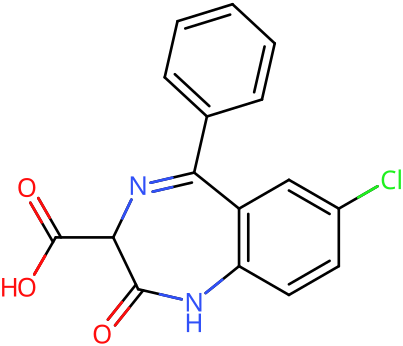
Clorazepate Stats & Data
XDDJGVMJFWAHJX-UHFFFAOYSA-NPharmacology
DrugBankDescription
A water-soluble benzodiazepine derivative effective in the treatment of anxiety. It has also muscle relaxant and anticonvulsant actions.
Mechanism of Action
Benzodiazepines bind nonspecifically to benzodiazepine receptors BNZ1, which mediates sleep, and BNZ2, which affects affects muscle relaxation, anticonvulsant activity, motor coordination, and memory. As benzodiazepine receptors are thought to be coupled to gamma-aminobutyric acid-A (GABAA) receptors, this enhances the effects of GABA by increasing GABA affinity for the GABA receptor. Binding of the inhibitory neurotransmitter GABA to the site opens the chloride channel, resulting in a hyperpolarized cell membrane that prevents further excitation of the cell.
Pharmacodynamics
Clorazepate is a member of the group of drugs called benzodiazepines. Pharmacologically, clorazepate has the characteristics of the benzodiazepines. It has depressant effects on the central nervous system. The primary metabolite, nordiazepam, quickly appears in the blood stream. Studies in healthy men have shown that clorazenate has depressant effects on the central nervous system. Since orally administered clorazepate dipotassium is rapidly decarboxylated to form nordiazepam, there is essentially no circulating parent drug.
Metabolism
The drug is metabolized in the liver and excreted primarily in the urine. The primary metabolite, nordiazepam, is further metabolized by hydroxylation. The major urinary metabolite is conjugated oxazepam (3-hydroxynordiazepam), and smaller amounts of conjugated p-hydroxynordiazepam and nordiazepam are also found in the urine.
Absorption
Rapidly absorbed following oral administration (bioavailability is 91%).
Indication
For the management of anxiety disorders or for the short-term relief of the symptoms of anxiety. Also used as adjunctive therapy in the management of partial seizures and for the symptomatic relief of acute alcohol withdrawal.
Half-life
The serum half-life is about 2 days. Nordiazepam, the primary metabolite, quickly appears in the blood and is eliminated from the plasma with an apparent half-life of about 40 to 50 hours.
Protein Binding
The protein binding of nordiazepam in plasma is high (97-98%).
Elimination
The drug is metabolized in the liver and excreted primarily in the urine.
Clorazepate dipotassium is classified as a psychloleptc, anxiolytic benzodiazepine derivative. White or light yellow solid crystals which are soluble in water, practically insoluble in acetone, in chloroform in dichloromethane and in ether. Benzodiazepines bind nonspecifically to benzodiazepine receptors BNZ1, which mediates sleep, and BNZ2, which affects affects muscle relaxation, anticonvulsant activity, motor coordination, and memory. As benzodiazepine receptors are thought to be coupled to gamma-aminobutyric acid-A (GABA<sub>A</sub>) receptors, this enhances the effects of GABA by increasing GABA affinity for the GABA receptor.
LD50
LD50: 1320 mg/kg (Oral, Rat) (A308)LD50: >1600 mg/kg (Oral, Rat)
Carcinogenicity
No indication of carcinogenicity to humans (not listed by IARC).
Health effects (PubChem excerpts)
May cause a potentially dangerous rash that may develop into Stevens Johnson syndrome, an extremely rare but potentially fatal skin disease.
Effect Profile
CuratedStrong anxiolysis and euphoria with mild cognitive impairment, low sedation
Tolerance & Pharmacokinetics
drugs.wikiNo tolerance chart. Our decay curves for these drugs were estimates, and a curve can make tolerance look longer-lasting than it is, which is the dangerous direction.
How fast tolerance to these drugs fades after a break has not been measured well enough to draw, so don't count on a dose you used to take still being safe: after time off, start with a much smaller amount and don't use alone. Mixing sedatives with each other, with alcohol or with opioids sharply raises the risk of a fatal overdose. If you've been using regularly, don't stop suddenly: withdrawal from benzodiazepines, alcohol or GHB/GBL can cause seizures or delirium, so get medical help to cut down gradually.
Sources: FRANK: benzodiazepines · Alcohol and Drug Foundation: GHB · FDA 2020: benzodiazepine boxed warning · FDA 2019: gabapentinoids and breathing · NHS: alcohol use disorder
Experience Report Analysis
ErowidDemographics
Gender Distribution
Too few reports for a chart: gender is known from 1 report, and a split is drawn only from 20 reports or more. Counts are shown instead. Why 20?
- Male 1 of 1
Reports Over Time
Benzodiazepine Equivalence
Clorazepate - 15mg ~=10mg Diazepam.