
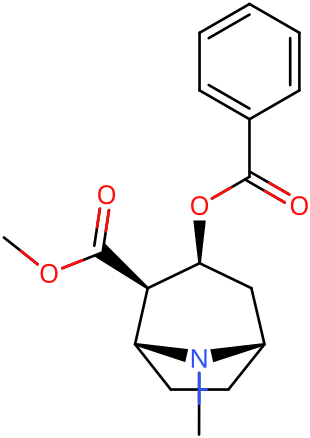
Cocaine Stats & Data
CN1C2CCC1C(C(C2)OC(=O)C3=CC=CC=C3)C(=O)OCZPUCINDJVBIVPJ-LJISPDSOSA-NInteraction Warnings
When used in conjunction with other stimulants, the cardiovascular effects of cocaine such as increased heart rate become dangerously high. This is potentially fatal and severely increases the risk of cardiac arrest.
When used in conjunction with depressants such as opioids and benzodiazepines, the cardiovascular effects of the two classes begin to conflict as one increases the heart rate while the other decreases it. This is potentially fatal and can result in an extremely irregular heart rate leading onto cardiac arrest.
The neurotoxic effects of MDMA may be increased when combined with cocaine.
Many cocaine users find that consumption of tobacco products during cocaine use enhances the euphoria because nicotine increases the levels of dopamine in the brain. This, however, may have undesirable consequences such as uncontrollable chain smoking during cocaine use (even users who do not smoke cigarettes have been known to chain smoke when using cocaine) in addition to the detrimental health effects and the additional strain on the cardiovascular system caused by tobacco.
Pharmacology
DrugBankDescription
An alkaloid ester extracted from the leaves of plants including coca. It is a local anesthetic and vasoconstrictor and is clinically used for that purpose, particularly in the eye, ear, nose, and throat. It also has powerful central nervous system effects similar to the amphetamines and is a drug of abuse. Cocaine, like amphetamines, acts by multiple mechanisms on brain catecholaminergic neurons; the mechanism of its reinforcing effects is thought to involve inhibition of dopamine uptake.
Mechanism of Action
Cocaine produces anesthesia by inhibiting excitation of nerve endings or by blocking conduction in peripheral nerves. This is achieved by reversibly binding to and inactivating sodium channels. Sodium influx through these channels is necessary for the depolarization of nerve cell membranes and subsequent propagation of impulses along the course of the nerve. Cocaine is the only local anesthetic with vasoconstrictive properties. This is a result of its blockade of norepinephrine reuptake in the autonomic nervous system. Cocaine binds differentially to the dopamine, serotonin, and norepinephrine transport proteins and directly prevents the re-uptake of dopamine, serotonin, and norepinephrine into pre-synaptic neurons. Its effect on dopamine levels is most responsible for the addictive property of cocaine.
Pharmacodynamics
Cocaine is a local anesthetic indicated for the introduction of local (topical) anesthesia of accessible mucous membranes of the oral, laryngeal and nasal cavities.
Metabolism
Hepatic. Cocaine is metabolized to benzoylecgonine and ecgonine methyl ester, which are both excreted in the urine. In the presence of alcohol, a further active metabolite, cocaethylene is formed, and is more toxic then cocaine itself.
Absorption
Cocaine is absorbed from all sites of application, including mucous membranes and gastrointestinal mucosa. By oral or intra-nasal route, 60 to 80% of cocaine is absorbed.
Indication
For the introduction of local (topical) anesthesia of accessible mucous membranes of the oral, laryngeal and nasal cavities.
Receptor Profile
Receptor Actions
Receptor Binding
Measured Affinities
Guide to PHARMACOLOGYMeasured binding and functional data for cocaine, curated by the IUPHAR/BPS Guide to PHARMACOLOGY. Each row cites the paper it came from. Lower concentrations mean tighter binding — a value in the sub-nanomolar range indicates a very potent interaction.
| Target | Action | Measure | Value | Concentration | Species | Source |
|---|---|---|---|---|---|---|
| DAT Slc6a3 | Inhibition | pIC50 | 7.1 | 79.43 nM | Rat | PMID 15566309 |
| 5-HT3AB HTR3A|HTR3B | Antagonist | pKi | 4.8 | 15,849 nM | Human | PMID 11489465 |
| 5-HT3A HTR3A | Antagonist | pKi | — | — | Human | — |
Reading this. pKi, pEC50 and pIC50 are negative log molar values, so a higher number means a tighter interaction; the concentration column converts them for you. Values from non-human species are laboratory measurements and do not translate directly to human effect. Receptor affinity is not a dose — it describes what a molecule binds, not how much of it is safe to take.
Receptor data from the IUPHAR/BPS Guide to PHARMACOLOGY (v2026.2), licensed CC BY-SA 4.0. Matched to this substance by InChIKey.
History & Culture
6000 BCE–present
Coca chewing dates back at least 8,000 years in South America, making it one of the oldest known psychoactive plant practices. The leaves were integral to Andean civilizations including the ancient Wari and Inca cultures, where they served both stimulant and medicinal purposes. Traditional consumption methods included chewing the dried leaves, drinking them as tea (known as "Mate de Coca"), or preparing them in a sachet wrapped around alkaline burnt ashes held against the inner cheek. The combination with alkaline substances such as lime or plant ash is essential for psychoactive effect, as this activates hydrolysis and produces the alkaloid ecgonine, which can then be absorbed by the body. Without these alkaline additives, coca leaves produce only a numbing effect on the tongue. Traditional applications centered on suppressing appetite, combating cold, and alleviating altitude sickness. When the Spanish arrived in South America, they initially banned coca but soon reversed course after recognizing its importance to indigenous labor, instead choosing to legalize and tax the substance. The word "cocaine" traces its etymology from the Quechua word "kúka," which passed through Spanish as "coca" and subsequently into French as "Cocaïne" before entering English.
1855–1900
The active alkaloid was first isolated from coca leaves in 1855 by German chemist Friedrich Gaedcke. The compound was later refined by Albert Niemann, who gave it the name "cocaine." During the late 1800s, cocaine gained significant popularity in Western medicine, primarily as a local anesthetic. Karl Koller's groundbreaking discovery of cocaine's anesthetic properties is regarded as the second most significant advance in the history of anesthesia. James Leonard Corning subsequently demonstrated its application in peridural anesthesia. Beyond medical applications, cocaine became a common ingredient in various commercial products during this period, including beverages and patent remedies. However, the compound's toxic effects and potential for abuse eventually drove the search for safer alternatives, and cocaine was gradually replaced in most medical contexts by synthetic local anesthetics with more favorable safety profiles.
1900–1920
Before the early 1900s, American newspapers primarily portrayed addiction as the main consequence of cocaine use, depicting typical users as upper or middle class White individuals. This characterization underwent a dramatic shift in the following years. In 1914, The New York Times published an article titled "Negro Cocaine 'Fiends' Are a New Southern Menace," which portrayed Black cocaine users as dangerous and possessing superhuman abilities to withstand normally fatal wounds. This racist narrative contributed to the social climate surrounding early drug legislation. The federal government instituted national drug labeling requirements for cocaine and cocaine-containing products through the Pure Food and Drug Act of 1906. The subsequent Harrison Narcotics Tax Act of 1914 established a regulatory and licensing regime rather than outright prohibition. Notably, the Harrison Act did not recognize addiction as a treatable medical condition, thereby outlawing the therapeutic use of cocaine, heroin, or morphine for individuals suffering from dependence.
1970–present
Prior to World War II, large-scale coca cultivation and cocaine production had expanded beyond South America to Taiwan (then known as Formosa) and Java in the Dutch East Indies (now Indonesia). The modern cocaine boom—characterized by a sharp rise in illegal production and trafficking—began in the late 1970s and peaked during the 1980s. From the 1980s onward, the cocaine trade became dominated by centralized, hierarchical drug cartels, most notably the Medellín and Cali organizations in Colombia, along with various successors and early factions of the FARC guerrilla group. By the early 2000s, this consolidated model fragmented into a diverse network of global trafficking links, enabling South American cocaine production to supply markets across Europe, Africa, Asia, and Oceania through multiple routes. In countries where cocaine is produced illegally, an intermediate product known as cocaine paste—referred to as "poor man's cocaine"—is frequently smoked in impoverished communities. This substance is favored in these areas primarily due to its low cost and greater accessibility compared to refined cocaine, though its use poses severe health risks. Cocaine production has also contributed substantially to environmental degradation; the United Nations Office on Drugs and Crime estimated that approximately 97,622 hectares of primary forest were cleared for coca cultivation between 2001 and 2004 in the Andean region alone, causing significant habitat destruction in areas recognized as biodiversity hotspots.
Subjective Effects
Physical
The physical effects of cocaine can be broken down into several components which progressively intensify proportional to dosage.
- Increased heart rate
- Stimulation: In terms of its effects on the physical energy levels of the user, cocaine is usually considered to be extremely energetic and stimulating in a fashion that is comparatively weaker than amphetamine or methamphetamine, but stronger than that of modafinil, caffeine, and methylphenidate. It is similar yet distinct from the stimulation experienced on MDMA, encouraging physical activities such as dancing, socializing, running, or cleaning. The particular style of stimulation which cocaine presents can be described as encouraged at low to moderate dosages but forced at higher dosages. This means that at certain dosages, it becomes difficult or impossible to keep still as jaw clenching, involuntarily bodily shakes and vibrations become present, resulting in extreme shaking of the entire body, unsteadiness of the hands, and a general lack of motor control. This effect is replaced with mild fatigue and general exhaustion during the offset of the experience.
- Abnormal heartbeat: This substance consistently raises one's heart rate to abnormally high levels which can be potentially dangerous with prolonged or extremely high dosages.
- Dehydration
- Sublingual numbing
- Appetite suppression
- Pain relief
- Vasoconstriction
- Temporary erectile dysfunction
- Bronchodilation
- Increased perspiration
- Increased blood pressure
Cognitive
The cognitive effects of cocaine can be broken down into several components which progressively intensify proportional to dosage. The general head space of cocaine is described by many as one of extreme mental stimulation, increased focus, and powerful euphoria. It contains a large number of typical stimulant cognitive effects. Although negative side effects are usually mild at low to moderate dosages, they become increasingly likely to manifest themselves with higher amounts or extended usage. This particularly holds true during the offset of the experience.
- Thought acceleration
- Focus enhancement: This component is most effective at low to moderate dosages as anything higher will usually impair concentration.
- Ego inflation
- Wakefulness
- Disinhibition
- Motivation enhancement
- Euphoria
- Anxiety
- Depression
- Irritability
- Compulsive redosing
- Cognitive fatigue: This component can occur during the offset of this compound as a rebound effect which is usually equal in its intensity to the enhancements which occurred before it.
Forked from Subjective Effect Documentation by Josie Kins, September 2015. Via dose.wiki (CC0).
Chronic cocaine use has been shown to lead to neurotoxicity, being associated with high morbidity and mortality rates. Its extended use or abuse does also cause short-term downregulation of neurotransmitters. The most potentially harmful physical effects of cocaine appear to be not neurological but cardiovascular. Severe cardiac adverse events, particularly sudden cardiac death, become a serious risk at high doses due to cocaine's blocking effect on cardiac sodium channels. Moreover, long-term cocaine use may result in cocaine-related cardiomyopathy.
LD50
LD50: 95.1 mg/kg (i.p, mouse) (L1860)
Carcinogenicity
No indication of carcinogenicity to humans (not listed by IARC).
Addiction & dependence
As with other stimulants, the chronic use of cocaine can be considered highly addictive with a high potential for abuse and is capable of causing psychological dependence among certain users. When addiction has developed, cravings and withdrawal effects may occur if a person suddenly stops their usage. Addiction is a serious risk with heavy recreational cocaine use but is unlikely to arise from typical medical use.
Effect Profile
Curated + 530 ReportsStrong euphoria with moderate stimulation and anxiety/jitters, mild focus
User Experiences
Duration Timeline
BluelightCommunity Effects
TripSitTolerance & Pharmacokinetics
drugs.wikiTolerance Decay
Marked acute tachyphylaxis within a session; compulsion to redose creates binge patterns. Subjective tolerance tends to decline substantially over 3–7 days and approaches baseline by ~1–2 weeks in many users. Numbers are approximate and reflect anecdotal/clinical synthesis rather than formal PK/PD studies.
Cross-Tolerances
Demographics
Gender Distribution
Age Distribution
Reports Over Time
Effect Analysis
Erowid + BluelightEffects aggregated from 468 experience reports (418 single-substance Erowid + 112 Bluelight)
Effect Sentiment Distribution
Confidence Distribution
Each bar is the share of reports mentioning the effect; its whisker, and the band on the rows below, is the 95% interval: where the share could plausibly be with other reports of the same kind.
Positive Effects 42
Adverse Effects 64
Show 41 more adverse effects
Show 28 neutral or unclassified mentions
Also reported in combinations. In the 247 Cocaine reports where another drug was taken too, 25 (10.1%) mention hospital, emergency services or an overdose, 9 (3.6%) a seizure and 10 (4.0%) psychosis. In the 418 single-substance reports: 8.9%, 2.6% and 1.0%. These are not in the figures above: they cannot be put down to Cocaine alone, and a mention is not always something that happened to the writer.
Dose-Response Correlation
How effect frequency changes across dose levels. Whiskers, and the numbers' hover text, give each figure's 95% interval.
View data table
| Effect | Heavy (n=45) |
|---|---|
| Euphoria | 46.7% (95% interval 33 to 61 percent) |
| Anxiety | 44.4% (95% interval 31 to 59 percent) |
| Stimulation | 42.2% (95% interval 29 to 57 percent) |
| Empathy | 22.2% (95% interval 12 to 36 percent) |
| Confusion | 17.8% (95% interval 9 to 31 percent) |
| Music Enhancement | 17.8% (95% interval 9 to 31 percent) |
| Increased Heart Rate | 15.6% (95% interval 8 to 29 percent) |
| Hospital | 8.9% (95% interval 4 to 21 percent) |
| Headache | 8.9% (95% interval 4 to 21 percent) |
| Sedation | 8.9% (95% interval 4 to 21 percent) |
| Memory Suppression | 8.9% (95% interval 4 to 21 percent) |
| Focus Enhancement | 8.9% (95% interval 4 to 21 percent) |
| Jaw Clenching | 8.9% (95% interval 4 to 21 percent) |
| Dissociation | 8.9% (95% interval 4 to 21 percent) |
| Visual Distortions | 8.9% (95% interval 4 to 21 percent) |
Subjective Effect Ontology
Experience ReportsStructured effect tags extracted from 715 Erowid & Bluelight experience reports using a controlled vocabulary of 220+ canonical effects across 15 domains.
Auditory
Cognitive
Emotional
Motor
Dose–Effect Mapping
Experience ReportsHow reported effects shift across dose tiers, based on 418 single-substance experience reports. The shaded band on each bar is its 95% interval. An arrow (↑ ↓) marks a change between the lowest and highest tier that count an effect only when the gap is bigger than chance would explain; ~ means no clear change. How changes are called
Limited tier coverage — most reports fall within the Heavy range. Effects at other dose levels may not be represented.
| Effect | Heavy (n=45) | Change with dose |
|---|---|---|
| euphoria | ||
| anxiety | ||
| stimulation | ||
| empathy | ||
| confusion | ||
| music enhancement | ||
| increased heart rate | ||
| hospital | ||
| headache | ||
| sedation | ||
| memory suppression | ||
| focus enhancement | ||
| jaw clenching | ||
| dissociation | ||
| visual distortions | ||
| nausea | ||
| auditory effects | ||
| sweating | ||
| pupil dilation | ||
| body high |
Showing top 20 of 21 effects
Dosage Distribution
Dose distribution from experience reports, one dose per report (the first listed). Doses above Q3 + 3×IQR, far above what people typically take, are left out of the median and range and listed under each route: most are real heavy doses or overdoses, not mistakes.
Real-World Dose Distribution
ErowidFrom 180 of 434 recorded dose entries: those that state a weight (mg, g or µg), in routes with at least five of them. Values above Q3 + 3×IQR, far above what people typically take, are left out; they can include real heavy doses and overdoses, not only mistakes.
Insufflated (n=138)
Intravenous (n=24)
Oral (n=6)
Smoked (n=7)
Common Combinations
Most co-occurring substances, as a share of all 665 reports filed under Cocaine; whiskers are 95% intervals
Form / Preparation
Most common forms and preparations, as a share of the 506 reports that give one; whiskers are 95% intervals
Body-Weight Dosing
Dose per kg of body weight, one dose per report (the first listed), from reports giving a weight of 30–250 kg. Doses above Q3 + 3×IQR, far above what people typically take, are left out of the median and range and listed under each route.
Insufflated
2 reports gave a dose above the typical range (121.581–171.569 mg/kg), so they are not in the figures above. Listing a dose here does not mean it is safe.
Show the reports
- 171.569 mg/kg · another drug taken too
- 121.581 mg/kg
Intravenous
Redose Patterns
Redosing behavior across 533 reports
Legal Status
| Country | Status | Notes |
|---|---|---|
| Australia | Schedule 8 (Poisons Standard) | Controlled drug requiring prescription for medical use. In Western Australia, the Misuse of Drugs Act 1981 specifies threshold quantities: 4.0 grams determines court of trial jurisdiction, 2.0 grams creates presumption of intent to supply, and 28.0 grams constitutes trafficking. |
| Bolivia | Coca leaf legal; refined cocaine prohibited | Coca cultivation for traditional indigenous consumption is protected under the Bolivian Cato accord, which specifies allowable annual yields for farmers. Coca leaves may be chewed or consumed as tea. Production, distribution, and consumption of refined cocaine remain criminal offenses. |
| Canada | Controlled (prescription medical use permitted) | Cocaine hydrochloride pharmaceutical preparations are available for legitimate medical purposes. Topical solutions have been marketed since the 1990s for clinical applications. Recreational possession, production, and distribution remain prohibited. |
| Colombia | Coca leaf legal; refined cocaine prohibited | Cultivation of coca leaf is permitted for traditional consumption by indigenous populations. Manufacturing, trafficking, and recreational use of cocaine are prohibited under national drug control legislation. |
| Peru | Coca leaf legal; refined cocaine prohibited | Traditional coca leaf consumption is permitted, including chewing and preparation as tea. The National Coca Company, a state enterprise, produces and sells coca-based teas and medicinal products, and exports leaves internationally for pharmaceutical use. However, production, sale, and recreational consumption of refined cocaine are illegal. |
| United States | Schedule II (Controlled Substances Act) | Classified as having high abuse potential with accepted medical uses. The 1970 Controlled Substances Act regulates manufacture, importation, possession, and distribution. Medical cocaine products remain available for topical anesthesia, including Goprelto (approved December 2017) and Numbrino (approved January 2020). Historical legislation includes the Harrison Narcotics Tax Act of 1914, which established licensing requirements, and the Jones-Miller Act of 1922, which imposed manufacturing restrictions. The Anti-Drug Abuse Act of 1986 created significant sentencing disparities between powder and crack cocaine. |
Harm Reduction
drugs.wiki- Alcohol + cocaine forms cocaethylene in the liver, which lasts longer than cocaine and is more cardiotoxic; this combo has been linked to higher rates of sudden death and stroke versus cocaine alone. Avoid co-use and beware delayed toxicity if alcohol was consumed earlier in the day.
- Fentanyl and other potent opioids have been repeatedly detected in white powders sold as cocaine in some regions; this has caused clusters of opioid overdoses among stimulant users. Never assume stimulant-only; avoid mixing with opioids, carry naloxone where legal, and test if drug checking is available.
- Levamisole, phenacetin, local anesthetics (lidocaine/procaine/benzocaine), and caffeine are common adulterants. Levamisole can cause agranulocytosis and vasculitis; seek medical care for fevers, mouth sores, or skin lesions. Drug checking services frequently report these cuts.
- Snorting care: finely crush, use your own clean straw or single-use tool, rinse with sterile/saline water before and after, rotate nostrils, and take breaks to reduce septal damage and infections, including BBV transmission via microbleeds. Avoid banknotes.
- High cardiovascular strain (tachycardia, hypertension, vasospasm) and overheating are key acute risks. Avoid strenuous activity/overheating, especially during binges; seek urgent care for chest pain, severe headache, confusion, or hyperthermia. Clinical guidance emphasizes external cooling and supportive care for toxicity.
- Beta-blockers: do not self-medicate. The old warning about “unopposed alpha” is debated; mixed alpha/beta agents (e.g., labetalol) are used in clinical settings, but nonselective beta-blockers can be problematic. If prescribed beta-blockers, discuss stimulant use with a clinician.
- Serotonergic medicines (SSRIs/SNRIs, tramadol, MAOIs) can increase risk of serotonin toxicity; MAOIs are particularly hazardous with stimulants. Treat all serotonergic combinations as higher risk and avoid MAOIs entirely.
- IV use markedly increases risk of arrhythmia, infection, and overdose. If injecting, sterile equipment, sterile water, skin cleaning, and safe disposal are essential; consider alternative routes to reduce harm.
- Smoking applies to crack/freebase only; use proper glass stems and heat-resistant screens to reduce burns and inhalation of toxic plastics. Avoid plastic pens/foil. HR orgs advise dedicated safer-smoking equipment.
- Sleep loss and repeated redosing amplify anxiety/paranoia and crash severity. Plan limits for dose/stop time, hydrate with modest fluids and electrolytes, eat light food, and schedule recovery sleep.
- Pregnancy/breastfeeding: cocaine passes into breast milk and has caused infant toxicity; complete avoidance is advised.
- Mixing with ketamine is increasingly reported in nightlife settings; the combination can complicate emergencies and adds cardiovascular and dissociative risks—treat as unsafe.
References
Data Sources
Cited References
- EMCDDA: Cocaine and Crack Drug Profile
- Erowid Cocaine Vault: Basics
- Erowid Cocaine Vault: Effects
- Hofmaier et al. 2014: Levamisole Neurotoxicity
- Nutt et al. 2010: Drug Harms in the UK
- O'Leary & Hancox 2010: Cocaine-Associated Cardiac Arrhythmias
- PsychonautWiki: Cocaine
- PubChem: Cocaine
- DrugWise: Cocaine Infographic
Additional references
- DrugBank: Cocaine (DB00907)
- Hi-Ground: Cocaine HR page (duration, dosing, safer snorting/injecting)
- NCBI Bookshelf: Treatment for Stimulant Use Disorders (cocaethylene toxicity)
- NCBI Bookshelf/StatPearls: Cocaine Toxicity (management; beta-blockers)
- EUDA/EMCDDA: Adulterants incl. levamisole (cocaine & crack profile/news)
- NCBI: Adverse effects of levamisole in cocaine users (review)
- Bluelight case summary: fentanyl sold as cocaine cluster
- Bluelight Drugs 101 (overview of onset/duration; inhaled/IV comments)