
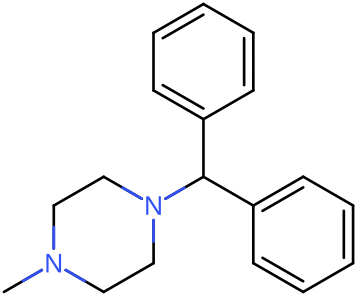
Cyclizine Stats & Data
UVKZSORBKUEBAZ-UHFFFAOYSA-NPharmacology
DrugBankDescription
A histamine H1 antagonist given by mouth or parenterally for the control of postoperative and drug-induced vomiting and in motion sickness. (From Martindale, The Extra Pharmacopoeia, 30th ed, p935)
Mechanism of Action
Vomiting (emesis) is essentially a protective mechanism for removing irritant or otherwise harmful substances from the upper GI tract. Emesis or vomiting is controlled by the vomiting centre in the medulla region of the brain, an important part of which is the chemotrigger zone (CTZ). The vomiting centre possesses neurons which are rich in muscarinic cholinergic and histamine containing synapses. These types of neurons are especially involved in transmission from the vestibular apparatus to the vomiting centre. Motion sickness principally involves overstimulation of these pathways due to various sensory stimuli. Hence the action of cyclizine which acts to block the histamine receptors in the vomiting centre and thus reduce activity along these pathways. Furthermore since cyclizine possesses anti-cholinergic properties as well, the muscarinic receptors are similarly blocked.
Pharmacodynamics
Cyclizine is a piperazine-derivative antihistamine used as an antivertigo/antiemetic agent. Cyclizine is used in the prevention and treatment of nausea, vomiting, and dizziness associated with motion sickness. Additionally, it has been used in the management of vertigo in diseases affecting the vestibular apparatus. Although the mechanism by which cyclizine exerts its antiemetic and antivertigo effects has not been fully elucidated, its central anticholinergic properties are partially responsible. The drug depresses labyrinth excitability and vestibular stimulation, and it may affect the medullary chemoreceptor trigger zone. It also possesses anticholinergic, antihistaminic, central nervous system depressant, and local anesthetic effects.
Metabolism
Cyclizine is metabolised to its N-demethylated derivative, norcyclizine, which has little antihistaminic (H1) activity compared to Cyclizine.
Indication
For prevention and treatment of nausea, vomiting, and dizziness associated with motion sickness, and vertigo (dizziness caused by other medical problems).
Measured Affinities
Guide to PHARMACOLOGYMeasured binding and functional data for cyclizine, curated by the IUPHAR/BPS Guide to PHARMACOLOGY. Each row cites the paper it came from. Lower concentrations mean tighter binding — a value in the sub-nanomolar range indicates a very potent interaction.
| Target | Action | Measure | Value | Concentration | Species | Source |
|---|---|---|---|---|---|---|
| H1 receptor HRH1 | Antagonist | pKi | 8.35 | 4.47 nM | Human | — |
Reading this. pKi, pEC50 and pIC50 are negative log molar values, so a higher number means a tighter interaction; the concentration column converts them for you. Values from non-human species are laboratory measurements and do not translate directly to human effect. Receptor affinity is not a dose — it describes what a molecule binds, not how much of it is safe to take.
Receptor data from the IUPHAR/BPS Guide to PHARMACOLOGY (v2026.2), licensed CC BY-SA 4.0. Matched to this substance by InChIKey.
Tolerance & Pharmacokinetics
drugs.wikiTolerance Decay
Experience Report Analysis
ErowidDemographics
Gender Distribution
Too few reports for a chart: gender is known from 12 reports, and a split is drawn only from 20 reports or more. Counts are shown instead. Why 20?
- Male 10 of 12
- Female 2 of 12
Age Distribution
Reports Over Time
Effect Analysis
ErowidEffects aggregated from 8 experience reports (8 single-substance Erowid)
Effect Sentiment Distribution
Confidence Distribution
Each bar is the share of reports mentioning the effect; its whisker, and the band on the rows below, is the 95% interval: where the share could plausibly be with other reports of the same kind.
Too few reports for bars: these effects come from 8 single-substance Erowid reports, and a bar is drawn only from 20 reports or more. With fewer, a percentage cannot tell a common effect from a rare one. Counts are shown instead. Why 20?
Positive Effects 2
Adverse Effects 2
Show 3 neutral or unclassified mentions
Also reported in combinations. In the 4 Cyclizine reports where another drug was taken too, 1 mentions hospital, emergency services or an overdose, 0 a seizure and 1 psychosis (too few reports for percentages). In the 8 single-substance reports: 2, 0 and 0. These are not in the figures above: they cannot be put down to Cyclizine alone, and a mention is not always something that happened to the writer.
Real-World Dose Distribution
ErowidFrom 6 of 13 recorded dose entries: those that state a weight (mg, g or µg), in routes with at least five of them. Values above Q3 + 3×IQR, far above what people typically take, are left out; they can include real heavy doses and overdoses, not only mistakes.
Oral (n=6)
Form / Preparation
Most common forms and preparations, as a share of the 7 reports that give one
Too few reports for bars: these forms come from 7 reports, and a bar is drawn only from 20 reports or more. With fewer, a percentage cannot tell a common effect from a rare one. Counts are shown instead. Why 20?
- Pill / Tablet 6 of 7
Redose Patterns
Redosing behavior across 10 reports
Too few reports for a chart: redosing is known from 10 reports, and a split is drawn only from 20 reports or more. Counts are shown instead. Why 20?
- Single dose 9 of 10
- Redosed 1 of 10