
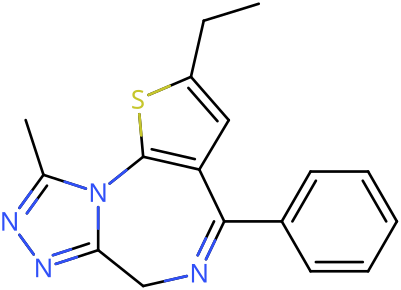
Deschloroetizolam Stats & Data
CCc1cc2C(=NCc3nnc(C)n3c2s1)c1ccccc1JIOBORXCOGMHSV-UHFFFAOYSA-NInteraction Warnings
This combination can result in an increased risk of vomiting during unconsciousness and death from the resulting suffocation. If this occurs, users should attempt to fall asleep in the recovery position or have a friend move them into it.
It is dangerous to combine benzodiazepines with stimulants due to the risk of excessive intoxication. Stimulants decrease the sedative effect of benzodiazepines, which is the main factor most people consider when determining their level of intoxication. Once the stimulant wears off, the effects of benzodiazepines will be significantly increased, leading to intensified disinhibition as well as other effects.
Receptor Profile
Receptor Actions
History & Culture
Deschloroetizolam is a designer thienotriazolodiazepine that emerged as a novel psychoactive substance in 2014. The compound is structurally derived from etizolam, differing only by the removal of a chlorine atom from the parent molecule—hence the "deschloro" prefix in its name. This minor structural modification results in a substance approximately half as potent as etizolam but with a duration roughly twice as long. The substance first appeared on grey market research chemical vendor websites, marketed primarily to collectors and researchers seeking legal alternatives to controlled benzodiazepines and thienodiazepines. It is sometimes sold under the alternative name "Etizolam-2." Unlike its parent compound etizolam, which holds medical approval in certain countries including Japan, Italy, and India, deschloroetizolam has never been developed for therapeutic use and lacks formal pharmaceutical recognition in any jurisdiction.
Subjective Effects
Physical
The physical effects of deschloroetizolam can be broken down into several components which progressively intensify proportional to dosage.
- Sedation: In terms of energy level alterations, this drug is extremely sedating and often results in an overwhelmingly lethargic state. At higher levels, this causes users to suddenly feel as if they are extremely sleep deprived and have not slept for days, forcing them to sit down and generally feel as if they are constantly on the verge of passing out instead of engaging in physical activities. This sense of sleep deprivation increases proportional to dosage and eventually becomes powerful enough to force a person into complete unconsciousness.
- Respiratory depression
- Muscle relaxation
- Dizziness
Cognitive
The cognitive effects of deschloroetizolam can be broken down into several components which progressively intensify proportional to dosage. The general head space of deschloroetizolam is described by many as one of intense sedation and decreased inhibition. It contains a large number of typical depressant cognitive effects. Paradoxical reactions to benzodiazepines such as increased seizures (in epileptics), aggression, increased anxiety, violent behavior, loss of impulse control, irritability and suicidal behavior sometimes occur (although they are rare in the general population, with an incidence rate below 1%). These paradoxical effects occur with greater frequency in recreational abusers, individuals with mental disorders, children, and patients on high-dosage regimes.
- Amnesia
- Anxiety suppression
- Thought deceleration
- Disinhibition
- Information processing suppression
- Euphoria
- Compulsive redosing
- Delusions of sobriety: This is the false belief that one is perfectly sober despite obvious evidence to the contrary such as severe cognitive impairment and an inability to fully communicate with others.
Forked from Subjective Effect Documentation by Josie Kins, August 2015. Via dose.wiki (CC0).
Toxicity
PsychonautWikiDeschloroetizolam likely has a low toxicity relative to dose. However, it is potentially lethal when mixed with depressants like alcohol or opioids. It is strongly recommended that one use harm reduction practices when using this drug.
Overdose
Thienodiazepine overdose may occur when a thienodiazepine is taken in extremely heavy quantities or concurrently with other depressants. This is particularly dangerous with other GABAergic depressants such as barbiturates and alcohol since they work in a similar fashion, but bind to distinct allosteric sites on the GABAA receptor, thus their effects potentiate one another.
Effect Profile
Curated + 3 ReportsStrong anxiolysis and euphoria with mild sedation and cognitive impairment
Tolerance & Pharmacokinetics
drugs.wikiNo tolerance chart. Our decay curves for these drugs were estimates, and a curve can make tolerance look longer-lasting than it is, which is the dangerous direction.
How fast tolerance to these drugs fades after a break has not been measured well enough to draw, so don't count on a dose you used to take still being safe: after time off, start with a much smaller amount and don't use alone. Mixing sedatives with each other, with alcohol or with opioids sharply raises the risk of a fatal overdose. If you've been using regularly, don't stop suddenly: withdrawal from benzodiazepines, alcohol or GHB/GBL can cause seizures or delirium, so get medical help to cut down gradually.
Sources: FRANK: benzodiazepines · Alcohol and Drug Foundation: GHB · FDA 2020: benzodiazepine boxed warning · FDA 2019: gabapentinoids and breathing · NHS: alcohol use disorder
Cross-Tolerances
Experience Report Analysis
ErowidDemographics
Gender Distribution
Too few reports for a chart: gender is known from 4 reports, and a split is drawn only from 20 reports or more. Counts are shown instead. Why 20?
- Male 2 of 4
- Not Specified 1 of 4
- Female 1 of 4
Age Distribution
Reports Over Time
Real-World Dose Distribution
ErowidFrom 10 of 12 recorded dose entries: those that state a weight (mg, g or µg), in routes with at least five of them. Values above Q3 + 3×IQR, far above what people typically take, are left out; they can include real heavy doses and overdoses, not only mistakes.
Oral (n=10)
Legal Status
| Country | Status | Notes |
|---|---|---|
| Canada | Not scheduled | Thienodiazepines are not scheduled under Canadian controlled substances legislation. However, sale or provision for human consumption is prohibited as deschloroetizolam lacks approval as a medical drug. |
| Germany | NpSG controlled | Controlled under the Neue-psychoaktive-Stoffe-Gesetz (New Psychoactive Substances Act) since July 18, 2019. Production and import with intent to market, administration to others, and trading constitute criminal offenses. Possession is prohibited but not subject to criminal penalty. |
| Russia | Schedule III | Listed as a Schedule III controlled substance since 2017 under Russian drug control legislation. |
| Switzerland | Verzeichnis E | Specifically named as a controlled substance under Verzeichnis E of Swiss narcotics scheduling. |
| Turkey | Illegal | Classified as a controlled drug under Turkish law. Possession, production, supply, and import are all prohibited activities. |
| United Kingdom | Psychoactive Substances Act | Controlled under the Psychoactive Substances Act 2016, effective May 26, 2016. Production, supply, and import are criminal offenses. Personal possession is not criminalized under this legislation, though the substance remains in a legal grey area. |
Harm Reduction
drugs.wikiDeschloroetizolam is a thienotriazolodiazepine closely related to etizolam; drug checking programs describe it as roughly half as strong per milligram and lasting up to about twice as long as etizolam, which increases next-day impairment risk; plan activities accordingly. Community and HR sources consistently flag benzodiazepines combined with alcohol, opioids, or GHB/GBL as dangerous due to additive/synergistic respiratory depression; avoid these combinations entirely and place any unresponsive person in the recovery position while seeking emergency help. Tramadol with benzodiazepines is particularly risky because it adds respiratory/CNS depression and has seizure potential; avoid this pairing. Etizolam (the parent compound) is primarily metabolized by CYP3A4; given close structural similarity, deschloroetizolam may be similarly affected—CYP3A4 inhibitors (azole antifungals, macrolides, grapefruit) can raise levels and prolong effects; dose conservatively and avoid redosing if such inhibitors are on board. Potency is in the low-milligram range; use a calibrated 0.001 g scale or volumetric dosing and ensure complete dissolution—do not rely on cloudy suspensions as uneven distribution can cause accidental overdoses and blackouts. Illicit supply variability is high; drug checking services have repeatedly detected deschloroetizolam—sometimes unexpectedly—in fentanyl samples; if any opioid exposure is possible, keep naloxone available (it reverses opioids, not benzodiazepines) and avoid using alone. Regular use builds tolerance quickly and can produce significant dependence; abrupt cessation after sustained use can trigger severe withdrawal and seizures—seek medical supervision for any taper. Flumazenil can reverse benzodiazepine effects in medical settings but may precipitate seizures in benzodiazepine-dependent people or mixed overdoses; it must not be self-administered. Avoid driving or operating machinery for at least a full waking day after significant doses due to amnesia, impaired coordination, and residual sedation. Because formal human pharmacokinetic data are limited, all timelines should be treated as approximate; start low, wait full onset and peak, and avoid stacking doses.
References
Cited References
- Characterization of designer benzodiazepines - Huppertz et al. 2015
- CFSRE: Deschloroetizolam Monograph
- PubMed: Designer benzodiazepines' pharmacological effects
- IsomerDesign: Explore the structures and analogues of Deschloroetizolam
- NDEWS: Alert - Deschloroetizolam
- New Designer Benzodiazepines - PMC
- PMC: Novel Designer Benzodiazepines Review
- TripSit: Deschloroetizolam Factsheet
Additional references
- TripSit Drug Combinations – benzodiazepines & alcohol/opioids/GHB/tramadol entries
- DrugChecking Community – Drug Dictionary (Deschloroetizolam profile: ~half as strong, lasts ~2× vs. etizolam)
- Toronto Drug Checking Service – multiple reports detecting deschloroetizolam in fentanyl/unexpected samples (supply variability)
- Toronto Drug Checking Service – report Oct 8–21, 2022 (deschloroetizolam found in fentanyl samples)
- DrugBank – Itraconazole inhibits etizolam metabolism; evidence for CYP3A4 involvement (inference to DCE)
- DrugBank – Etizolam metabolism summary (CYP3A4-major; longer half-life of metabolite)
- TripSit – Resources page (Volumetric Converter tool)
- Reddit (community HR) – Volumetric solution issues with deschloroetizolam; need full dissolution (avoid suspensions)
- Bluelight – DCE user reports (onset ~30 min; duration ~8–10 h; common doses in low mg)
- Bluelight – DCE thread: weaker than etizolam, longer lasting (anecdotal)
- Erowid – Alprazolam FAQ: flumazenil risks in dependent/mixed overdose contexts
- Erowid – Benzodiazepine ‘Bits & Pieces’: tolerance and withdrawal risks
- IsomerDesign – PiHKAL info, indexing thienotriazolodiazepines (structural context)