
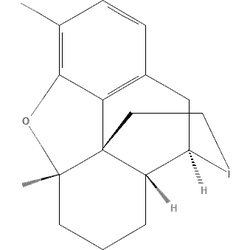
Desomorphine Stats & Data
CN1CCC23C4CCCC3C1Cc1ccc(O)c(O4)c12LNNWVNGFPYWNQE-GMIGKAJZSA-NPharmacology
DrugBankDescription
Desomorphine is a morphine analogue where the 6-hydroxyl group and the 7,8 double bond have been reduced. The traditional synthesis of desomorphine starts from α-chlorocodide, which is itself obtained by treating thionyl chloride with codeine. By catalytic reduction, α-chlorocodide gives dihydrodesoxycodeine, which yields desomorphine on demethylation. Desomorphine has been created by the public as a street drug. In that context, it is commonly called krokodil (Russian for crocodile), named for the scaly sores and necrosis that develop around the injection site.
Receptor Profile
Receptor Actions
History & Culture
1920–1934
Desomorphine was first discovered and patented in Germany in 1920 by researchers working for the pharmaceutical company Knoll, though this early work did not gain widespread recognition. The compound was independently synthesized in the United States in 1932 by chemist Lyndon Frederick Small, who subsequently obtained a US patent in November 1934. The original research aimed to develop an alternative to morphine that would demonstrate improved tolerance and addiction properties alongside a better side effect profile. However, these goals were not realized, as desomorphine ultimately exhibited an increased dependence potential compared to morphine.
1940–1981
Desomorphine entered clinical practice when Hoffmann-La Roche introduced it to the Swiss market in 1940 under the trade name Permonid. The drug was also used in Germany and Austria for the treatment of severe pain, particularly in postoperative settings. Clinically, it was characterized by a rapid onset of action, relatively short duration of effects, minimal nausea compared to other opioids, and analgesic potency estimated at eight to ten times that of morphine. Despite these favorable pharmacological properties, concerns regarding its high dependence and abuse potential led to its withdrawal from the market. Permonid was officially discontinued around the end of 1952. In an unusual circumstance, production continued in Switzerland until 1981 to serve the idiosyncratic analgesic needs of a single patient in Bern who suffered from a rare disease requiring this specific medication.
2003–2012
Desomorphine resurfaced in an entirely different context when homemade preparations began appearing in the Russian drug scene around 2003, initially reported in Siberia. This emergence coincided with a major governmental crackdown on heroin production and trafficking, which created demand for alternative opioids. The widespread availability of inexpensive over-the-counter codeine-containing medications in Russia, combined with a relatively straightforward synthesis process achievable in home laboratories, facilitated the spread of clandestine production. The street preparation became known as krokodil, the Russian word for crocodile. This name reportedly references the scaly, green-black skin discoloration frequently observed in users, though some sources suggest a connection to the chemical name of the precursor compound α-chlorocodide. The drug attracted international attention in 2010 following reports of severe medical cases resulting from intravenous injection of impure preparations. Street-produced krokodil is characteristically contaminated with toxic byproducts from the synthesis process, which involves reagents such as iodine, red phosphorus, and various solvents. The severe tissue damage and necrosis associated with injection of these impure preparations earned desomorphine media nicknames including "the flesh-eating drug" and "the zombie drug." Notably, pharmaceutical-grade desomorphine itself does not produce these tissue-damaging effects, which result entirely from contaminants in clandestine preparations.
Toxicity
PsychonautWiki===Toxicity of desomorphine=== Like most opioids, unadulterated desomorphine does not cause many long-term complications other than dependence and constipation. Outside of the extremely powerful addiction and physical dependence potential, the harmful or toxic aspects of desomorphine usage are exclusively associated with not taking appropriate precautions in regards to its administration, overdosing and using impure products derived from low-quality black-market self-manufacture. Animal studies comparing pure desomorphine to morphine showed it to have increased toxicity, more potent relief of pain, higher levels of sedation, decreased respiration, and increased digestive activity Heavy dosages of desomorphine can result in respiratory depression, leading to fatal or dangerous levels of anoxia (oxygen deprivation).
Overdose
Depending on drug interactions and numerous other factors, death from overdose can take anywhere from several minutes to several hours. Death usually occurs due to lack of oxygen resulting from the lack of breathing. Many fatalities reported as opiate overdoses are probably caused by interactions with other depressants such as alcohol or benzodiazepines.
Effect Profile
CuratedStrong euphoria with moderate itching/nausea, mild pain relief and sedation
Tolerance & Pharmacokinetics
drugs.wikiNo tolerance chart. Our decay curves for opioids were estimates, and a curve can make tolerance look longer-lasting than it is, which is the dangerous direction.
Opioid tolerance drops fast when you stop, and even a few days off can be enough, so a dose that used to be normal can now stop your breathing. Overdose deaths rise sharply after prison, detox or leaving treatment, and tolerance also falls during a hospital stay. After any break, start with a much smaller amount, try a test dose first, don't use alone, and keep naloxone within reach. Alcohol, benzodiazepines, gabapentinoids and other sedatives make an opioid overdose much more likely.
Sources: FRANK: heroin · National Harm Reduction Coalition · WHO: opioid overdose · Merrall et al. 2010 · Binswanger et al. 2007 · Strang et al. 2003 · FDA 2019: gabapentinoids and breathing
Cross-Tolerances
Legal Status
| Country | Status | Notes |
|---|---|---|
| Germany | Anlage I BtMG | Listed in Anlage I of the Betäubungsmittelgesetz (Narcotics Act). Manufacturing, importing, possessing, selling, or transferring the substance without a license is illegal. |
| Russia | Schedule I | Controlled as a Schedule I substance under Russian drug legislation. Possession, production, and distribution are prohibited. |
| Switzerland | Verzeichnis A | Specifically named as a controlled substance under Verzeichnis A of Swiss narcotics regulations. Unlike many other jurisdictions, medicinal use is permitted under appropriate authorization. |
| United States | Schedule I | Controlled under the Controlled Substances Act (USC Title 21). Manufacturing, buying, possessing, or distributing desomorphine without a DEA license is prohibited. Classified as a depressant with high abuse potential and no accepted medical use. |
Harm Reduction
drugs.wiki• The majority of catastrophic harms reported with “krokodil” are linked to impure, highly acidic home‑cooked mixtures containing iodine, red phosphorus by‑products, phosphoramides, and other corrosives; these contaminants—not pharmaceutical desomorphine itself—drive tissue necrosis, phlebitis, osteomyelitis, and systemic infections. Laboratory and clinical reviews consistently attribute the extreme local damage to these by‑products. Keep expectations realistic: harm reduction cannot fully mitigate risks from unknown, caustic mixtures.
• If injecting any opioid, markedly reduce risk by using sterile water, new sterile equipment each time, and a 0.22 μm wheel filter (PVDF/nylon) to remove particulates and many bacteria; avoid using cotton/cigarette filters. Avoid IM/SQ (“muscling/skin‑popping”), which carries especially high risk of abscess and necrosis with contaminated solutions. Rotate sites; never share supplies. These steps are standard HR practice and particularly critical with suspected krokodil.
• Rapid onset with short duration increases redose compulsion; plan doses in advance, avoid stacking, and use milligram‑accurate scales. Test allergy sensitivity with a very small fraction of an intended dose if opioid‑naïve or uncertain potency. Community and historical medical sources describe substantially higher potency than morphine by IV, underscoring overdose risk at mg/sub‑mg errors.
• Overdose risks: profound respiratory depression may peak early and can outlast perceived euphoria. Do not use alone; have naloxone present and someone trained to respond (rescue breathing, emergency services). Be aware of renarcotization: naloxone works 30–90 min; effects may wear off while the opioid persists—monitor for recurrence and repeat dosing as needed.
• Adulteration alert: opioid supplies in many cities frequently contain benzos (e.g., bromazolam), xylazine, and multiple high‑potency opioids (fluorofentanyl, nitazenes). These combinations blunt naloxone’s effect on sedation (xylazine) and increase overdose severity. Utilize drug‑checking services where available; if using test strips, remember fentanyl strips do not detect xylazine/benzos.
• Prefer non‑injecting ROAs (e.g., oral) when possible; if injecting, aim for near‑neutral pH and fully dissolved, filtered solutions; never inject turbid/colored mixtures. Seek prompt wound care for redness, swelling, warmth, severe pain, fever, or streaking—these are infection warning signs.
• Tolerance escalates rapidly with frequent dosing; physical dependence can develop within days. Plan spacing and consider opioid agonist therapy if daily use emerges. Keep constipation prevention in mind (hydration, fiber/osmotic laxatives) and avoid driving/operating machinery during and after use due to prolonged sedation.
• Supply reality: genuine, pharmaceutical‑grade desomorphine (e.g., historic Permonid) is almost never encountered; most “krokodil” reports involve crude, variable products with desomorphine sometimes only a minor component. Dose assumptions are therefore highly unreliable.
References
Data Sources
Cited References
- Alves et al. 2015 - The harmful chemistry behind krokodil (desomorphine) synthesis
- Cole & Jones 2015 - Krokodil: Use and harm reduction
- Eddy & Howes 1935 - Studies of Morphine, Codeine and Their Derivatives X
- Gahr et al. 2012 - Desomorphine goes 'crocodile'
- Grund et al. 2013 - Breaking worse: The emergence of krokodil
- Katselou et al. 2014 - A 'Krokodil' emerges from the murky waters of addiction
- Small et al. 1933 - The Catalytic Hydrogenation of the Halogenomorphides
- WHO Critical Review Report: Desomorphine (41st ECDD, 2018)
- Erowid: Desomorphine Vault
- Desomorphine – Krokodil. Gahr M et al., Journal of Addiction Medicine 2012
Additional references
- Erowid Desomorphine Basics
- Erowid Desomorphine Vault
- PubMed: The harmful chemistry behind krokodil (desomorphine) synthesis and mechanisms of toxicity
- PubMed: Desomorphine (Krokodil): chemistry, pharmacology, toxicology review
- DrugBank: Desomorphine (DB01531)
- Bluelight discussion citing medical potency comparisons (Permonid)
- EUDA/EMCDDA: Take‑home naloxone insights
- Bluelight: Managing opioid overdose (naloxone duration/renarcotization)
- Toronto’s Drug Checking Service: fentanyl supply adulteration snapshots
- Toronto’s Drug Checking Service: multiple high‑potency opioid/benzo/tranquilizer admixtures