
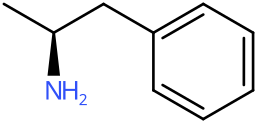
Dexedrine Stats & Data
CC(N)Cc1ccccc1KWTSXDURSIMDCE-QMMMGPOBSA-NPharmacology
DrugBankDescription
Dextroamphetamine is the dextrorotary enantiomer of amphetamine. Dextroamphetamine was approved by the FDA in 2001 for the treatment of attention deficit hyperactivity disorder.
Mechanism of Action
The exact mechanism of amphetamines as a class is not known. Dextroamphetamine acts by preventing reuptake, increasing release, and stimulating reverse-transport of dopamine in synaptic clefts in the striatum. Newer evidence shows amphetamines may also alter the number of dopamine transporters in synaptic clefts.
Pharmacodynamics
Dextroamphetamine is a noncatecholamine, sympathomimetic amine that acts as a CNS stimulant. Dextroamphetamine raises systolic and diastolic blood pressure, acts as a weak bronchodilator, and also acts as a respiratory stimulant. The general mechanism of action of dextroamphetamine has not been well established.
Metabolism
Dextroamphetamine is metabolized by cytochrome P-450 2D6 in the liver to 4-hydroxyamphetamine and later conjugated by sulfotransferase or glucoronyltransferase.
Absorption
Bioavailability data of dextroamphetamine is not readily available, however there is no difference in bioavailability when taken with or without a meal.
Indication
Dextroamphetamine is indicated for the treatment of attention deficit hyperactivity disorder (ADHD).
Half-life
11.75 hours. In a study of post-stroke patients the half life was 16.0 hours in females and 12.4 hours in males. Studies in healthy populations show a half life of 7.9 hours.
Elimination
A third of the drug is eliminated renally.
Receptor Profile
Receptor Actions
Receptor Binding
Measured Affinities
Guide to PHARMACOLOGYMeasured binding and functional data for dexamfetamine, curated by the IUPHAR/BPS Guide to PHARMACOLOGY. Each row cites the paper it came from. Lower concentrations mean tighter binding — a value in the sub-nanomolar range indicates a very potent interaction.
| Target | Action | Measure | Value | Concentration | Species | Source |
|---|---|---|---|---|---|---|
| NET SLC6A2 | Inhibition | pKi | 7 | 100 nM | Human | PMID 23602445 |
| DAT SLC6A3 | Inhibition | pKi | 6.96 | 109.65 nM | Human | PMID 23602445 |
| TA1 receptor Taar1 | Full agonist | pEC50 | — | — | Rat | — |
| TA1 receptor Taar1 | Full agonist | pEC50 | — | — | Mouse | — |
| TA1 receptor TAAR1 | Full agonist | pEC50 | — | — | Human | — |
Reading this. pKi, pEC50 and pIC50 are negative log molar values, so a higher number means a tighter interaction; the concentration column converts them for you. Values from non-human species are laboratory measurements and do not translate directly to human effect. Receptor affinity is not a dose — it describes what a molecule binds, not how much of it is safe to take.
Receptor data from the IUPHAR/BPS Guide to PHARMACOLOGY (v2026.2), licensed CC BY-SA 4.0. Matched to this substance by InChIKey.
History & Culture
1887–1937
Racemic amphetamine was first synthesized in Berlin in 1887 by the Romanian chemist Lazăr Edeleanu, who prepared the compound under the chemical name "phenylisopropylamine." The substance remained relatively obscure for several decades until the pharmaceutical company Smith, Kline & French began marketing it in 1932 as the Benzedrine inhaler, intended for use as a bronchodilator. The stimulant properties of amphetamine, particularly those of the dextrorotatory isomer, came to medical attention in 1935. Two years later, Smith, Kline and French introduced dextroamphetamine in tablet form under the brand name Dexedrine, marking the beginning of its distinct therapeutic identity. The compound was subsequently approved in the United States for the treatment of narcolepsy and attention deficit hyperactivity disorder.
Preparations containing dextroamphetamine saw significant use during World War II, where they were administered to military personnel as a treatment against fatigue during extended operations. This established a precedent for military use of amphetamines that continues in modified form today. The United States Air Force employs dextroamphetamine as one of its "go pills," provided to pilots undertaking long missions to maintain focus and alertness. Counterpart "no-go pills" are administered following mission completion to facilitate recovery from both mission demands and stimulant effects. The Tarnak Farm incident was subsequently linked in media reports to the use of these stimulants on fatigued aircrew. Dextroamphetamine-containing medications remain widely prescribed in contemporary medicine. As of 2022, mixed amphetamine salts marketed as Adderall ranked as the fourteenth most commonly prescribed medication in the United States, accounting for more than 34 million prescriptions annually.
1960s–1970s
Dextroamphetamine developed significant recreational and subcultural associations in the United Kingdom during the 1960s. The substance became popular within the mod scene in England in the early part of that decade, and this cultural connection persisted as amphetamine use carried through to the Northern Soul scene in the north of England, remaining prominent through the end of the 1970s.
1970–present
Despite early recognition that dextroamphetamine and related amphetamines possessed substantial potential for misuse, comprehensive federal controls in the United States were not implemented until 1970. That year, passage of the Comprehensive Drug Abuse Prevention and Control Act by Congress established the modern scheduling system, with dextroamphetamine classified under Schedule II—the most restrictive category available for substances recognized as having legitimate medical applications.
Toxicity
DrugBankToxicity (DrugBank)
Dextroamphetamine has been shown to be teratogenic and embryotoxic in mice at 41 times the maximum human dose. These effects were not seen in rat or rabbit studies, and the effects on human pregnancy have not been studied. The risk and benefit of use during pregnancy should be weighed as bone deformities, tracheoesophageal fistula, anal atresia, low birthweight, and withdrawl have been reported in the children of mothers who were taking dextroamphetamine during pregnancy. Mothers should not take amphetamines while nursing as the drug is excreted in breast milk. Long term effects of dextroamphetamine have not bee determined in pediatric patients and dextroamphetamine should be avoided in children under 3 years.
Tolerance & Pharmacokinetics
drugs.wikiTolerance Decay
Operational guidance: with repeated use across days, noticeable tolerance to the desired effects develops rapidly; multi‑week breaks restore sensitivity. This aligns with clinical and community observations.
Experience Report Analysis
ErowidDemographics
Gender Distribution
Too few reports for a chart: gender is known from 18 reports, and a split is drawn only from 20 reports or more. Counts are shown instead. Why 20?
- Male 15 of 18
- Female 3 of 18
Age Distribution
Reports Over Time
Effect Analysis
ErowidEffects aggregated from 6 experience reports (6 single-substance Erowid)
Effect Sentiment Distribution
Confidence Distribution
Each bar is the share of reports mentioning the effect; its whisker, and the band on the rows below, is the 95% interval: where the share could plausibly be with other reports of the same kind.
Too few reports for bars: these effects come from 6 single-substance Erowid reports, and a bar is drawn only from 20 reports or more. With fewer, a percentage cannot tell a common effect from a rare one. Counts are shown instead. Why 20?
Positive Effects 1
Adverse Effects 0
Also reported in combinations. In the 12 Dexedrine reports where another drug was taken too, 1 mentions hospital, emergency services or an overdose, 0 a seizure and 0 psychosis (too few reports for percentages). In the 6 single-substance reports: 0, 0 and 0. These are not in the figures above: they cannot be put down to Dexedrine alone, and a mention is not always something that happened to the writer.
Real-World Dose Distribution
ErowidFrom 35 of 35 recorded dose entries: those that state a weight (mg, g or µg), in routes with at least five of them. Values above Q3 + 3×IQR, far above what people typically take, are left out; they can include real heavy doses and overdoses, not only mistakes.
Sublingual (n=10)
Oral (n=25)
Common Combinations
Most co-occurring substances, as a share of all 18 reports filed under Dexedrine
Too few reports for bars: these combinations come from 18 reports, and a bar is drawn only from 20 reports or more. With fewer, a percentage cannot tell a common effect from a rare one. Counts are shown instead. Why 20?
- Amphetamine 6 of 18
Legal Status
| Country | Status | Notes |
|---|---|---|
| Australia | Schedule 8 | Classified as a controlled drug under the Poisons Standard. Available by prescription for therapeutic purposes but subject to strict dispensing and record-keeping requirements. |
| Austria | Illegal (SMG) | Prohibited under the Suchtmittelgesetz (Narcotics Act). Possession, production, and sale are illegal without specific authorization. |
| Brazil | Class A3 | Controlled as a Class A3 psychoactive substance under national pharmaceutical legislation, indicating recognized abuse potential with some therapeutic application. |
| Canada | Schedule I (CDSA) | Controlled under Schedule I of the Controlled Drugs and Substances Act. Available for medical use by prescription but subject to strict regulatory oversight. |
| France | Stupéfiant | Classified as a narcotic substance as an isomer of amphetamine. Possession, purchase, sale, and manufacture are prohibited. Notably, it is not available by medical prescription in France, unlike in many other jurisdictions. |
| Germany | Anlage III BtMG | Controlled under Anlage III of the Betäubungsmittelgesetz (Narcotics Act), indicating a prescription-capable narcotic. Can only be dispensed using a special narcotic prescription form (Betäubungsmittelrezept). |
| Netherlands | List I (Opiumwet) | Controlled as a hard drug under List I of the Opium Act. Unauthorized possession, distribution, and production carry criminal penalties. |
| South Korea | Prohibited | Completely banned including for medical purposes, in strict compliance with United Nations Convention obligations. No therapeutic exemptions are granted. |
| Sweden | List II | Controlled substance with restricted prescribing authority. Only physicians with specialist qualifications in child and adolescent psychiatry, adult psychiatry, forensic psychiatry, neurology, or child and adolescent neurology with habilitation may prescribe it. |
| United Kingdom | Class B | Amphetamine and its isomers are controlled under the Misuse of Drugs Act 1971. Available by prescription for medical conditions but unauthorized possession and supply constitute criminal offenses. |
| United States | Schedule II | Controlled under Schedule II of the Controlled Substances Act, recognized as having substantial abuse potential alongside accepted medical applications. Marketed under trade names including Dexedrine and Zenzedi for treatment of ADHD and narcolepsy. |
Harm Reduction
drugs.wiki- Dextroamphetamine is metabolized by CYP2D6; strong CYP2D6 inhibitors (fluoxetine, paroxetine, bupropion, quinidine) can increase plasma levels and side‑effects; start low and avoid stacking with multiple inhibitors. Evidence: DrugBank metabolism section; StatPearls warns that co‑use with CYP2D6 inhibitors elevates serotonin‑toxicity risk.
- Co‑administration with MAOIs is contraindicated and requires a minimum 14‑day washout to avoid hypertensive crisis and serotonin syndrome. This applies to classical MAOIs and agents with MAOI activity (linezolid, methylene blue).
- Serotonergic combinations (SSRIs, SNRIs, TCAs, tramadol, dextromethorphan, triptans) increase serotonin‑toxicity risk; seek medical care for agitation, tremor, hyperreflexia, clonus, hyperthermia.
- Urinary and GI pH strongly influence exposure: alkaline urine slows elimination and increases half‑life; acidic urine accelerates clearance. Acidic fruit juices can also reduce GI absorption; conversely, antacids/alkalinizers may increase exposure. Plan dosing and timing accordingly and avoid deliberate alkalinization to “potentiate.”
- Cardiovascular risks rise with dose, redosing, dehydration, and co‑stimulants (e.g., caffeine, decongestants). Screen for personal/family cardiac disease and stop use if chest pain, syncope, or sustained tachycardia occur.
- Heat stress and overexertion can precipitate hyperthermia; avoid heavy exercise and hot environments during peak effects; maintain moderate hydration with electrolytes, but do not over‑hydrate.
- Compulsive redosing is a recognized pattern with stimulants; pre‑measure doses, keep reserves out of reach, and plan a hard stop time to reduce binge risk.
- Expect common acute effects like appetite suppression, insomnia, anxiety/irritability, bruxism, dry mouth, tachycardia, and increased BP; jaw protection (sugar‑free gum) and oral hygiene help mitigate bruxism/dry mouth.
- High or repeated doses raise risks of paranoid ideation and psychosis; sleep, nutrition, and multi‑day breaks markedly reduce this risk. Seek medical attention for persistent hallucinations, severe agitation, or suicidality.
- Difficulty urinating and peripheral vasoconstriction (cold fingers/toes) can occur; take bathroom breaks and keep warm; seek care if painful retention or severe pallor/paresthesia occurs.
- Extended‑release capsules/patches are designed for slow delivery; tampering (crushing, chewing, extracting) defeats the mechanism and may cause overdose. Treat transdermal patch disposal carefully to prevent diversion. (General HR; product forms listed on DrugBank.)
- Nutrition: plan balanced meals around use days and refeed on comedown; stimulants can suppress appetite and, over time, contribute to weight loss and low immunity.
References
Data Sources
Cited References
Additional references
- DrugBank: Dextroamphetamine (PK, metabolism, food interactions, brands)
- EUDA (EMCDDA) Amphetamine drug profile (urinary pH and elimination, effects/risks)
- StatPearls: Amphetamine (MAOI 14‑day washout; serotonin syndrome risk with CYP2D6 inhibitors/serotonergics; CV cautions)
- StatPearls: Dextromethorphan Toxicity (serotonergic interaction warnings)
- DrugWise: Amphetamines (effects, harms, practical HR tips) – updated June 2025
- DrugWise: Drug interactions – amphetamine and urine pH (acidify vs alkalinise)
- Effect Index – Compulsive redosing (stimulant‑linked behavior)
- Effect Index – Difficulty urinating (seen with stimulants)
- Erowid (Drugs & Poisons) – amphetamines section (psychosis risk from heavy/repeated use)