
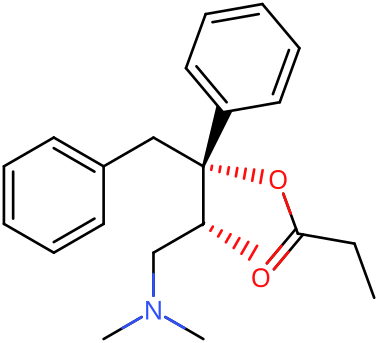
Dextropropoxyphene Stats & Data
CCC(=O)OC(Cc1ccccc1)(C(C)CN(C)C)c1ccccc1XLMALTXPSGQGBX-GCJKJVERSA-NPharmacology
DrugBankDescription
Dextropropoxyphene is an opioid analgesic manufactured by Eli Lilly and Company. It is used in the symptomatic treatment of mild pain. It displays antitussive and local anaesthetic actions. Due to the risk of cardiac arrhythmias and overdose, possibly leading to death, dextropropoxyphene has been withdrawn from the market in Europe and the United States. The drug is often referred to as the general form, "propoxyphene", however only the dextro-isomer (dextropropoxyphene) has any analgesic effect. The levo-isomer appears to exhibit a very limited antitussive effect.
Mechanism of Action
Propoxyphene acts as a weak agonist at OP1, OP2, and OP3 opiate receptors within the central nervous system (CNS). Propoxyphene primarily affects OP3 receptors, which are coupled with G-protein receptors and function as modulators, both positive and negative, of synaptic transmission via G-proteins that activate effector proteins. Binding of the opiate stimulates the exchange of GTP for GDP on the G-protein complex. As the effector system is adenylate cyclase and cAMP located at the inner surface of the plasma membrane, opioids decrease intracellular cAMP by inhibiting adenylate cyclase. Subsequently, the release of nociceptive neurotransmitters such as substance P, GABA, dopamine, acetylcholine, and noradrenaline is inhibited. Opioids such as propoxyphene also inhibit the release of vasopressin, somatostatin, insulin, and glucagon. Opioids close N-type voltage-operated calcium channels (OP2-receptor agonist) and open calcium-dependent inwardly rectifying potassium channels (OP3 and OP1 receptor agonist). This results in hyperpolarization and reduced neuronal excitability.
Pharmacodynamics
Propoxyphene, a synthetic opiate agonist, is structurally similar to methadone. Its general pharmacologic properties are those of the opiates as a group. The analgesic effect of propoxyphene is due to the d-isomer, dextropropoxyphene. It binds to the opiate receptors and leads to a decrease of the perception of pain stimuli. Propoxyphene possesses little to no antitussive activity and no antipyretic action.
Indication
For the relief of mild to moderate pain.
Elimination
The major route of metabolism is cytochrome CYP3A4 mediated N-demethylation to norpropoxyphene, which is excreted by the kidneys. In 48 hours, approximately 20% to 25% of the administered dose of propoxyphene is excreted via the urine, most of which is free or conjugated norpropoxyphene.
Receptor Profile
Receptor Actions
Receptor Binding
Dextropropoxyphene has a high toxicity relative to dose. As with all opioids, long-term effects can vary but can include diminished libido, apathy and memory loss. It is also potentially lethal when mixed with depressants like alcohol or benzodiazepines and generally has a wider range of substances which it is dangerous to combine with in comparison to other opioids. Dextropropoxyphene is known to lower the seizure threshold. It should not be taken during benzodiazepine withdrawals as this can potentially cause seizures.
LD50
LD50: 230mg/kg (oral, rat)
Carcinogenicity
No indication of carcinogenicity to humans (not listed by IARC).
Effect Profile
Curated + 2 ReportsStrong euphoria with moderate itching/nausea, mild pain relief and sedation
Tolerance & Pharmacokinetics
drugs.wikiNo tolerance chart. Our decay curves for opioids were estimates, and a curve can make tolerance look longer-lasting than it is, which is the dangerous direction.
Opioid tolerance drops fast when you stop, and even a few days off can be enough, so a dose that used to be normal can now stop your breathing. Overdose deaths rise sharply after prison, detox or leaving treatment, and tolerance also falls during a hospital stay. After any break, start with a much smaller amount, try a test dose first, don't use alone, and keep naloxone within reach. Alcohol, benzodiazepines, gabapentinoids and other sedatives make an opioid overdose much more likely.
Sources: FRANK: heroin · National Harm Reduction Coalition · WHO: opioid overdose · Merrall et al. 2010 · Binswanger et al. 2007 · Strang et al. 2003 · FDA 2019: gabapentinoids and breathing
Experience Report Analysis
ErowidDemographics
Gender Distribution
Too few reports for a chart: gender is known from 2 reports, and a split is drawn only from 20 reports or more. Counts are shown instead. Why 20?
- Male 2 of 2