
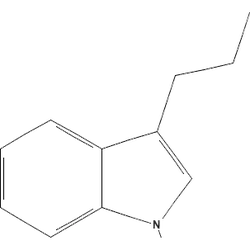
DMT Stats & Data
CN(C)CCC1=CNC2=CC=CC=C21DMULVCHRPCFFGV-UHFFFAOYSA-NPharmacology
DrugBankDescription
An N-methylated indoleamine derivative, a serotonergic hallucinogen found in several plants, especially Prestonia amazonica (Apocynaceae) and in mammalian brain, blood, and urine. It apparently acts as an agonist at some types of serotonin receptors and an antagonist at others.
Mechanism of Action
DMT acts as a non-selective agonist at most or all of the serotonin receptors.
Indication
Some people use this compound as a psychedelic inducing agent.
Receptor Profile
Receptor Actions
Measured Affinities
Guide to PHARMACOLOGYMeasured binding and functional data for dimethyltryptamine, curated by the IUPHAR/BPS Guide to PHARMACOLOGY. Each row cites the paper it came from. Lower concentrations mean tighter binding — a value in the sub-nanomolar range indicates a very potent interaction.
| Target | Action | Measure | Value | Concentration | Species | Source |
|---|---|---|---|---|---|---|
| 5-HT6 receptor HTR6 | Full agonist | pKi | 7.2 | 63.1 nM | Human | PMID 8522988 |
| 5-HT1D receptor HTR1D | Full agonist | pKi | — | — | Human | PMID 8967979 |
Reading this. pKi, pEC50 and pIC50 are negative log molar values, so a higher number means a tighter interaction; the concentration column converts them for you. Values from non-human species are laboratory measurements and do not translate directly to human effect. Receptor affinity is not a dose — it describes what a molecule binds, not how much of it is safe to take.
Receptor data from the IUPHAR/BPS Guide to PHARMACOLOGY (v2026.2), licensed CC BY-SA 4.0. Matched to this substance by InChIKey.
History & Culture
DMT has been used as an entheogen in South America for thousands of years, primarily in the form of ayahuasca brews and snuffs. Archaeological evidence suggests snuff use dating back several millennia, though DMT typically served as a minor constituent in these preparations rather than the primary compound. Amazonian tribes have traditionally employed ayahuasca to receive guidance from protective spirits, gain insight into the causes and treatments of illness, perceive future events, communicate with distant groups, prepare for warfare and hunting, and identify enemies and their intentions.
1931–1957
DMT was first synthesized in 1931 by Richard Helmuth Fredrick Manske, a Canadian chemist. The compound's hallucinogenic properties remained unknown for another quarter century until Hungarian chemist and psychiatrist Stephen Szára investigated them in 1956. Szára had initially attempted to acquire LSD from Sandoz Laboratories in Switzerland, but his request was denied on the grounds that such a potent psychotropic substance could prove dangerous in the hands of a communist country. This rejection led him to synthesize DMT in his own laboratory and test it on himself through injection. He subsequently administered it to several medical colleagues before expanding his study to thirty additional participants, predominantly physicians. In 1955, DMT was definitively isolated from a plant source for the first time, extracted from Anadenanthera peregrina seeds used in traditional snuff preparations. Two years later, American chemists identified DMT in leaves of a plant they erroneously named "Prestonia amazonicum." This taxonomic error later influenced writer William Burroughs, who experimented with DMT in Tangier in 1961 under the belief he was using "Prestonia."
1930s–1961
Following the Amazon rubber boom, several syncretic religious movements incorporating ayahuasca emerged in Brazil. These traditions blended indigenous South American practices with Catholic and European influences alongside Brazilian cosmological beliefs. Santo Daime, the first of these movements, was founded in the 1930s by Raimundo Irineu Serra, a Brazilian rubber tapper. Barquinha formed in 1945 through a schism with Santo Daime. The União do Vegetal was established in 1961 by Jose Gabriel da Costa, also a rubber tapper. These religious movements would later become central to legal challenges regarding DMT's controlled status, with the UDV's 2006 U.S. Supreme Court victory establishing important precedent for religious use exemptions.
1960s–2010
During the 1960s in the United States, DMT earned the colloquial name "businessman's trip" due to its rapid onset, intense effects, and relatively brief duration—allowing users to experience the full depth of a psychedelic journey in considerably less time than substances like LSD or psilocybin mushrooms. Ethnobotanist Terence McKenna became instrumental in popularizing DMT during the 1980s and 1990s, particularly advocating for inhalation as the preferred route of administration. He spoke enthusiastically and frequently about his experiences, introducing many to the substance's unique phenomenology. In the 1990s, Rick Strassman, a medical doctor at the University of New Mexico Hospital Clinical Research Center, began the first government-approved research on DMT in decades. He selected the compound for study because of its short duration, natural occurrence in humans, potentially unexplored physiological roles, and relative obscurity. His research led to the publication of "DMT: The Spirit Molecule" in 2000 and an accompanying documentary in 2010. Strassman hypothesized that DMT might be produced in the pineal gland and released during dreams, birth, and death—ideas subsequently popularized by McKenna and others, though they remain scientifically unconfirmed.
A distinctive cultural phenomenon surrounding DMT is the remarkably consistent reports of encounters with apparently autonomous entities during the experience. Terence McKenna coined the term "machine elves" for the beings he first encountered after smoking DMT in Berkeley in 1965, also describing them as "fractal elves" or "self-transforming machine elves." In analyzing self-reports from his clinical study participants, Strassman observed striking similarities between descriptions of these entities and figures from ancient religious traditions, including the Ḥayyot haq-Qodesh from Hebrew mysticism, as well as various depictions of angels and demons. He and others have speculated that such hallucinatory experiences may underlie reports of alien abduction and extraterrestrial encounters, suggesting DMT's effects might illuminate the neurological basis of certain mystical and paranormal experiences.
Subjective Effects
Physical
- Spontaneous tactile sensations: The body high of DMT can be described as a pleasurable, warm, soft, and all encompassing glow. It maintains a consistent presence that quickly rises with the onset and hits its limit once the peak has been reached. It is capable of becoming very powerful at higher doses and remains for up to half an hour after the trip itself.
- Changes in gravity: At higher dosages physical feelings of being catapulted across vast distances at incredibly high speeds are common.
Cognitive
The head space of DMT is described by most as extremely sober and clear headed in its style when compared to other commonly used psychedelics such as LSD, psilocin or even ayahuasca. It contains a limited amount of typical cognitive effects. DMT in its smokeable form is perhaps the least psychologically intoxicating psychedelic, leading many people to describe it not as a drug induced trip but a genuine experience that is actually happening to them.
- Enhancement of current mind state
- Removal of cultural filter
- Feelings of fascination, importance and awe
- Rejuvenation
- Direct communication with the subconscious
- Ego suppression, loss and death
- States of unity and interconnectedness
Sensory
- Enhancements
- Distortions
- Hallucinations
- Visual drifting: (Melting, Breathing, Morphing and Flowing) - In comparison to other psychedelics, this effect can be described as highly detailed, slow and smooth in motion and static in its appearance.
- Tracers
- After images
- Texture repetition
- Colour shifting
- Scenery slicing
- Increased visual acuity
- Enhancement of colours
- Enhanced pattern recognition
DMT produces a full range of high level hallucinatory states in a fashion that is more consistent and reproducible than that of any other commonly used psychedelic.
- External hallucinations
- Internal hallucinations: This particular effect commonly contains hallucinations with scenarios, settings, concepts and autonomous entity contact. They are more common within dark environments and can be described as internal in their manifestation, lucid in believability, interactive in style and almost exclusively religious, spiritual, mystical or transcendental in nature.
Forked from Subjective Effect Documentation by Josie Kins, April 2012. Via dose.wiki (CC0).
Toxicity
PsychonautWikiDMT is considered to be non-addictive, is not associated with any form of neurotoxicity, and has an extremely low toxicity relative to dose. As with other psychedelic substances, there are relatively few physical side effects associated with acute DMT exposure. Various studies have shown that in reasonable doses in a careful context, it has little to no negative cognitive, psychiatric or physical consequences. However, as with psychedelics generally, DMT is thought to be able to act as a potential trigger for those with underlying psychiatric conditions. Those with a personal or family history of mental illness are advised not to use this substance unless under medical supervision.
Addiction & dependence
Like other serotonergic psychedelics, DMT is considered to be non-addictive with a low abuse potential. There are no literature reports of successful attempts to train animals to self-administer DMT — an animal model predictive of abuse liability — indicating that it does not have the necessary pharmacology to either initiate or maintain dependence. Likewise, there is virtually no withdrawal syndrome when chronic use of DMT is stopped.
Effect Profile
Curated + 889 ReportsStrong visuals, headspace, and auditory effects with mild body load
User Experiences
Duration Timeline
BluelightCommunity Effects
TripSitTolerance & Pharmacokinetics
drugs.wikiTolerance Decay
Human studies found minimal to no rapid psychological tolerance after closely spaced IV administrations compared to other psychedelics; subjective effects remained robust, although some biological measures declined across repeated doses. Community reports suggest the ability to redose within a session with little tolerance, but cumulative physiological/psychological load increases. Data quality is mixed; cross-tolerance with other 5‑HT2A psychedelics is presumed but not well quantified.
Cross-Tolerances
Demographics
Gender Distribution
Age Distribution
Reports Over Time
Effect Analysis
Erowid + BluelightEffects aggregated from 690 experience reports (640 single-substance Erowid + 249 Bluelight)
Effect Sentiment Distribution
Confidence Distribution
Each bar is the share of reports mentioning the effect; its whisker, and the band on the rows below, is the 95% interval: where the share could plausibly be with other reports of the same kind.
Positive Effects 74
Adverse Effects 31
Show 10 more adverse effects
Show 31 neutral or unclassified mentions
Also reported in combinations. In the 403 DMT reports where another drug was taken too, 19 (4.7%) mention hospital, emergency services or an overdose, 5 (1.2%) a seizure and 15 (3.7%) psychosis. In the 640 single-substance reports: 4.2%, 0.8% and 2.7%. These are not in the figures above: they cannot be put down to DMT alone, and a mention is not always something that happened to the writer.
Dose-Response Correlation
How effect frequency changes across dose levels. Whiskers, and the numbers' hover text, give each figure's 95% interval.
View data table
| Effect | Common (n=29) | Strong (n=38) | Heavy (n=36) |
|---|---|---|---|
| Visual Distortions | 69.0% (95% interval 51 to 83 percent) | 89.5% (95% interval 76 to 96 percent) | 77.8% (95% interval 62 to 88 percent) |
| Color Enhancement | 62.1% (95% interval 44 to 77 percent) | 71.1% (95% interval 55 to 83 percent) | 72.2% (95% interval 56 to 84 percent) |
| Anxiety | 62.1% (95% interval 44 to 77 percent) | 55.3% (95% interval 40 to 70 percent) | 47.2% (95% interval 32 to 63 percent) |
| Closed-Eye Visuals | 48.3% (95% interval 31 to 66 percent) | 47.4% (95% interval 32 to 63 percent) | 36.1% (95% interval 22 to 52 percent) |
| Empathy | 34.5% (95% interval 20 to 53 percent) | 44.7% (95% interval 30 to 60 percent) | 44.4% (95% interval 30 to 60 percent) |
| Euphoria | 20.7% (95% interval 10 to 38 percent) | 44.7% (95% interval 30 to 60 percent) | 41.7% (95% interval 27 to 58 percent) |
| Auditory Effects | 24.1% (95% interval 12 to 42 percent) | 36.8% (95% interval 23 to 53 percent) | 25.0% (95% interval 14 to 41 percent) |
| Music Enhancement | 27.6% (95% interval 15 to 46 percent) | 28.9% (95% interval 17 to 45 percent) | 36.1% (95% interval 22 to 52 percent) |
| Dissociation | 17.2% (95% interval 8 to 34 percent) | 28.9% (95% interval 17 to 45 percent) | 36.1% (95% interval 22 to 52 percent) |
| Confusion | 20.7% (95% interval 10 to 38 percent) | 34.2% (95% interval 21 to 50 percent) | 30.6% (95% interval 18 to 47 percent) |
| Stimulation | 27.6% (95% interval 15 to 46 percent) | 26.3% (95% interval 15 to 42 percent) | 30.6% (95% interval 18 to 47 percent) |
| Introspection | — | 26.3% (95% interval 15 to 42 percent) | 25.0% (95% interval 14 to 41 percent) |
| Focus Enhancement | 17.2% (95% interval 8 to 34 percent) | 5.3% (95% interval 2 to 17 percent) | 25.0% (95% interval 14 to 41 percent) |
| Time Distortion | — | 15.8% (95% interval 7 to 30 percent) | 25.0% (95% interval 14 to 41 percent) |
| Body High | 10.3% (95% interval 4 to 26 percent) | 21.1% (95% interval 11 to 36 percent) | 19.4% (95% interval 10 to 35 percent) |
Subjective Effect Ontology
Experience ReportsStructured effect tags extracted from 1,093 Erowid & Bluelight experience reports using a controlled vocabulary of 220+ canonical effects across 15 domains.
Auditory
Cognitive
Emotional
Motor
Selfhood
Somatic
Tactile
Temporal
Visual
Dose–Effect Mapping
Experience ReportsHow reported effects shift across dose tiers, based on 640 single-substance experience reports. The shaded band on each bar is its 95% interval. An arrow (↑ ↓) marks a change between the lowest and highest tier that count an effect only when the gap is bigger than chance would explain; ~ means no clear change. How changes are called
| Effect | Common (n=29) | Strong (n=38) | Heavy (n=36) | Change with dose |
|---|---|---|---|---|
| visual distortions | (no clear change: +9 points from Common to Heavy, 95% interval −12 to +30) | |||
| color enhancement | (no clear change: +10 points from Common to Heavy, 95% interval −12 to +32) | |||
| anxiety | (no clear change: −15 points from Common to Heavy, 95% interval −36 to +9) | |||
| closed-eye visuals | (no clear change: −12 points from Common to Heavy, 95% interval −34 to +11) | |||
| empathy | (no clear change: +10 points from Common to Heavy, 95% interval −14 to +32) | |||
| euphoria | (no clear change: +21 points from Common to Heavy, 95% interval −2 to +40) | |||
| auditory effects | (no clear change: +1 points from Common to Heavy, 95% interval −20 to +21) | |||
| music enhancement | (no clear change: +8 points from Common to Heavy, 95% interval −14 to +29) | |||
| dissociation | (no clear change: +19 points from Common to Heavy, 95% interval −3 to +38) | |||
| confusion | (no clear change: +10 points from Common to Heavy, 95% interval −12 to +29) | |||
| stimulation | (no clear change: +3 points from Common to Heavy, 95% interval −19 to +24) | |||
| introspection | — | (no clear change: −1 points from Strong to Heavy, 95% interval −21 to +18) | ||
| focus enhancement | (no clear change: +8 points from Common to Heavy, 95% interval −13 to +26) | |||
| time distortion | — | (no clear change: +9 points from Strong to Heavy, 95% interval −9 to +27) | ||
| body high | (no clear change: +9 points from Common to Heavy, 95% interval −10 to +26) | |||
| memory suppression | (no clear change: +6 points from Common to Heavy, 95% interval −12 to +23) | |||
| open-eye visuals | — | (no clear change: −10 points from Strong to Heavy, 95% interval −25 to +5) | ||
| sedation | — | — | counted in the Heavy tier only | |
| tactile enhancement | (no clear change: −2 points from Common to Heavy, 95% interval −19 to +13) | |||
| ego dissolution | — | (no clear change: −5 points from Common to Strong, 95% interval −22 to +9) |
Showing top 20 of 28 effects
Risk Escalation
Sentiment AnalysisAverage frequency of positive vs adverse effects across dose tiers. A tier's average is the mean share of the effects counted in that tier, not a share of reports, and its range is a deliberately wide 95% interval. A tier with more reports also counts rarer effects, which pulls its average down, so compare single effects in the breakdown rather than these averages. There, the shaded band on each bar is its 95% interval, and Change is marked up or down only when the gap between two tiers is bigger than chance would explain. How changes are called
View effect breakdown
Adverse Effects
| Effect | Common (n=29) | Strong (n=38) | Heavy (n=36) | Change |
|---|---|---|---|---|
| Anxiety | no clear change (no clear change: −15 points from Common to Heavy, 95% interval −36 to +9) | |||
| Confusion | no clear change (no clear change: +10 points from Common to Heavy, 95% interval −12 to +29) | |||
| Memory Suppression | no clear change (no clear change: +6 points from Common to Heavy, 95% interval −12 to +23) | |||
| Headache | — | — | — | |
| Increased Heart Rate | — | no clear change (no clear change: +0.3 points from Strong to Heavy, 95% interval −12 to +13) | ||
| Thought Loops | — | — | — | |
| Motor Impairment | — | — | — | |
| Nausea | — | — | — | |
| Jaw Clenching | — | — | — |
Positive Effects
| Effect | Common (n=29) | Strong (n=38) | Heavy (n=36) | Change |
|---|---|---|---|---|
| Visual Distortions | no clear change (no clear change: +9 points from Common to Heavy, 95% interval −12 to +30) | |||
| Color Enhancement | no clear change (no clear change: +10 points from Common to Heavy, 95% interval −12 to +32) | |||
| Closed-Eye Visuals | no clear change (no clear change: −12 points from Common to Heavy, 95% interval −34 to +11) | |||
| Empathy | no clear change (no clear change: +10 points from Common to Heavy, 95% interval −14 to +32) | |||
| Euphoria | no clear change (no clear change: +21 points from Common to Heavy, 95% interval −2 to +40) | |||
| Music Enhancement | no clear change (no clear change: +8 points from Common to Heavy, 95% interval −14 to +29) | |||
| Stimulation | no clear change (no clear change: +3 points from Common to Heavy, 95% interval −19 to +24) | |||
| Introspection | — | no clear change (no clear change: −1 points from Strong to Heavy, 95% interval −21 to +18) | ||
| Focus Enhancement | no clear change (no clear change: +8 points from Common to Heavy, 95% interval −13 to +26) | |||
| Body High | no clear change (no clear change: +9 points from Common to Heavy, 95% interval −10 to +26) | |||
| Open-Eye Visuals | — | no clear change (no clear change: −10 points from Strong to Heavy, 95% interval −25 to +5) | ||
| Tactile Enhancement | no clear change (no clear change: −2 points from Common to Heavy, 95% interval −19 to +13) | |||
| Creativity Enhancement | — | — | — |
Dosage Distribution
Dose distribution from experience reports, one dose per report (the first listed). Doses above Q3 + 3×IQR, far above what people typically take, are left out of the median and range and listed under each route: most are real heavy doses or overdoses, not mistakes.
Smoked
6 reports gave a dose above the typical range (160–750 mg), so they are not in the figures above. Listing a dose here does not mean it is safe.
Insufflated
Real-World Dose Distribution
ErowidFrom 516 of 1008 recorded dose entries: those that state a weight (mg, g or µg), in routes with at least five of them. Values above Q3 + 3×IQR, far above what people typically take, are left out; they can include real heavy doses and overdoses, not only mistakes.
Smoked (n=423)
Oral (n=54)
Intravenous (n=9)
Insufflated (n=15)
Common Combinations
Most co-occurring substances, as a share of all 1,043 reports filed under DMT; whiskers are 95% intervals
Form / Preparation
Most common forms and preparations, as a share of the 447 reports that give one; whiskers are 95% intervals
Body-Weight Dosing
Dose per kg of body weight, one dose per report (the first listed), from reports giving a weight of 30–250 kg. Doses above Q3 + 3×IQR, far above what people typically take, are left out of the median and range and listed under each route.
Smoked
6 reports gave a dose above the typical range (2.273–10 mg/kg), so they are not in the figures above. Listing a dose here does not mean it is safe.
Show the reports
- 10 mg/kg · another drug taken too
- 4.902 mg/kg
- 4.48 mg/kg · another drug taken too
- 2.941 mg/kg · another drug taken too
- 2.489 mg/kg · another drug taken too
- 2.273 mg/kg
Oral
Insufflated
Redose Patterns
Redosing behavior across 554 reports
Legal Status
| Country | Status | Notes |
|---|---|---|
| Brazil | Legal (religious use of ayahuasca) | Brazilian law was adjusted in 1996 to permit the religious use of ayahuasca following a legal challenge from the União do Vegetal church. This exemption applies specifically to traditional ceremonial contexts. Synthetic DMT remains controlled. |
| Canada | Schedule III | Listed as a Schedule III controlled substance under the Controlled Drugs and Substances Act. This scheduling carries criminal penalties for unauthorized possession and trafficking. |
| New Zealand | Class A | Controlled under the Misuse of Drugs Act 1975. Class A drugs carry the highest penalties under New Zealand drug legislation. |
| United Kingdom | Class A | Controlled under the Misuse of Drugs Act. Class A substances carry the most severe penalties for possession, production, and distribution. |
| United States | Schedule I | Controlled under the Controlled Substances Act of 1970. Classified as having high abuse potential with no accepted medical use. However, in 2006 the Supreme Court ruled that the União do Vegetal (UDV) church could use their ayahuasca brew for religious purposes despite DMT's Schedule I status, based on the 1993 Religious Freedom Restoration Act. |
Harm Reduction
drugs.wiki- Test and verify substance identity: DMT is an indole and typically reacts positive with indole-sensitive reagents (e.g., Ehrlich), but reagent color alone cannot prove purity; formal drug checking is preferred. Mislabeling between N,N-DMT and 5-MeO-DMT has led to overdoses due to very different potency and effects profiles.
- Vaporization technique matters: use heat, not direct flame; pre-measure with a mg-accurate scale; expect that melted residue can linger in glassware and cause unexpected extra milligrams later. Sit or lie down before the last inhalation to avoid falls due to rapid incapacitation.
- Cardiovascular effects (transient hypertension/tachycardia) are common at psychoactive doses; screen for uncontrolled hypertension, significant cardiac disease, or recent stimulant use; avoid combining with vasopressors or strong stimulants.
- Oral DMT requires MAO-A inhibition; this markedly increases duration/intensity and interaction risks. Avoid serotonergic medications (SSRIs/SNRIs/TCAs), tramadol, meperidine, DXM, and stimulant drugs for an adequate washout period when MAOIs are involved. Some foods high in tyramine can pose added risk with prescription/strong MAOIs.
- Mental health cautions: strong psychedelics can precipitate or exacerbate psychosis or mania in vulnerable individuals; those with personal/family history of psychotic or bipolar disorders should avoid or proceed only with clinical oversight.
- Sitter and environment: due to near-instant onset, a sober sitter should remove hot devices and protect from falls. Use in a quiet, seated/lying setting with minimal obstacles.
- Avoid redosing loops: acute tolerance is minimal with DMT compared to LSD/psilocybin; however, repeated back-to-back inhalations can stack cardiovascular/psychological load without providing integration time.
- Changa (DMT on MAOI-containing herbs) typically requires slightly lower DMT doses and lasts longer than freebase alone; interaction cautions of harmalas apply.
- Pulmonary irritation is common with hot or combusted vapor; lower-temperature vaporization and cooling the vapor (e.g., water piece) can reduce airway discomfort; individuals with reactive airway disease should be cautious.
- Distinguish N,N-DMT from 5-MeO-DMT: 5-MeO-DMT is active at much lower doses and carries higher risk of severe adverse reactions, particularly with MAOIs. Never assume marketed “DMT” is N,N-DMT; verify before dosing.
- Drug checking services (where available) can detect adulterants and misrepresentation; several European services have reported misdeclared tryptamine products, underscoring the need for verification before use.
References
Data Sources
Cited References
- Chacruna - DMT and serotonin syndrome risks
- dos Santos et al. - Ayahuasca risks review (2016)
- Mind Foundation - Psychedelic-Antidepressant Interactions
- Nichols DE - Psychedelics review (2016)
- PMC: Drug-drug interactions involving classic psychedelics
- PubChem: N,N-Dimethyltryptamine (CID 6089)
- Spiers et al. - Continuous DMT infusion study (2024)
- Spirit Pharmacist - Healing States or Serotonin Toxicity
- Strassman RJ - Dose-response study in humans (1994)
- Timmermann et al. - DMT models near-death experience (2018)
Additional references
- PubChem Compound CID 6089 (DMT)
- Erowid DMT – Dosage (smoked/vaporized)
- Erowid DMT – Effects/Duration (smoked) and Changa note
- Erowid DMT – Basics (onset, sitter, rapid duration)
- Erowid Ayahuasca – Effects/Duration (oral DMT + MAOI)
- TripSit Wiki – DMT (oral dosing with harmalas; smoked ranges; vaporization cautions)
- Erowid MAOI Vault – Summary of Interactions (SSRIs, stimulants, potentiation)
- Erowid MAOI Vault – Drugs to Avoid (SSRIs, MDMA, DXM, etc.)
- Erowid Syrian Rue (P. harmala) – Basics/Contraindications
- Erowid Online Books – Ayahuasca Analogues (harmala/DMT technique tips; vaporization cautions)
- Erowid Essential Psychedelic Guide – DMT (practical vaporization harm-reduction)
- Strassman 1996 overview (Erowid reference abstract: tolerance study)
- Strassman & Qualls 1994 (DrugBank article entry; human IV DMT dose–response, CV effects)
- Erowid 5‑MeO‑DMT is Not ‘DMT’ (mislabeling warning)
- Saferparty.ch – Example warnings/mislabeling; tryptamine misdeclarations (NMT; admixtures)