
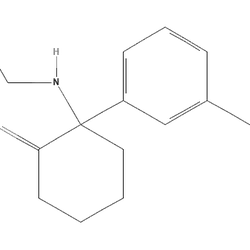
DMXE Stats & Data
CCNC1(CCCCC1=O)c1cccc(C)c1WIMLPRYZJQNQLE-UHFFFAOYSA-NReceptor Profile
Receptor Actions
History & Culture
DMXE emerged as a novel research chemical around October 2020, when it first appeared on online designer drug markets. The compound is structurally derived from methoxetamine (MXE), with the 3-methoxy substituent replaced by a methyl group—hence its alternative designation as "3D-MXE" (3-desmethoxy-MXE). It was first definitively identified by a forensic laboratory in Denmark in February 2021, marking its formal entry into scientific documentation of novel psychoactive substances. The compound appeared during a period of continued innovation in the arylcyclohexylamine research chemical space, following patterns established by earlier designer dissociatives. Its emergence reflects ongoing efforts within clandestine chemistry to develop structural analogues of controlled or unavailable substances like MXE.
Effect Profile
Curated + 9 ReportsStrong dissociative depth with strong motor impairment, moderate mania, low insight
Duration Timeline
BluelightTolerance & Pharmacokinetics
drugs.wikiTolerance Decay
Acute tolerance rises within a session and across days; many users report unpredictability and diminished effects with frequent use. Long washouts (≥4 weeks) are commonly used to restore baseline response. Estimates are anecdotal and inferred from MXE/ketamine patterns and community reports on DMXE.
Cross-Tolerances
Experience Report Analysis
ErowidDemographics
Gender Distribution
Too few reports for a chart: gender is known from 14 reports, and a split is drawn only from 20 reports or more. Counts are shown instead. Why 20?
- Male 10 of 14
- Not Specified 3 of 14
- Female 1 of 14
Age Distribution
Reports Over Time
Effect Analysis
ErowidEffects aggregated from 9 experience reports (9 single-substance Erowid)
Effect Sentiment Distribution
Confidence Distribution
Each bar is the share of reports mentioning the effect; its whisker, and the band on the rows below, is the 95% interval: where the share could plausibly be with other reports of the same kind.
Too few reports for bars: these effects come from 9 single-substance Erowid reports, and a bar is drawn only from 20 reports or more. With fewer, a percentage cannot tell a common effect from a rare one. Counts are shown instead. Why 20?
Positive Effects 6
Adverse Effects 5
Show 6 neutral or unclassified mentions
Real-World Dose Distribution
ErowidFrom 11 of 12 recorded dose entries: those that state a weight (mg, g or µg), in routes with at least five of them. Values above Q3 + 3×IQR, far above what people typically take, are left out; they can include real heavy doses and overdoses, not only mistakes.
Insufflated (n=11)
Form / Preparation
Most common forms and preparations, as a share of the 9 reports that give one
Too few reports for bars: these forms come from 9 reports, and a bar is drawn only from 20 reports or more. With fewer, a percentage cannot tell a common effect from a rare one. Counts are shown instead. Why 20?
- Powder / Crystals 4 of 9
- Liquid 4 of 9
Harm Reduction
drugs.wiki• Identity: DMXE = 3-Me-2′-oxo-PCE, also known as 3D‑MXE. This places it in the ketamine/PCx family with likely NMDA receptor antagonism; human pharmacokinetics remain poorly characterized. • Mislabeling risk: Drug checking services have found DMXE sold as MXE; do not assume a vendor or pellet label is accurate—use reagent/lab testing where available. • Combining CNS depressants (alcohol, GHB/GBL, opioids) with dissociatives markedly increases risks of loss of consciousness, aspiration and respiratory depression; if someone becomes unresponsive, place them in the recovery position and seek help. • Benzodiazepines and dissociatives potentiate each other’s sedation/ataxia and can lead to unexpected blackouts at high doses; treat as a caution-only combination. • Stimulant or serotonergic co-use (e.g., MDMA/SSRIs) can produce unpredictable effects (e.g., anxiety, blood-pressure elevation, or unusual mood shifts), and MXE analogs have specific MAOI/SSRI cautions—avoid such mixes or proceed only with expert-level caution. • Repeated/frequent dissociative use is linked to urinary tract (‘ketamine cystitis’) and biliary complications with ketamine; similar risks may generalize to analogs—watch for urinary urgency, pain or blood; take prolonged breaks and stop use if symptoms appear. • Expect marked motor impairment and poor situational awareness—clear hazards, stay seated/lying at higher doses, and never drive. General dissociative harm-reduction stresses environment control and moderation. • Intranasal use: crush finely; avoid shared/contaminated implements; rinse with sterile saline before/after to reduce mucosal damage. • Potency and duration vary by batch and route; some users report prolonged residual dissociation after high cumulative dosing or all‑night redosing—resist the urge to ‘chase the hole’ and allow full plateaus to resolve before considering more. • The smell or color of product (e.g., tan/odorous powder, black/grey pellets) is not a quality guarantee and may reflect impurities or excipients; lab testing beats home ‘purification’ hacks.
References
Data Sources
Cited References
- Bluelight: DMXE 70mg Intranasal Trip Report
- Bluelight: The Big & Dandy DMXE Thread
- Chemical Collective - DMXE: The Ultimate Guide
- Erowid DMXE Experience: Tessellated Neon Bubble
- Hirokawa et al. (2022) - Derivatives of methoxetamine block NMDA receptors
- Hu et al. (2024) - Metabolism of DMXE and ketamine analogs
- NDEWS: Alert on Reddit discussions of DMXE
- PsychonautWiki: DMXE Talk Page
- PubMed: Identification of arylcyclohexylamines (MXPr, MXiPr, DMXE)
Additional references
- Isomerdesign PiHKAL-info: DMXE (synonyms & structure)
- PubChem CID 157010705 (DMXE compound record)
- Bluelight: Big & Dandy DMXE thread (community dose/duration variability)
- Reddit: DMXE ‘holing’ dose discussion (60–100 mg range comments)
- Reddit: General experiences incl. ROA differences
- Reddit: Info thread summarizing common vendor pellet dosages and user timings
- Reddit: DMXE pellet adverse effects report (binders/excipients concerns)
- Reddit: All‑night redose leading to prolonged residual dissociation
- Saferparty.ch alert: DMXE sold as MXE (mislabeling)
- Toronto Drug Checking Service: Annual report notes DMXE among checked samples (market presence)
- TripSit: Drug combinations page (ketamine/MXE interactions used by analogy)
- TripSit: Dissociatives HR page (general safety, motor risk, bladder cautions)
- NCBI LiverTox: Ketamine—urinary/biliary complications with chronic/repeated use