
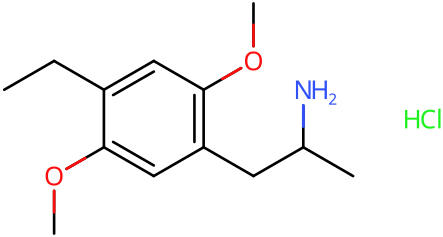
DOET Stats & Data
HXJKWPGVENNMCC-UHFFFAOYSA-NReceptor Profile
Receptor Actions
History & Culture
1963–1967
DOET was discovered by Alexander Shulgin during the 1960s while he was employed at Dow Chemical Company. Following his synthesis of the structurally related compound DOM in 1963 and the subsequent recognition of its psychoactive properties in 1964, Shulgin began systematically assessing similar analogues. During this investigation, he found that DOET possessed distinctive characteristics as what he termed a "psychic energizer" when administered at low doses—producing cognitive enhancement without the pronounced sensory distortions associated with higher doses or other psychedelics. Recognizing its potential as a pharmaceutical agent, Shulgin proposed DOET to Dow Chemical Company for development. The company found the compound sufficiently promising to advance it toward clinical investigation, commissioning neuroscientist Solomon H. Snyder at Johns Hopkins University to conduct formal human studies. However, this development pathway was abruptly terminated in 1967 when DOM emerged as a street drug in San Francisco under the name "STP." The public health crisis that ensued—precipitated by psychedelic chemist Owsley Stanley distributing very-high-dose DOM tablets after learning of the compound from Shulgin—prompted Dow Chemical Company to withdraw entirely from research on DOET and related compounds.
1968–1974
Despite the termination of Dow's research program, Solomon Snyder continued investigating DOET through academic channels. In 1968, he and his colleagues published the first formal description of the compound in the scientific literature. Snyder remained interested in DOET's potential therapeutic applications, particularly its ability to produce cognitive enhancement at sub-psychedelic doses. Between 1968 and 1974, Snyder conducted and published three clinical trials examining low-dose DOET in human subjects. These studies explored the compound's effects at dosage levels that enhanced cognition without producing overt psychedelic manifestations. Despite this sustained research effort demonstrating its properties, DOET was never further developed as a pharmaceutical medication.
DOET has carried several designations throughout its history. Alexander Shulgin originally named the compound DOE, following the standard naming convention of the DOx series. However, he subsequently recognized that "DOE" was also an established acronym for desoxyephedrine (methamphetamine), creating potential confusion in the literature. To address this ambiguity, he revised the name to DOET (sometimes written DOEt), incorporating the complete "ethyl" designation to clearly distinguish it from other substances. Beyond its systematic nomenclature, Shulgin also designated the compound Hecate after the Greek goddess, placing it among the substances he classified as the "Classic Ladies" in his writings. The abbreviation DMEA, derived from dimethoxyethylamphetamine, represents another alternative name that has appeared in reference to this compound.
Effect Profile
Curated + 1 ReportsMild visuals with low body load and headspace
Moderate euphoria with strong anxiety/jitters, low stimulation
Tolerance & Pharmacokinetics
drugs.wikiTolerance Decay
Tolerance to 5‑HT2A agonists develops quickly and decays over 1–2 weeks; cross‑tolerance across serotonergic psychedelics is expected. Data are inferred from human/animal LSD literature and community experience; specific DOET kinetics are sparsely characterized.
Cross-Tolerances
Experience Report Analysis
ErowidDemographics
Gender Distribution
Too few reports for a chart: gender is known from 2 reports, and a split is drawn only from 20 reports or more. Counts are shown instead. Why 20?
- Male 2 of 2
Age Distribution
Reports Over Time
Form / Preparation
Most common forms and preparations, as a share of the 2 reports that give one
Too few reports for bars: these forms come from 2 reports, and a bar is drawn only from 20 reports or more. With fewer, a percentage cannot tell a common effect from a rare one. Counts are shown instead. Why 20?
- Powder / Crystals 2 of 2
Legal Status
| Country | Status | Notes |
|---|---|---|
| United States | Not specifically scheduled (Analogue Act may apply) | DOET is not explicitly listed as a controlled substance and has not been specifically scheduled by federal drug enforcement agencies. However, the Controlled Substance Analogue Enforcement Act of 1986 may apply when the substance is intended for human consumption, as DOET is a close structural analogue of DOM (Schedule I). This could potentially subject possession or distribution to Schedule I penalties depending on prosecutorial interpretation and intent of use. |
Harm Reduction
drugs.wiki- Potency lies in the low milligram range; weighing errors are a common source of adverse outcomes. Volumetric dosing reduces risk when working at this scale. - DOET has a slow come-up (often 1–3 h); early redosing is a frequent mistake that can produce unexpectedly intense, prolonged effects. - Expect long stimulation and insomnia; plan 24 hours without obligations and avoid driving/operating machinery until well-rested. - Peripheral vasoconstriction, jaw tension, mild hypertension and anxiety can occur, especially >5 mg and in sensitive users; those with cardiovascular disease should avoid. - On blotter, DOx compounds have historically been mis-sold as LSD; verify with multiple reagents or lab testing, and do not assume blotter equals LSD. - Avoid mixing with MAOIs or lithium; multiple credible case aggregates link lithium+psychedelics to seizures and severe adverse states. - Tramadol and bupropion each lower seizure threshold; avoid combining. - Use an allergy test with any new batch (100–500 μg) due to rarity and uncertain provenance; community reports note variable body load. - Hydrate and eat lightly; avoid overheating. Have a trusted sober sitter for first trials. - DOx insufflation significantly increases risk (rapid spikes, nasal injury); oral is the safer route for titration.
References
Data Sources
Cited References
- Bonson KR et al. (1971) - DOET human clinical study
- Erowid: PiHKAL entry #66 DOET
- FASEB J 2022 - Monoamine receptor and transporter interactions
- Front Psychiatry 2017 - Novel Psychoactive Substances review
- Nature Communications 2020 - Structure of 5-HT2A complex
- Neuropharmacology 2020 - Head-twitch potency correlation
- PMC: 2016 - Psychedelics safety overview
- PMC: 2022 - Serotonin syndrome and MAOI interactions
- PLoS ONE 2010 - Psychedelics and the Human Receptorome
- Psychopharmacologia 1975 - DOET discrimination study
- Tripsitter: DOET profile
- Wiley 2024 - Structure-activity of 5-HT2A agonists
- Wikipedia: 2,5-Dimethoxy-4-ethylamphetamine
- Bluelight: DOET 2.5 mg trip report
- Bonson KR et al., DOET human study
- Monoamine receptor & transporter interaction, FASEB J 2022
- Psychedelics & the Human Receptorome, PLoS ONE 2010
- Novel Psychoactive Substances – progress review, Front Psychiatry 2017
- Structure of hallucinogen-activated 5-HT2A complex, Nat Commun 2020
- Analysis of 2,5-dimethoxy-amphetamines, J Anal Toxicol 2022
- Structure-activity of 5-HT2A agonists, Wiley 2024
Additional references
- PIHKAL #66 – DOET (Shulgin; human-active range)
- Isomer Design – DOET index (names, identifiers; dose 2–6 mg)
- Erowid – DOM and DOB dosage/duration (slow onset, long duration typical for DOx)
- Erowid – DOB dosage/duration (onset 1–2 h; long tail)
- TripSit – resources incl. volumetric converter (microgram–milligram safety)
- Bluelight – DOET first-time report with allergy test and volumetric dosing
- Erowid – LSD + Lithium interactions (seizures, severe reactions)
- Erowid – LSD Interactions overview (lithium warning)
- Erowid – MAOIs: interactions summary (avoid stimulants; psychedelics potentiation)
- Erowid – Amphetamines health (MAOI warning)
- Erowid – Tramadol health (seizures; serotonergic interactions)
- Erowid – Bupropion basics (seizure risk)
- Erowid – Marquis reagent FAQ (2C-B/DOM/DOB reactions; testing limits)
- Erowid – ‘Less Ecstasy, More Data’ (Mandelin purple for LSD; NBOMe on blotter)