
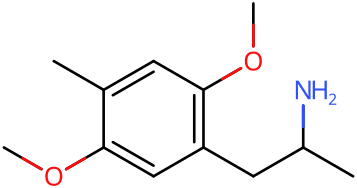
DOM Stats & Data
CC1=CC(=C(C=C1OC)CC(C)N)OCNTJQREUGJKIARY-UHFFFAOYSA-NPharmacology
DrugBankDescription
A psychedelic phenyl isopropylamine derivative, commonly called DOM, whose mood-altering effects and mechanism of action may be similar to those of LSD.
Receptor Profile
Receptor Actions
Measured Affinities
Guide to PHARMACOLOGYMeasured binding and functional data for DOM, curated by the IUPHAR/BPS Guide to PHARMACOLOGY. Each row cites the paper it came from. Lower concentrations mean tighter binding — a value in the sub-nanomolar range indicates a very potent interaction.
| Target | Action | Measure | Value | Concentration | Species | Source |
|---|---|---|---|---|---|---|
| 5-HT2A receptor Htr2a | Full agonist | pKi | 6.8 | 158.49 nM | Rat | PMID 9655845 |
Reading this. pKi, pEC50 and pIC50 are negative log molar values, so a higher number means a tighter interaction; the concentration column converts them for you. Values from non-human species are laboratory measurements and do not translate directly to human effect. Receptor affinity is not a dose — it describes what a molecule binds, not how much of it is safe to take.
Receptor data from the IUPHAR/BPS Guide to PHARMACOLOGY (v2026.2), licensed CC BY-SA 4.0. Matched to this substance by InChIKey.
History & Culture
1963–1964
DOM was first synthesized by Alexander Shulgin in 1963. The initial step of the synthesis was performed by his then fifteen-year-old son Theodore "Ted" Shulgin at Dow Chemical Company on June 22, 1963, during a brief period when the younger Shulgin had developed an interest in chemistry. Alexander Shulgin completed the synthesis on November 30, 1963. The compound was initially assigned the code name K-61,082, with "DOM" itself being an acronym derived from the code name "des-oxy-methyl" that Shulgin coined for the substance. Shulgin first discovered the effects of DOM on January 4, 1964, when he ingested a 1 mg dose orally. The hallucinogenic properties of the compound were subsequently confirmed on February 3, 1964, when Shulgin's colleague Thornton W. Sargent ingested 2.3 mg and experienced its full psychedelic effects.
1967–present
In mid-1967, DOM appeared on the black market in the Haight-Ashbury district of San Francisco during the height of the counterculture movement. Tablets containing 20 mg, and later 10 mg, of DOM were distributed widely under the name "STP," which was said to stand for "Serenity, Tranquility, and Peace," though alternative interpretations such as "Super Terrific Psychedelic" and "Stop The Police" also circulated. The name was actually borrowed from a motor oil additive that bore no chemical relation to the drug. These tablets were manufactured by underground chemists Owsley Stanley and Tim Scully. This distribution proved disastrous for several reasons. The tablets contained excessively high doses of the compound, and DOM's slow onset of action created particular problems for users accustomed to LSD. While LSD typically produces noticeable effects within fifteen to twenty minutes, DOM may only show initial effects at the half-hour mark, with full intensity not reached until approximately two hours after ingestion. Many users, expecting the rapid onset they knew from LSD and observing little activity after thirty minutes, assumed the dose was weak and consumed one or two additional tablets. This resulted in numerous hospitalizations, with treatment further complicated by the fact that medical personnel were initially unaware that the tablets called "STP" contained DOM. The negative publicity and health emergencies caused the supply of DOM to fade thereafter.
Despite the troubled circumstances of its initial distribution, DOM holds a significant place in psychedelic history. Shulgin later documented the compound in his book PiHKAL and included it among his "magical half-dozen," a personal selection of the phenethylamine compounds he considered most important. This group comprises mescaline, DOM, 2C-B, 2C-E, 2C-T-2, and 2C-T-7, with DOM being one of the five that Shulgin himself developed and synthesized. There are reports that low doses of DOM were used as a stimulant by members of the Grateful Dead, which may represent one of the earliest documented instances of psychedelic microdosing.
Subjective Effects
Physical
The physical effects of DOM can be broken down into several components which progressively intensify proportional to dosage.
- Spontaneous tactile sensations: The "body high" of DOM is manifested as somewhat intense in comparison to most classical psychedelics. However, in comparison to DOC and the overwhelming forcefulness of 2C-E, it can actually be considered quite mild. The sensation itself can be described as a constantly present yet somewhat mild energetic pins and needles sensation that encompasses a person's entire body. This is coupled with a euphoric, fast-moving, sharp and location specific tingling sensation. It is usually felt over every square inch of the skin, but occasionally manifests itself in the form of a continuously shifting tingling sensation that travels up and down the body in spontaneous waves.
- Stimulation: In terms of its effects on the physical energy levels of the tripper, DOM is usually considered to be extremely stimulating at levels which do not become overwhelming, resulting in a shakiness and unsteadiness of the hands but encouraging trippers to move around, run, dance, climb and generally engage in physical activities. In comparison, other more commonly used psychedelics such as psilocin are generally sedating and relaxed.
- Tactile enhancement: Feelings of enhanced tactile sensation are consistently present at moderate levels throughout most DOM trips. Once Level 8A visuals are reached, an intense sensation of suddenly becoming aware of and being able to feel every single nerve ending across a person's entire body all at once is consistently present.
- Nausea: Mild to extreme nausea are reported when consumed in moderate to high dosages and either passes once the tripper has vomited or gradually fades by itself as the peak sets in.
- Vasoconstriction: This effect is usually only present at higher dosages, but can be particularly uncomfortable.
- Bodily control enhancement
- Increased heart rate
- Increased blood pressure
- Pupil dilation
Cognitive
The cognitive effects of DOM are described by many as a combination of extreme mental stimulation and a powerful enhancement of a person's current mental state.
- Empathy, love and sociability enhancement: This component is consistently manifested only in the context of social settings in which one is within the company of others. These feelings of sociability, love and empathy are a little weaker and less sharp than those found on substances such as MDMA and 2C-B, but still prove strong enough to provide long lasting therapeutic effects.
- Analysis enhancement
- Thought acceleration
- Time distortion
- Novelty enhancement
- Conceptual thinking
- Immersion enhancement
- Thought connectivity
- Current mind state enhancement
- Personal bias suppression
- Memory suppression
- Ego death
- Wakefulness
Sensory
- Enhancements
- Distortions
- Hallucinations
- Drifting: (Melting, flowing, breathing and morphing) - In comparison to other psychedelics, this effect can be described as highly detailed, slow and smooth in motion, static in appearance and unrealistic/cartoon-like in style.
- Tracers
- After images
- Symmetrical texture repetition
- Colour shifting
- Scenery slicing
DOM presents a full and complete array of possible visual enhancements.
- Acuity enhancement
- Colour enhancement
- Pattern recognition enhancement
DOM produces a full range of high level hallucinatory states in a fashion that is more consistent and reproducible than that of many other commonly used psychedelics. This holds particularly true in comparison to other substances within the phenethylamine family.
- Transformations
- Internal hallucinations: (Autonomous entities; settings, sceneries, and landscapes; alterations in perspective and scenarios and plots) - In comparison to other psychedelics such as LSD, DOM is extremely high in its internal hallucinations. This particular effect commonly contains hallucinations with scenarios, settings, concepts and autonomous entity contact. They can be comprehensively described in terms of their variations as lucid in believability, interactive in style, new experiences in content, autonomous in controllability and geometry-based in appearance. They are more common within dark environments and can be described as internal in their manifestation, lucid in believability, interactive in style and almost exclusively of religious, spiritual, mystical or a transcendental nature in their overall theme.
Forked from Subjective Effect Documentation by Josie Kins, September 2015. Via dose.wiki (CC0).
Toxicity
PsychonautWikiThe toxicity and long-term health effects of recreational DOM use do not seem to have been studied in any scientific context and the exact toxic dose is unknown. Anecdotal evidence suggests that there are no negative health effects attributed to simply trying the substance by itself at low to moderate doses and using it very sparingly (but nothing can be completely guaranteed). Independent research should always be done to ensure that a combination of two or more substances is safe before consumption. It is strongly recommended that one use harm reduction practices when using this substance.
Effect Profile
Curated + 42 ReportsStrong visuals and auditory effects with strong body load, moderate headspace
Strong stimulation with strong anxiety/jitters, moderate euphoria, mild focus
Tolerance & Pharmacokinetics
drugs.wikiTolerance Decay
Acute tolerance rises rapidly after a single dose and can persist for days; functional tolerance commonly makes redosing ineffective and mostly prolongs duration. Cross-tolerance with other classic serotonergic psychedelics is expected. Data are primarily from community reports and general psychedelic pharmacology rather than controlled trials.
Cross-Tolerances
Demographics
Gender Distribution
Age Distribution
Reports Over Time
Effect Analysis
Erowid + BluelightEffects aggregated from 42 experience reports (29 single-substance Erowid + 13 Bluelight)
Effect Sentiment Distribution
Confidence Distribution
Each bar is the share of reports mentioning the effect; its whisker, and the band on the rows below, is the 95% interval: where the share could plausibly be with other reports of the same kind.
Rows resting on fewer than 20 reports show a count (“3 of 7”) instead of a bar. Why 20?
Positive Effects 38
Adverse Effects 40
Show 20 more adverse effects
Show 13 neutral or unclassified mentions
Also reported in combinations. In the 25 DOM reports where another drug was taken too, 1 (4.0%) mentions hospital, emergency services or an overdose, 0 (0.0%) a seizure and 2 (8.0%) psychosis. In the 29 single-substance reports: 6.9%, 0.0% and 3.4%. These are not in the figures above: they cannot be put down to DOM alone, and a mention is not always something that happened to the writer.
Dosage Distribution
Dose distribution from experience reports, one dose per report (the first listed). Doses above Q3 + 3×IQR, far above what people typically take, are left out of the median and range and listed under each route: most are real heavy doses or overdoses, not mistakes.
1 report gave a dose above the typical range (30 mg), so it is not in the figures above. Listing a dose here does not mean it is safe.
Show the report
- 30 mg · another drug taken too
Real-World Dose Distribution
ErowidFrom 45 of 62 recorded dose entries: those that state a weight (mg, g or µg), in routes with at least five of them. Values above Q3 + 3×IQR, far above what people typically take, are left out; they can include real heavy doses and overdoses, not only mistakes.
Oral (n=34)
Sublingual (n=9)
Common Combinations
Most co-occurring substances, as a share of all 54 reports filed under DOM; whiskers are 95% intervals
Form / Preparation
Most common forms and preparations, as a share of the 42 reports that give one; whiskers are 95% intervals
Body-Weight Dosing
Dose per kg of body weight, one dose per report (the first listed), from reports giving a weight of 30–250 kg. Doses above Q3 + 3×IQR, far above what people typically take, are left out of the median and range and listed under each route.
Oral
Sublingual
Redose Patterns
Redosing behavior across 43 reports
Legal Status
| Country | Status | Notes |
|---|---|---|
| Australia | Illegal | Prohibited under a blanket ban covering all substituted phenethylamines, which includes the entire DOx family of compounds. |
| Austria | Illegal | Controlled under the SMG (Suchtmittelgesetz Österreich). Possession, production, and sale are prohibited. |
| Belgium | Schedule I | Listed under HOOFDSTUK II of Belgian controlled substances legislation. Possession, distribution, and production are prohibited. |
| Brazil | Illegal | Listed on Portaria SVS/MS nº 344 under the name 'STP'. Possession, production, and sale are prohibited. |
| Canada | Schedule I | Controlled substance under the Controlled Drugs and Substances Act. Possession, trafficking, and production are criminal offenses. |
| Czech Republic | Schedule I | Classified as a Schedule I controlled substance under national drug legislation. |
| Germany | Anlage I BtMG | Controlled under Anlage I of the Betäubungsmittelgesetz (Narcotics Act) since April 15, 1971. Manufacturing, possession, import, export, buying, selling, procuring, or dispensing without a license is illegal. |
| Italy | Tabella I | Listed in Tabella I of the 'Tabelle delle sostanze stupefacenti e psicotrope'. Possession, purchase, and sale are illegal. |
| Latvia | Schedule I | Classified as a Schedule I controlled substance under Latvian drug control legislation. |
| New Zealand | Class A | Controlled as a Class A substance, the most restrictive classification under New Zealand's Misuse of Drugs Act. |
| Russia | Schedule I | Classified as a Schedule I substance in the Russian Federation. Buying, selling, or possessing without a license is illegal. |
| Switzerland | Verzeichnis D | Specifically named as a controlled substance under Verzeichnis D of Swiss narcotics legislation. |
| United Kingdom | Class A | Controlled under the Misuse of Drugs Act 1971. Buying, selling, or possessing without a license is prohibited. |
| United States | Schedule I | Controlled under the Controlled Substances Act. Manufacturing, buying, possessing, or distributing without a DEA license is illegal. |
Harm Reduction
drugs.wikiDOM has a slow onset and an extremely long duration; this historically led to non-fatal overdoses in the late 1960s when strong tablets were redosed prematurely. Redosing is discouraged, as intensity can increase significantly several hours after ingestion. Cardiovascular stimulation and peripheral vasoconstriction are commonly reported with DOx compounds; avoid combining with other stimulants or vasoconstrictors and avoid strenuous activity or hot environments; stay cool and sip fluids regularly. Lithium has repeatedly been associated with seizures and severe adverse reactions when combined with serotonergic psychedelics (e.g., LSD); by extension treat DOM + lithium as a dangerous combination. Metabolism involves CYP2D6; potent CYP2D6 inhibitors (fluoxetine, paroxetine, quinidine) may increase exposure, and DOM/related DOx can themselves inhibit CYP2D6—be cautious with co-medications that rely on this pathway. Immunoassay urine screens may return class-positive for ‘amphetamines’ with substituted amphetamines; targeted confirmation (e.g., GC/MS) can detect hydroxy-DOM and other metabolites, and detection windows vary—do not rely on specific ‘one week’ claims. Because DOM is potent at low milligram doses, use a 1 mg-accurate scale or volumetric dosing to reduce dosing error; avoid insufflation due to prolonged vasoconstriction and unpredictable intensity. Be prepared for insomnia during and after the experience; plan 24–36 hours of downtime. Where available, use reagent testing and consider lab drug checking; be aware that DOx has been sold on blotter or as other psychedelics—always wait at least 3 hours before making any dosing decisions.
References
Data Sources
Cited References
Additional references
- TripSit DOM Wiki (dosage/duration, warning about long onset)
- Erowid DOM (STP) Vault (history of 1960s overdoses; long duration)
- PiHKAL #68 DOM (primary literature summary; human-active range)
- Ewald et al., 2007 (DOM metabolism via CYP2D6; hydroxy-DOM detection) — summary via Drugs-Forum studies and citation
- Bluelight discussion citing Ewald et al. J Chrom B 2007 (CYP2D6 involvement; analytical detection)
- Reddit r/researchchemicals: DOx and stimulant combo risks; vasoconstriction anecdotes (community harm-reduction context)
- Reddit r/researchchemicals: DOM dose-dependent body load and long stimulation (user report)
- Bluelight threads summarizing lithium + psychedelics seizure risk (applied cautiously to DOM)
- TripSit drug combination chart (general interaction cautioning for psychedelics + stimulants/MAOIs)
- Erowid Crew Blog/DrugsData project update (drug checking context; status updates 2024–2025)