
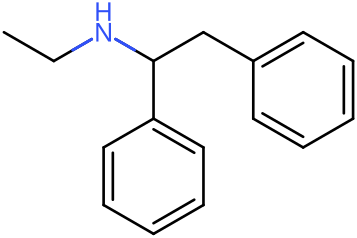
Ephenidine Stats & Data
CCNC(Cc1ccccc1)c1ccccc1IGFZMQXEKIZPDR-UHFFFAOYSA-NReceptor Profile
Receptor Actions
History & Culture
Ephenidine emerged on the research chemical market in early 2015 as a dissociative anesthetic sold through online vendors as a designer drug. It was marketed as a potentially smoother alternative to other diarylethylamine dissociatives that were legally available at the time, particularly diphenidine and methoxphenidine, which had gained a reputation for producing comparatively harsh experiences. As a relatively unknown research chemical, ephenidine has very little documented history of human usage. The lack of formal research into the substance means that most pharmacological understanding has been derived from its structural similarities to related dissociatives rather than from direct scientific investigation of the compound itself. Its status as a structural isomer of the banned opioid lefetamine complicated its legal standing in some jurisdictions from the outset, leading several countries to move relatively quickly toward scheduling the substance despite its brief presence on the market.
Subjective Effects
Physical
The subjective physical effects of ephenidine can be broken down into several components which progressively intensify proportional to dosage.
- Tactile disconnection
- Spontaneous tactile sensations: The ephenidine body high is a soft and pleasurable tingling sensation which is motionless and all-encompassing with no specific location.
- Stimulation: This compound provides stimulating effects at lower dosages which are less intense than that of diphenidine or methoxphenidine.
- Tactile suppression: This partially to entirely suppresses one's sense of touch, creating feelings of numbness within the extremities. It is responsible for the anaesthetic properties of this substance.
- Motor control loss: A loss of gross and fine motor control alongside of balance and coordination is prevalent within the ephenidine experience and becomes especially strong at higher doses. This means that one should be sitting down before the onset (unless one is experienced) in case of falling over and injuring oneself.
- Decreased bodily weight: This creates the sensation that the body is floating and has become entirely weightless. This effect is strangely stimulating and encourages physical activities at low to moderate doses by making the body feel light and effortless to move.
- Physical autonomy
- Increased heart rate
Cognitive
The general head space of ephenidine is often described as particularly euphoric and clear-headed in comparison to that of DXM and ketamine.
- Depersonalization
- Derealization
- Consciousness disconnection
- Memory suppression
- Thought deceleration
- Information processing suppression
- Time distortion
- Euphoria
- Introspection
- Déjà vu
- Conceptual thinking
- Compulsive redosing
- Anxiety suppression
- Disinhibition
- Amnesia
- Unity and interconnectedness
Sensory
This substance does not enhance visual stimuli; instead, it tends to degrade and decrease visual aptitude in a variety of ways.
- Enhancements
- Suppression
- Distortions
- Hallucinations
Ephenidine exhibits a full array of dissociative distortions and alterations in visual perception.
- Visual drifting: (melting, flowing, breathing and morphing) - In comparison to other dissociatives, this effect is more prominent than ketamine, MXE, diphenidine and methoxphenidine. The visual drifting is simplistic, slow and smooth in motion, static in appearance and unrealistic/cartoon-like in style.
- Perspective distortions
- Scenery slicing
At high doses, ephenidine can produce a full range of high level hallucinatory states in a fashion that is less consistent and reproducible than that of many other commonly used psychedelics.
- Internal hallucinations: (autonomous entities, settings, sceneries, and landscapes, alterations in perspective and scenarios and plots) - In comparison to other dissociatives, this effect can occur at heavy dosages, but is considerably less common than the same effect found within psychedelics and deliriants. It can be comprehensively described as delirious in believability, fixed in style, equal in new experiences and memory replays in content, autonomous in controllability and solid in style.
- Visual disconnection: This eventually results in the ephenidine equivalent of the famous 'k-hole' or, more specifically, holes, spaces and voids alongside of structures. However, it is worth noting that particularly heavy dosages must be consumed to reach the deepest state of this component in comparison to other more classical dissociatives such as ketamine or methoxetamine.
- Visual acuity suppression
- Double vision: This component is prevalent at moderate to heavy dosages and makes reading impossible unless one closes an eye.
- Pattern recognition suppression: This effect generally occurs at higher dosages and makes one unable to recognize and interpret perceivable visual data.
Forked from Subjective Effect Documentation by Josie Kins, July 2015. Via dose.wiki (CC0).
Toxicity
PsychonautWikiThe toxicity and long-term health effects of recreational ephenidine use do not seem to have been studied in any scientific context and the exact toxic dosage is unknown. This is because ephenidine has very little history of human usage. Anecdotal reports from those who have tried ephenidine suggest that there do not seem to be any negative health effects attributed to simply trying this drug at low to moderate doses by itself and using it sparingly (but nothing can be completely guaranteed). Independent research should always be done to ensure that a combination of two or more substances is safe before consumption. It is strongly recommended that one use harm reduction practices when using this substance.
Effect Profile
Curated + 4 ReportsStrong dissociative depth and insight with strong mania and motor impairment
Duration Timeline
BluelightCommunity Effects
TripSitTolerance & Pharmacokinetics
drugs.wikiTolerance Decay
Estimates reflect strong, rapid cross-tolerance typical of NMDA antagonists; values are extrapolated from dissociative literature and user reports rather than controlled human PK studies.
Cross-Tolerances
Experience Report Analysis
ErowidDemographics
Gender Distribution
Too few reports for a chart: gender is known from 16 reports, and a split is drawn only from 20 reports or more. Counts are shown instead. Why 20?
- Male 14 of 16
- Not Specified 1 of 16
- Female 1 of 16
Age Distribution
Reports Over Time
Dosage Distribution
Dose distribution from experience reports, one dose per report (the first listed). Doses above Q3 + 3×IQR, far above what people typically take, are left out of the median and range and listed under each route: most are real heavy doses or overdoses, not mistakes.
Real-World Dose Distribution
ErowidFrom 21 of 25 recorded dose entries: those that state a weight (mg, g or µg), in routes with at least five of them. Values above Q3 + 3×IQR, far above what people typically take, are left out; they can include real heavy doses and overdoses, not only mistakes.
Oral (n=20)
Common Combinations
Most co-occurring substances, as a share of all 16 reports filed under Ephenidine
Too few reports for bars: these combinations come from 16 reports, and a bar is drawn only from 20 reports or more. With fewer, a percentage cannot tell a common effect from a rare one. Counts are shown instead. Why 20?
- THC 5 of 16
Form / Preparation
Most common forms and preparations, as a share of the 13 reports that give one
Too few reports for bars: these forms come from 13 reports, and a bar is drawn only from 20 reports or more. With fewer, a percentage cannot tell a common effect from a rare one. Counts are shown instead. Why 20?
- Powder / Crystals 10 of 13
- Capsule 3 of 13
Body-Weight Dosing
Dose per kg of body weight, one dose per report (the first listed), from reports giving a weight of 30–250 kg. Doses above Q3 + 3×IQR, far above what people typically take, are left out of the median and range and listed under each route.
Redose Patterns
Redosing behavior across 15 reports
Too few reports for a chart: redosing is known from 15 reports, and a split is drawn only from 20 reports or more. Counts are shown instead. Why 20?
- Single dose 7 of 15
- Redosed 8 of 15
Legal Status
| Country | Status | Notes |
|---|---|---|
| United Kingdom | Grey area (as of 2015) | As of 2015 sources, ephenidine was legally available through online research chemical vendors as a designer drug. It was marketed alongside similar diarylethylamine compounds such as diphenidine and methoxphenidine. Sources cautioned that this grey area status did not guarantee immunity from prosecution, as legality was likely to vary and could change. |
Harm Reduction
drugs.wikiEphenidine is a selective NMDA receptor antagonist at the PCP site (Ki ≈ 66 nM) with modest activity at DAT/NET and sigma sites; this explains dissociation with a lightly stimulating edge in some users. Oral onset can be slow and sometimes delayed beyond 60 minutes, which increases the temptation to redose early—waiting a full 2 hours before any redose lowers the risk of overshooting. Residual stimulation, cognitive fog, and trouble sleeping can persist into the next day following strong doses; plan dosage timing accordingly (avoid late-evening starts if sleep is important). Compared with arylcyclohexylamines like ketamine, diarylethylamines have less defined data on urinary toxicity; nonetheless, users have reported bladder/urinary discomfort after heavy or frequent use—staying well-hydrated, spacing sessions widely, and stopping if urinary symptoms appear is prudent. Insufflation is frequently reported as harsh and irritating with a large chemical drip and shorter, less predictable effects; many users prefer oral or carefully prepared rectal solutions to reduce local irritation. Mixing with alcohol, GHB/GBL, or opioids markedly increases the risk of loss of consciousness, vomiting, and respiratory depression; these combinations account for many serious dissociative-related emergencies. Combining with stimulants increases heart rate and blood pressure and can precipitate anxious or manic states, particularly when sleep is missed. Dissociatives strongly impair balance and depth perception—set up a safe environment, avoid heights/water, and do not drive or cycle during or after use until fully baseline. Rapid, pronounced cross-tolerance exists across NMDA antagonists; frequent use quickly blunts effects and encourages dose escalation—spacing sessions by several weeks reduces risk. Community reagent-testing anecdotes suggest ephenidine may give an orange→brown Marquis and green Mandelin reaction; however, reagent kits cannot prove identity—use a professional drug checking service when possible.
References
Cited References
- ACMD Diphenidine Review (2023)
- ACMD Full Report PDF (2023)
- Bluelight: Ephenidine Thread (2015)
- Bluelight: N-methyl-ephenidine Thread (2014)
- Eiden et al. (2018) - French Addictovigilance Network
- Erowid: Experience Vault - Ephenidine
- Goodson et al. (1946) - Original Synthesis
- Kang et al. (2016) - NMDA Receptor Properties
- Kang et al. (2016) - PMC Full Text
- Nervewing: Blog - Trip Report (2016)
- PsychonautWiki: Ephenidine
- PubChem: CID 110821 - Ephenidine
- Reddit: r/ResearchChemicals - Dosage Survey
- ResearchGate: NMDA Binding Data (2016)
- Thurkauf et al. (1989) - PCP Binding Site
- TripSit: Factsheet - Ephenidine
- Wallach et al. (2016) - Pharmacological Investigations
- Wink et al. (2014) - Metabolism Study
- J Psychopharmacol (2017) – NMDA profile
- Addictovigilance complications (Wiley 2018)
Additional references
- PubChem CID 110821 – Ephenidine
- Ephenidine: NMDA antagonist profile (Neuropharmacology 2017) – PubMed
- Ephenidine: NMDA antagonist profile – full text (PMC)
- Erowid Experience Vault – Ephenidine reports
- Effect Index – ‘The Polychrome Sea’ (150 mg oral)
- TripSit Wiki – Dissociatives (general HR, bladder/tolerance cautions)
- TripSit Wiki – Drug combinations (ketamine/MXE interactions as dissociative proxies)
- Drugs-Forum – Ephenidine insufflated RoA (harshness, short duration)
- Reddit r/dissociatives – Residual stimulation and sleep difficulties
- Reddit r/researchchemicals – ‘Ephenidine almost killed me’ (overdose/complications account)
- Reddit r/researchchemicals – ‘My Review of Ephenidine’ (vaping, bladder concern anecdote)
- TripSit – Methoxetamine (for dissociative interaction analogies)
- TripSit – PCP (general dissociative risks and HR)
- Drug Checking Community (Ontario) – service/limitations documents
- Reddit r/ReagentTesting – anecdotal Marquis/Mandelin reactions for material sold as ephenidine
- J Psychopharmacol (2017) – NMDA profile
- ACMD diarylethylamine harms review (2023)
- ACMD full PDF report (2023)
- Bluelight TR – 300 mg IV+oral (2015)