
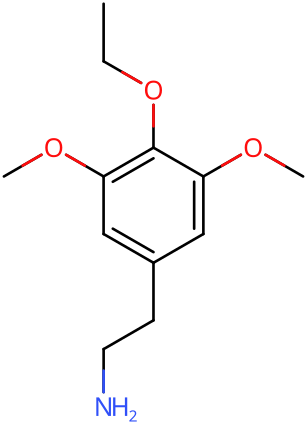
Escaline Stats & Data
NCCc1cc(OC)c(OCC)c(OC)c1RHOGRSKNWDNCDN-UHFFFAOYSA-NReceptor Profile
Receptor Actions
History & Culture
Escaline was first described in the scientific literature by George S. Grace in 1934. It was subsequently synthesized and reported by F. Benington and colleagues in 1954. The compound was later re-examined in the laboratory of David E. Nichols, who prepared a series of mescaline analogues including escaline, proscaline, and isoproscaline, publishing their findings in 1977. The effects of escaline in humans were documented by Alexander Shulgin in his 1991 book PiHKAL: A Chemical Love Story. The name "escaline" derives from an etymological play on words related to its chemical structure. The central oxygen of mescaline bears a methyl group (one carbon), with the prefix "methyl" stemming from the Greek word "methy" meaning wine. When this methyl group is replaced with an ethyl group (two carbons), the natural linguistic extension transforms "mescaline" to "escaline." While this relationship is etymologically appealing, it carries no botanical significance—escaline has no known natural source. The coincidence that mescaline, methyl, and methoxy all begin with the letter "M" is simply fortuitous.
Subjective Effects
Physical
- Spontaneous tactile sensations
- Stimulation
- Nausea
- Tactile enhancement
- Bodily control enhancement
- Pupil dilation
- Wakefulness
- Increased heart rate
- Muscle spasms
Cognitive
- Current mind state enhancement
- Thought acceleration
- Novelty enhancement
- Time distortion
- Déjà vu
- Personal bias suppression
- Conceptual thinking
- Immersion enhancement
- Memory suppression
- Ego death
- Thought loops
- Delusions
- Thought disorganization
- Suggestibility enhancement
- Laughter
- Mindfulness
- Feelings of interdependent opposites
- Spirituality enhancement
Sensory
- Enhancements
- Distortions
- Hallucinations
- Drifting: (Melting, flowing, breathing and morphing)
- Tracers
- After images
- Symmetrical texture repetition
- Colour shifting
- Scenery slicing
- Acuity enhancement
- Colour enhancement
- Pattern recognition enhancement
- Transformations
- Internal hallucinations: (Autonomous entities; settings, sceneries, and landscapes; alterations in perspective and scenarios and plots)
- External hallucinations: (Autonomous entities; settings, sceneries, and landscapes; alterations in perspective and scenarios and plots)
Forked from Subjective Effect Documentation by Josie Kins, February 2016. Via dose.wiki (CC0).
Toxicity
PsychonautWikiThe toxicity and long-term health effects of recreational escaline use do not seem to have been studied in any scientific context and the exact toxic dose is unknown. This is because escaline is a research chemical with a very brief history of human usage. Anecdotal evidence from people within the community who have tried escaline suggests that there are no negative health effects attributed to simply trying the substance by itself at low to moderate doses and using it very sparingly (but nothing can be completely guaranteed). Independent research should always be done to ensure that a combination of two or more substances is safe before consumption. It is strongly recommended that one use harm reduction practices when using this substance.
Effect Profile
Curated + 1 ReportsStrong visuals, headspace, and auditory effects with strong body load
Community Effects
TripSitTolerance & Pharmacokinetics
drugs.wikiTolerance Decay
Experience Report Analysis
ErowidDemographics
Gender Distribution
Too few reports for a chart: gender is known from 2 reports, and a split is drawn only from 20 reports or more. Counts are shown instead. Why 20?
- Male 2 of 2
Age Distribution
Reports Over Time
Real-World Dose Distribution
ErowidFrom 6 of 7 recorded dose entries: those that state a weight (mg, g or µg), in routes with at least five of them. Values above Q3 + 3×IQR, far above what people typically take, are left out; they can include real heavy doses and overdoses, not only mistakes.
Oral (n=6)
Legal Status
| Country | Status | Notes |
|---|---|---|
| Germany | Controlled (NpSG) | Regulated under the Neue-psychoaktive-Stoffe-Gesetz (New Psychoactive Substances Act) since November 26, 2016. Production and importation with intent to distribute, administration to others, marketing, and trading are criminal offenses. Possession is prohibited but not subject to criminal penalty, though ordering the substance may constitute incitement to distribute. |
| Japan | Controlled substance | Designated as a controlled substance under Japanese drug laws effective December 21, 2016. |
| Switzerland | Controlled (Verzeichnis E) | Specifically listed by name in Verzeichnis E (Schedule E) of the Swiss controlled substances regulations. |
| United Kingdom | Illegal (Psychoactive Substances Act) | Production, supply, and importation are prohibited under the Psychoactive Substances Act 2016, which took effect on May 26, 2016. This blanket legislation covers psychoactive substances not specifically exempted. |
| United States | Unscheduled | Not specifically scheduled at the federal level. However, prosecution under the Federal Analogue Act remains possible if the substance is sold or possessed with intent for human consumption, given its structural similarity to the Schedule I substance mescaline. |
References
Cited References
- Benington et al. (1954) - Monoamine Oxidase Inhibitors
- Blaazer et al. (2008) - Structure-Activity Relationships of Phenylalkylamines
- Erowid: Escaline Experience Vault
- Halberstadt & Geyer (2018) - Effects of Hallucinogens on Unconditioned Behavior
- Isomer Design: Escaline (PiHKAL Entry #72)
- Nichols et al. (1977) - Asymmetric Synthesis of Psychotomimetic Phenylisopropylamines
- Shulgin & Shulgin (1991) - PiHKAL Entry #72
- Shulgin (1978) - Psychotomimetic Drugs: Structure-Activity Relationships
- Bluelight: The Big & Dandy Escaline Thread
- Talaie et al. (2009) - Tramadol and Seizure Risk
- Blaazer et al. (2008) - ChemMedChem
- Halberstadt & Geyer (2018) - PMC
- Shulgin & Shulgin (1991) - PiHKAL Entry #72