
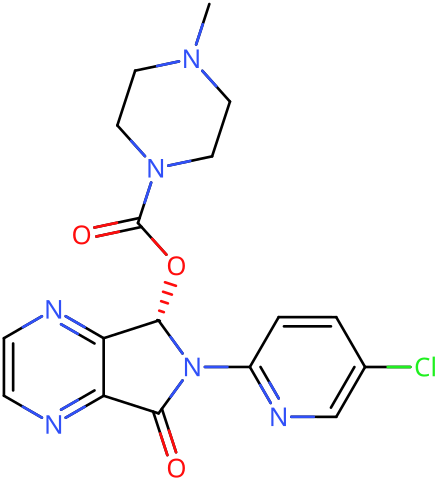
Eszopiclone Stats & Data
CN1CCN(CC1)C(=O)OC1c2nccnc2C(=O)N1c1ccc(Cl)cn1GBBSUAFBMRNDJC-INIZCTEOSA-NPharmacology
DrugBankDescription
Eszopiclone, marketed by Sepracor under the brand-name Lunesta, is a nonbenzodiazepine hypnotic drug used to treat insomnia. It is the active stereoisomer of zopiclone, belonging to the class of drugs known as _cyclopyrrolones_. Cyclopyrrolone drugs demonstrate high efficacy and low toxicity, offering a safer alternative to other drugs used for insomnia. One major benefit of eszopiclone is that it is approved by the FDA for the long-term treatment of insomnia. This sets it apart from many other hypnotic sedatives, which are generally approved only for the relief of short-term (6-8 weeks) insomnia. Eszopiclone was initially approved by the FDA in 2004.
Mechanism of Action
The exact mechanism of action of eszopiclone is unknown at this time but is thought to occur via binding with the GABA receptor complexes at binding sites located near benzodiazepine receptors, possibly explaining its hypnotic and sedative effects. It has particular affinity for GABA-A (or GABAA) receptor subunits 1, 3 and 5. Eszopiclone increases GABA-A channel currents significantly. GABA-A channels are major inhibitory channels that cause CNS depression when their receptors are activated.
Pharmacodynamics
Eszopiclone rapidly induces sleep and decreases sleep latency. It also aids in the maintenance of sleep, preventing frequent awakenings. This drug has shown anticonvulsant and muscle relaxant properties in animals but is used in humans for its sedating effects. Eszopiclone is a central nervous system depressant with various effects. These include changes in alertness and motor coordination and the risk of next morning impairment, increasing with the amount of eszopiclone administered. Exercise caution and advise against driving a motor vehicle or activities that require full mental alertness the next morning. Complex sleep behaviors may result from eszopiclone use. Eszopiclone should be discontinued in these cases. Avoid the use of alcohol and other CNS depressants when eszopiclone is administered. Advise patients to skip the eszopiclone dose if alcohol has been consumed before bed or during the evening. Use the smallest dose of eszopiclone as possible, especially in elderly patients, who may experience exaggerated drug effects. Though the potential for dependence and abuse with eszopiclone is lower than for other hypnotic drugs, this drug has been abused and is known to cause dependence.
Metabolism
Following oral administration, eszopiclone is extensively biotransformed and the major metabolites are S-desmethylzopiclone and zopiclone-N-oxide, which are largely inactive.. The enzymes involved in the metabolism of eszopiclone are CYP3A (the primary metabolizing enzyme), CYP2C8, and CYP2E1. The N-oxide derivative shows weak pharmacological activity in animals. The N-desmethyl metabolite is pharmacologically active.
Absorption
Eszopiclone is rapidly absorbed and the peak concentration is reached within about 1 hour after oral administration. The mean AUC after a 3 mg dose of eszopiclone was 278 ng/mL × h. The consumption of a high-fat has been shown to slow absorption. Steady-state concentrations of eszopiclone are reached within 24-48 hours.
Indication
Eszopiclone is indicated for the treatment of insomnia.
Half-life
The half-life is 6.1 hours in healthy patients but is prolonged in various patients, including those with hepatic impairment, elderly patients, in addition to those taking CYP3A enzyme inhibiting drugs.
Protein Binding
This drug is 52-59% bound to plasma proteins.
Elimination
Only about 10% of an eszopiclone dose is found excreted in the urine as the parent drug. As much as 75% of an orally administered dose of racemic zopiclone as is found to be excreted in the urine in the form of metabolites. Eszopiclone, the S-isomer of racemic zopiclone, would likely show the same excretion pattern.
Volume of Distribution
The volume of distribution of eszopiclone is estimated at 89.9L
Clearance
The mean clearance of eszopiclone in young, healthy volunteers was 184 mL/min in one pharmacokinetic study.
Receptor Profile
Receptor Actions
Receptor Binding
History & Culture
2004–present
Eszopiclone represents the isolated S-stereoisomer of zopiclone, a cyclopyrrolone sedative-hypnotic that had been available in Europe since 1989. The development of eszopiclone as a distinct pharmaceutical product was undertaken by Sepracor, who marketed the compound under the brand name Lunesta. The medication received approval from the United States Food and Drug Administration in December 2004 for the treatment of insomnia, entering the American market the following year. Eszopiclone belongs to a family of medications informally known as "Z-drugs," which also includes zopiclone, zaleplon, and zolpidem. These compounds were initially developed with the expectation that they would carry less potential for misuse compared to benzodiazepines; however, this assessment has been revised in subsequent years as cases of dependence and habituation have been documented. A notable distinction of eszopiclone compared to many other hypnotic medications is its approval for long-term treatment of insomnia, with evidence supporting efficacy for up to six months and some studies suggesting similar benefits after twelve months of use. By 2020, eszopiclone had become the 232nd most frequently prescribed medication in the United States, with over one million prescriptions dispensed annually.
2007–2020
In September 2007, Sepracor entered into a marketing agreement with GlaxoSmithKline to distribute eszopiclone in European markets under the brand name Lunivia. The following year, Sepracor submitted an authorization application to the European Medicines Agency and initially received a favorable assessment. However, the authorization effort encountered a significant obstacle in 2009 when the EMA determined that eszopiclone could not be granted "new active substance" status. The agency concluded that the compound was pharmacologically and therapeutically too similar to its parent compound zopiclone to warrant recognition as a distinct patentable product. Because zopiclone's patent had expired, this ruling would have enabled competing manufacturers to produce generic versions of eszopiclone for European markets. Sepracor subsequently withdrew its application. The arrangement with GlaxoSmithKline dissolved, and GSK instead pursued an agreement to market almorexant, an orexin receptor antagonist, though that compound's development was later discontinued due to adverse effects. Eszopiclone eventually became available in several European countries beginning in 2020, marketed by GL Pharma under the brand name Esogno.
2009–present
A 2009 article published in the New England Journal of Medicine titled "Lost in Transmission—FDA Drug Information That Never Reaches Clinicians" drew attention to concerns about the accessibility of clinical efficacy data for eszopiclone. The authors noted that prescribing information merely stated that eszopiclone was "superior to placebo" without providing specific efficacy metrics. The relevant clinical data was located on page 306 of a 403-page FDA medical review document. The article reported that in the largest phase 3 trial, participants receiving eszopiclone fell asleep an average of fifteen minutes faster and slept approximately thirty-seven minutes longer than those receiving placebo. Despite these improvements, patients in the treatment group still met diagnostic criteria for insomnia and did not report clinically meaningful enhancements in next-day alertness or functioning.
By itself, Eszopiclone likely has a low toxicity relative to dose. However, it is potentially lethal when mixed with depressants like benzodiazepines, alcohol or opioids. When combined with one or several of these drugs the already existing chance of a having a "black-out" is significantly increased, leaving the user with very little to no memory of the events that occurred whilst under the influence of Eszopiclone alone or combined with most other CNS depressants. Users have reported taking Eszopiclone in combination with alcohol in an attempt to treat hangovers with varying degrees of success. It is strongly recommended that one use harm reduction practices when using this substance.
Carcinogenicity
No indication of carcinogenicity to humans (not listed by IARC).
Liver injury risk
Low concern (rare serious cases reported)
Toxicity (DrugBank)
The oral LD50 of eszopiclone in rats is 980 mg/kg and 3200 mg/kg in rabbits. Symptoms of overdose may include mental status changes and somnolence, demonstrating general exaggeration of the drug's pharmacological effects. Perform gastric lavage and offer supportive treatment if an overdose is suspected, including intravenous fluids as required. Flumazenil may be used. Vital signs should be closely monitored in addition to patient symptoms. Appropriate medical interventions should be employed. The possibility of an overdose with multiple drugs should be considered. Ensure to contact the local poison control center for the most updated management of hypnotic drug overdose.
Tolerance & Pharmacokinetics
drugs.wikiNo tolerance chart. Our decay curves for these drugs were estimates, and a curve can make tolerance look longer-lasting than it is, which is the dangerous direction.
How fast tolerance to these drugs fades after a break has not been measured well enough to draw, so don't count on a dose you used to take still being safe: after time off, start with a much smaller amount and don't use alone. Mixing sedatives with each other, with alcohol or with opioids sharply raises the risk of a fatal overdose. If you've been using regularly, don't stop suddenly: withdrawal from benzodiazepines, alcohol or GHB/GBL can cause seizures or delirium, so get medical help to cut down gradually.
Sources: FRANK: benzodiazepines · Alcohol and Drug Foundation: GHB · FDA 2020: benzodiazepine boxed warning · FDA 2019: gabapentinoids and breathing · NHS: alcohol use disorder
Experience Report Analysis
ErowidDemographics
Gender Distribution
Too few reports for a chart: gender is known from 19 reports, and a split is drawn only from 20 reports or more. Counts are shown instead. Why 20?
- Male 15 of 19
- Female 3 of 19
- Not Specified 1 of 19
Age Distribution
Reports Over Time
Effect Analysis
ErowidEffects aggregated from 14 experience reports (14 single-substance Erowid)
Effect Sentiment Distribution
Confidence Distribution
Each bar is the share of reports mentioning the effect; its whisker, and the band on the rows below, is the 95% interval: where the share could plausibly be with other reports of the same kind.
Too few reports for bars: these effects come from 14 single-substance Erowid reports, and a bar is drawn only from 20 reports or more. With fewer, a percentage cannot tell a common effect from a rare one. Counts are shown instead. Why 20?
Positive Effects 5
Adverse Effects 2
Show 2 neutral or unclassified mentions
Dosage Distribution
Dose distribution from experience reports, one dose per report (the first listed). Doses above Q3 + 3×IQR, far above what people typically take, are left out of the median and range and listed under each route: most are real heavy doses or overdoses, not mistakes.
1 report gave a dose above the typical range (25 mg), so it is not in the figures above. It mentions hospital, emergency services or an overdose. Listing a dose here does not mean it is safe.
Show the report
- 25 mg · mentions hospital, emergency services or an overdose
Real-World Dose Distribution
ErowidFrom 27 of 29 recorded dose entries: those that state a weight (mg, g or µg), in routes with at least five of them. Values above Q3 + 3×IQR, far above what people typically take, are left out; they can include real heavy doses and overdoses, not only mistakes.
Oral (n=26)
Form / Preparation
Most common forms and preparations, as a share of the 14 reports that give one
Too few reports for bars: these forms come from 14 reports, and a bar is drawn only from 20 reports or more. With fewer, a percentage cannot tell a common effect from a rare one. Counts are shown instead. Why 20?
- Pill / Tablet 12 of 14
Body-Weight Dosing
Dose per kg of body weight, one dose per report (the first listed), from reports giving a weight of 30–250 kg. Doses above Q3 + 3×IQR, far above what people typically take, are left out of the median and range and listed under each route.
1 report gave a dose above the typical range (0.306 mg/kg), so it is not in the figures above. It mentions hospital, emergency services or an overdose. Listing a dose here does not mean it is safe.
Show the report
- 0.306 mg/kg · mentions hospital, emergency services or an overdose
Redose Patterns
Redosing behavior across 15 reports
Too few reports for a chart: redosing is known from 15 reports, and a split is drawn only from 20 reports or more. Counts are shown instead. Why 20?
- Single dose 13 of 15
- Redosed 2 of 15
Legal Status
| Country | Status | Notes |
|---|---|---|
| Canada | Prescription medication | Available as a prescription medication under the brand name Lunesta. Marketing authorization was granted in October 2020. Requires a prescription for lawful possession. |
| United States | Schedule IV | Classified as a Schedule IV controlled substance under the Controlled Substances Act. Approved by the FDA on December 15, 2004 for the treatment of insomnia. The scheduling reflects recognized abuse potential comparable to benzodiazepines. Possession without a valid prescription may result in drug charges. |