
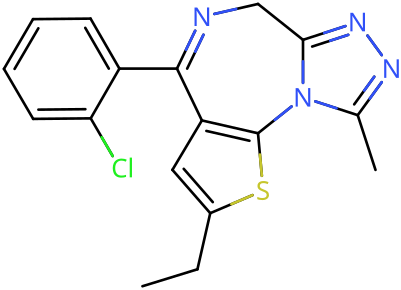
Etizolam Stats & Data
CCc1cc2C(=NCc3nnc(C)n3c2s1)c1ccccc1ClVMZUTJCNQWMAGF-UHFFFAOYSA-NInteraction Warnings
This combination can result in an increased risk of vomiting during unconsciousness and death from the resulting suffocation. If this occurs, users should attempt to fall asleep in the recovery position or have a friend move them into it.
It is dangerous to combine benzodiazepines with stimulants due to the risk of excessive intoxication. Stimulants decrease the sedative effect of benzodiazepines, which is the main factor most people consider when determining their level of intoxication. Once the stimulant wears off, the effects of benzodiazepines will be significantly increased, leading to intensified disinhibition as well as other effects.
Pharmacology
DrugBankDescription
Etizolam is a thienodiazepine which is chemically related to benzodiazepine (BDZ) drug class; it differs from BDZs in having a benzene ring replaced with a thiophene ring. It is an agonist at GABA-A receptors and possesses amnesic, anxiolytic, anticonvulsant, hypnotic, sedative and skeletal muscle relaxant properties. Initially introduced in 1983 in Japan as treatment for neurological conditions such as anxiety and sleep disorders, etizolam is marketed in Japan, Italy and India. It is not approved for use by FDA in the US; however it remains unscheduled in several states and is legal for research purposes.
Mechanism of Action
Etizolam is selectively a full agonist at GABA-A receptors to increase GABAergic transmission and enhance GABA-induced Cl- currents . It is reported to bind to the benzodiazepine binding site which is located across the interface between the alpha and gamma subunits. Benzodiazapines are reported to only bind to receptors that contain gamma 2 and alpha 1/2/3/5 subunits . Alpha-1-containing receptors mediate the sedative effects of etizolam whereas alpha-2 and alpha-3 subunit-containing receptors mediate the anxiolytic effect . Etizolam shows high potency and affinity towards GABA-A receptor with alpha 1 beta 2 gamma 2S subunit combination . By binding to the regulatory site of the receptor, etizolam potentiates GABA transmission by facilitating the opening of GABA-induced chloride channels . Etizolam is a specific antagonist at PAFR. It inhibits PAF-induced platelet aggregation by inhibiting PAF binding to the receptors located on the surface of platelets with an IC50 of 22nM .
Pharmacodynamics
Etizolam is a CNS depressant with anxiolytic, anticonvulsant, sedative-hypnotic and muscle relaxant effects. It acts on the benzodiazepine site of the GABA-A receptor as an agonist to increase inhibitory GABAergic transmission throughout the central nervous system. Studies indicate that etizolam mediates its pharmacological actions with 6 to 10 times more potency than that of diazepam. Clinical human studies performed in Italy showed clinical effectiveness of etizolam in relieving symptoms in patients with generalized anxiety disorders with depressive symptoms . Etizolam also mediates imipramine-like neuropharmacological and behavioral effects, as well as minor effects on cognitive functioning. It is shown to substitute the actions of a short-acting barbiturate, pentobarbitol, in a drug discrimination study . Etizolam is an antagonist at platelet-activating-factor (PAF) receptor and attenuates the recurrence of chronic subdural hematoma after neurosurgery in clinical studies . It is shown to inhibit PAF-induced bronchoconstriction and hypotension .
Metabolism
Biotransformation of etizolam is extensive and involves hydroxylation and conjugation . The main metabolite formed via 1'-hydroxylation is α-hydroxyetizolam which retains pharmacological activity comparable to that of the parent drug, indicating that the action of metabolites may contribute to the clinical effects of etizolam . CYP3A4 is predicted to be the main CYP enzyme responsible for mediating etizolam metabolism. CYP2C18 and CYP2C19 are also involved in the metabolic pathways .
Absorption
Etizolam is well absorbed from the intestines with a biological bioavailability of 93% following oral administration. After a single oral dosing of 0.5mg etizolam, it takes approximately 0.9 hours to reach the peak plasma concentration of 8.3 ng/mL .
Indication
Indicated for the treatment of generalized anxiety disorder with depression, panic disorder and insomnia.
Half-life
The average elimination half life of etizolam following a single oral dose of 0.5mg is 3.4 hours but may be increased up to 17 hours depending on the rate of metabolism . The main metabolite α-hydroxyetizolam displays a longer elimination half life of 8.2 hours .
Elimination
In a rat study, the amounts of etizolam excreted was 30% in urine was 70% in feces, while the values in a mouse study were 40% in urine and 60% in feces .
Volume of Distribution
Apparent distribution volume was 0.9 ± 0.2 L/kg following a single oral doing of 0.5mg etizolam .
Receptor Profile
Receptor Actions
History & Culture
1972–1984
Etizolam was patented in 1972 and first received approval for medical use in Japan in 1984. Medical literature documenting its therapeutic application for anxiety conditions has appeared since at least the early 1990s. The compound has been prescribed as an anxiolytic in several countries, commonly marketed under brand names such as Etilaam, Etizest, and Depas.
2011–present
Etizolam emerged on online research chemical markets in 2011, and its popularity grew steadily in subsequent years. This rise was likely driven by its low cost, wide availability, and the strongly reinforcing properties it shares with recreational benzodiazepines. Unlike most research chemicals, etizolam occupied an unusual position as a substance with established medical use in some jurisdictions while simultaneously being sold as an unregulated compound in others.
1991–present
Cases of etizolam dependence have been documented in medical literature since 1991, with misuse and addiction reports increasing substantially in subsequent years due to varying levels of accessibility across different regions. The compound has become particularly associated with overdose deaths in Scotland, where drug-related fatalities involving etizolam increased by 107% between 2008 and 2018, reaching 1,187 officially recorded overdoses that year. Women showed a disproportionately greater increase in these deaths compared to men. Counterfeit tablets sold as Xanax or other pharmaceutical benzodiazepines have frequently been found to contain etizolam rather than their labeled ingredients, contributing to unpredictable dosing and increased harm.
Subjective Effects
Physical
The physical effects of etizolam can be broken down into several components which progressively intensify proportional to dosage.
- Sedation: In terms of energy level alterations, this drug is extremely sedating and often results in an overwhelmingly lethargic state. At higher levels, this causes users to suddenly feel as if they are extremely sleep deprived and have not slept for days, forcing them to sit down and generally feel as if they are constantly on the verge of passing out instead of engaging in physical activities. This sense of sleep deprivation increases proportional to dosage and eventually becomes powerful enough to force a person into complete unconsciousness.
- Physical euphoria
- Motor control loss
- Respiratory depression
- Muscle relaxation
- Dizziness
- Temporary erectile dysfunction
Cognitive
The cognitive effects of etizolam can be broken down into several components which progressively intensify proportional to dosage. The general head space of etizolam is described by many as one of recreationally intense sedation and decreased inhibition. It contains a large number of typical depressant cognitive effects.
- Anxiety suppression
- Thought deceleration
- Disinhibition
- Information processing suppression
- Euphoria
- Compulsive redosing
- Amnesia
- Delusions of sobriety: This is the false belief that one is perfectly sober despite obvious evidence to the contrary such as severe cognitive impairment and an inability to fully communicate with others.
Forked from Subjective Effect Documentation by Josie Kins, September 2015. Via dose.wiki (CC0).
Etizolam likely has a low toxicity relative to dose. However, it is potentially lethal when mixed with depressants like alcohol or opioids. It is strongly recommended that one use harm reduction practices such as volumetric dosing when using this substance. Blepharospasms (twitching eyelid) can occur with long-term use; rarely, erythema annulare centrifugum skin lesions have also been reported.
Carcinogenicity
No indication of carcinogenicity to humans (not listed by IARC).
Overdose
Thienodiazepine overdose may occur when taken in extremely heavy quantities or concurrently with other depressants. This is particularly dangerous with other GABAergic depressants such as barbiturates and alcohol since they work in a similar fashion, but bind to distinct allosteric sites on the GABAA receptor, thus their effects potentiate one another.
Toxicity (DrugBank)
Major adverse effects include drowsiness, sedation, muscle weakness and incoordination, fainting, headache, confusion, depression, slurred speech, visual disturbances and changes in libido and tremor . Flumazenil is a competitive antagonist of GABA-A receptors and can be also used to reverse the effect of etizolam overdosage. Etizolam demonstrates no effects on fertility, development and teratogenicity . LD50 values of etizolam when delivered orally, intraperitoneally, and subcutaneously are 3509mg/kg, 825mg/kg, and >5000mg/kg in rats, respectively, and 3070mg/kg, 783mg/kg and 5000mg/kg in mice, respectively .
Effect Profile
Curated + 75 ReportsStrong anxiolysis, euphoria, and sedation with strong cognitive impairment
Tolerance & Pharmacokinetics
drugs.wikiNo tolerance chart. Our decay curves for these drugs were estimates, and a curve can make tolerance look longer-lasting than it is, which is the dangerous direction.
How fast tolerance to these drugs fades after a break has not been measured well enough to draw, so don't count on a dose you used to take still being safe: after time off, start with a much smaller amount and don't use alone. Mixing sedatives with each other, with alcohol or with opioids sharply raises the risk of a fatal overdose. If you've been using regularly, don't stop suddenly: withdrawal from benzodiazepines, alcohol or GHB/GBL can cause seizures or delirium, so get medical help to cut down gradually.
Sources: FRANK: benzodiazepines · Alcohol and Drug Foundation: GHB · FDA 2020: benzodiazepine boxed warning · FDA 2019: gabapentinoids and breathing · NHS: alcohol use disorder
Cross-Tolerances
Demographics
Gender Distribution
Age Distribution
Reports Over Time
Effect Analysis
Erowid + BluelightEffects aggregated from 75 experience reports (60 single-substance Erowid + 15 Bluelight)
Effect Sentiment Distribution
Confidence Distribution
Each bar is the share of reports mentioning the effect; its whisker, and the band on the rows below, is the 95% interval: where the share could plausibly be with other reports of the same kind.
Rows resting on fewer than 20 reports show a count (“3 of 7”) instead of a bar. Why 20?
Positive Effects 20
Adverse Effects 34
Show 14 more adverse effects
Show 9 neutral or unclassified mentions
Also reported in combinations. In the 68 Etizolam reports where another drug was taken too, 7 (10.3%) mention hospital, emergency services or an overdose, 1 (1.5%) a seizure and 3 (4.4%) psychosis. In the 60 single-substance reports: 3.3%, 3.3% and 0.0%. These are not in the figures above: they cannot be put down to Etizolam alone, and a mention is not always something that happened to the writer.
Dose-Response Correlation
How effect frequency changes across dose levels. Whiskers, and the numbers' hover text, give each figure's 95% interval.
Not drawn, too few reports (a dose tier needs 20): Oral Strong (n=10). Why 20?
Dosage Distribution
Dose distribution from experience reports, one dose per report (the first listed). Doses above Q3 + 3×IQR, far above what people typically take, are left out of the median and range and listed under each route: most are real heavy doses or overdoses, not mistakes.
1 report gave a dose above the typical range (20 mg), so it is not in the figures above. Listing a dose here does not mean it is safe.
1 dose more than 50 times the median may be a typing or unit error and is not in the figures either: check the report.
Real-World Dose Distribution
ErowidFrom 202 of 213 recorded dose entries: those that state a weight (mg, g or µg), in routes with at least five of them. Values above Q3 + 3×IQR, far above what people typically take, are left out; they can include real heavy doses and overdoses, not only mistakes.
Oral (n=166)
Insufflated (n=8)
Sublingual (n=19)
Common Combinations
Most co-occurring substances, as a share of all 128 reports filed under Etizolam; whiskers are 95% intervals
Form / Preparation
Most common forms and preparations, as a share of the 58 reports that give one; whiskers are 95% intervals
Body-Weight Dosing
Dose per kg of body weight, one dose per report (the first listed), from reports giving a weight of 30–250 kg. Doses above Q3 + 3×IQR, far above what people typically take, are left out of the median and range and listed under each route.
Unknown
Oral
2 reports gave a dose above the typical range (0.126–0.259 mg/kg), so they are not in the figures above. Listing a dose here does not mean it is safe.
1 dose more than 50 times the median may be a typing or unit error and is not in the figures either: check the report.
Show the reports
- 0.259 mg/kg
- 0.126 mg/kg · another drug taken too
Possibly a typing or unit error:
- 3.191 mg/kg · another drug taken too · mentions hospital, emergency services or an overdose
Sublingual
Redose Patterns
Redosing behavior across 94 reports
Benzodiazepine Equivalence
Etizolam - 1mg ~=10mg Diazepam.
Legal Status
| Country | Status | Notes |
|---|---|---|
| Australia | Schedule 4 | Listed as Schedule 4 by the Office of Drug Control under Regulation 5 of the Customs (Prohibited Imports) Regulations 1956. License and permit required for import and export. |
| Austria | Illegal (NPSG) | Prohibited since 2012 under the Neue-Psychoaktive-Substanzen-Gesetz (New Psychoactive Substances Act). Possession, production, supply, and import are illegal, though offenders without intent to distribute may not face prosecution. |
| Brazil | Controlled | Illegal since March 23, 2021 following ANVISA Resolution RDC nº 473. Listed on Portaria SVS/MS nº 344, prohibiting possession, production, and sale. |
| Canada | Schedule VI (CDSA) | Captured under section 18 of Schedule VI of the Controlled Drugs and Substances Act as a benzodiazepine derivative and its salts. |
| Finland | Controlled | Classified as a controlled drug since 2016. Not approved for medical use in Finland. |
| Germany | Anlage III BtMG | Controlled under Anlage III of the Betäubungsmittelgesetz (Narcotics Act) since July 17, 2013. Can only be prescribed using a narcotic prescription form (Betäubungsmittelrezept). |
| Japan | Controlled | Regulated under the Narcotics and Psychotropics Control Law. Possession, sale, and manufacture without a prescription are illegal. Approved for medical use with prescription. |
| Netherlands | List II (Opiumwet) | Controlled as a List 2 substance under the Opium Act (Opiumwet). Possession and distribution are illegal. |
| Poland | NPS class | Classified as a New Psychoactive Substance under the Act on Counteracting Drug Addiction. Possession and distribution are prohibited. |
| Russia | Schedule III | Listed as a Schedule III controlled substance since 2017 under Russian drug control legislation. |
| Switzerland | Controlled (Verzeichnis B) | Specifically named as a controlled substance under Verzeichnis B of Swiss narcotics legislation. Medicinal use is permitted with appropriate authorization. |
| Turkey | Illegal | Classified as a controlled drug under Turkish law. Possession, production, supply, and import are prohibited. |
| United Kingdom | Class C | Controlled as a Class C substance under the Misuse of Drugs Act 1971 since May 31, 2017. Possession, production, and supply are criminal offenses. |
| United States | Schedule I (temporary) | Temporarily placed in Schedule I by the DEA effective January 23, 2023, with permanent scheduling likely. Prior to federal action, numerous states independently scheduled etizolam: Alabama (Schedule I, March 2014), Mississippi (Schedule I, April 2014), Arkansas (Schedule I, December 2014), Georgia (Schedule IV, May 2015), Indiana (Schedule I, July 2017), North Carolina (Schedule I, March 2017), Texas (Penalty Group 3, June 2017), Arizona (controlled via House Bill 2033, 2018), and Florida, Louisiana, Ohio, South Carolina, and Virginia (various state controls). |
Harm Reduction
drugs.wikiEtizolam is prescribed in Japan and India under brand names like Depas, Pasaden, Etilaam, Etizola, and Etizest, but is unapproved in many other countries; in unregulated markets it often appears as pressed tablets or powders of uncertain dose. Counterfeit 'benzo' tablets and blister packs may contain etizolam or other designer benzodiazepines; use drug checking services when possible and do not assume branding equals content. Compared dose-for-dose, 1 mg etizolam is commonly estimated around 10 mg diazepam in anxiolytic/sedative effect; individual response varies, so start low to avoid blackouts. Onset is relatively fast (roughly 10–40 minutes), and redosing during the come-up markedly increases the risk of amnesia, disinhibition, accidents, and respiratory depression, especially if other depressants are onboard. As a CYP3A4 substrate, etizolam’s levels can be increased by potent CYP3A4 inhibitors (e.g., some azole antifungals, macrolide antibiotics, fluvoxamine) and reduced by inducers (e.g., carbamazepine); this can unpredictably strengthen or weaken effects. Mixing with opioids, alcohol, GHB/GBL, or Z‑drugs greatly raises overdose risk (compounded sedation, hypoventilation, aspiration); avoid concurrent use and seek help immediately if someone cannot be roused or breathes slowly or irregularly. In several drug checking datasets, benzo-adulterants, including etizolam, appear in expected-fentanyl samples—be vigilant if using opioids, as combined depressants drive severe poisonings. Withdrawal after sustained or high-dose use can produce severe rebound anxiety, insomnia, tremor, and seizures; never abruptly stop after regular use—medical supervision and gradual tapering are strongly advised. Driving or operating machinery is unsafe while under the influence and can remain unsafe the next morning because of residual sedation and psychomotor impairment. Volumetric dosing (diluting a known small mass into a measured volume) reduces dosing error with powders/solutions; avoid eyeballing or 'drops' from unknown-concentration liquids. Intranasal and especially injection routes are discouraged due to poor solubility, binders, infection risk, and unpredictable kinetics—oral or sublingual are the least risky non-medical routes. Packaging and appearance are unreliable indicators of content; use reagent tests and, where available, GC/MS drug checking to verify. Store powders/solutions cool, dry, and protected from light to limit degradation, and keep all benzodiazepines secured to prevent accidental pediatric/naïve exposure.
References
Data Sources
Cited References
- Busardo et al. (2019) - Etizolam safety and psychomotor effects
- DrugBank: Etizolam
- Drug Users Bible: Etizolam
- Fracasso et al. (1991) - Pharmacokinetics of etizolam
- Nielsen & McAuley (2020) - Etizolam pharmacology and harms
- Sanna et al. (2005) - Low tolerance liability of etizolam
- TripSit: Combination Chart
- TripSit Factsheet: Etizolam
- WHO Expert Committee on Drug Dependence - Etizolam Review
- DrugWise: Etizolam Factsheet
- Drug-Do: Benzos
Additional references
- Erowid Etizolam Vault (brand names; background)
- Saferparty Zürich: Etizolam (dose, onset, duration, risks, mixing cautions, brand examples)
- DrugWise: Etizolam overview (equivalence, UK context)
- DrugWise: Benzodiazepines (dependence, withdrawal, impairment)
- DrugBank: Etizolam metabolic reaction (alpha-hydroxyetizolam active metabolite)
- DrugBank (Etizolam categories include CYP3A/CYP3A4 substrate)
- Drugs-Forum Wiki: Etizolam (PK notes; metabolite half-life; ROA considerations)
- EUDA/EMCDDA: New benzodiazepines in Europe – review (counterfeits; polydrug risk)
- EUDA/EMCDDA news: Designer benzodiazepines risks (incl. etizolam)
- Toronto Drug Checking Service (reports showing etizolam in fentanyl samples, combined depressant risk)